
In March 1894, a reader of Harper’s Weekly could buy a moving picture of a man sneezing and take it home folded inside the magazine. Getting Fred Ott to move took a little work. His portrait appeared eighty-one times on page 280. Follow the top row with a finger and his head jerks about rather wildly. Start again at the upper left and move your finger down. For several pictures he barely stirs. Now the sneeze has a rhythm. [4]
The Library of Congress clip below makes a good companion to that experiment. William Kennedy Laurie Dickson recorded Ott, a colleague at Edison’s laboratory in New Jersey with a reputation for comic sneezing. The Library made this viewing copy from images that survived on a sheet submitted for copyright. Watch the hand at Ott’s face just as the action begins, around 0:00. Try to remember where it was when his head came forward. The magazine lets you go back and settle the question with your finger. [1][2][3]
The hand goes first
The pleasure of watching Ott lies partly in knowing what he has agreed to do. The title gives away the punch line before he has lifted a finger. That leaves time to look at the arrangement. His light jacket makes the arm legible against the dark ground. His other hand stays up in front of him as if he might need it again. For an instant the head is tipped so far back that the underside of the chin becomes the most prominent part of his face. Then the face drops back into view. You can recognize the gesture even with the sound turned off. In fact, the record supplies no sound at all. [1][4]
Try stopping on that upturned chin. As a portrait it makes a peculiar choice. Very little of what would help you identify the sitter survives the angle. As one exposure among several it does a precise job. It marks the distance Ott’s head has to travel before his chin comes down. The dark background stays put, and the shoulder of his jacket hardly shifts. Those two fixed points make a small movement surprisingly easy to measure by eye. [1][4]
Two ways to keep a performance
On January 9, 1894, Dickson submitted his copyright application. The object that went on file was an eight-by-ten-inch photograph containing forty-five frames. Photography already had a place in the registration system. Motion pictures would get categories of their own in August 1912. Someone handling the deposit in 1894 could hold the whole sequence by its edges. Decades later, rephotographing its frames in succession let a viewer see Ott take his pinch of snuff and react to it in a single sitting. The clerk and the later viewer had access to the same small differences between exposures. Only the viewer had a machine to set the pace. [1][2][3]
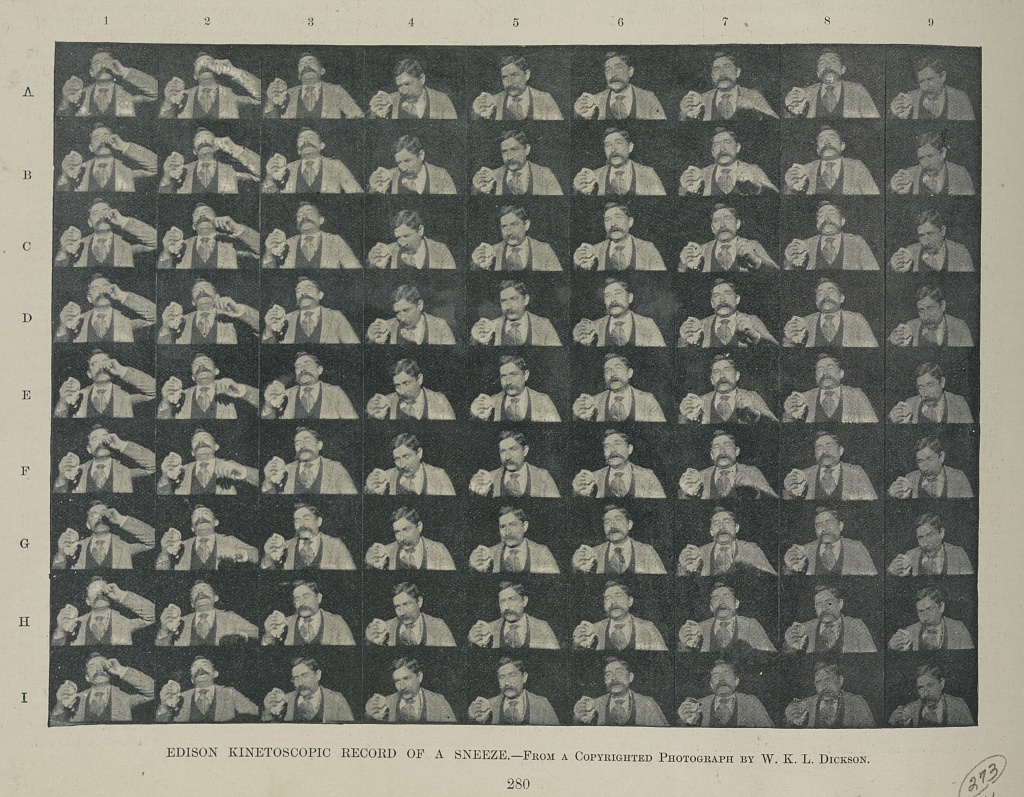
The magazine offered a different bargain. Look down column two. At the top, Ott’s sleeve cuts across his face. Farther down, his elbow descends and his mustache clears the cuff. At the foot of the column his arm has dropped away. Slide a finger back up and the cuff travels neatly over his mouth again. A reader could run that movement backward, hold it halfway or place a slip of paper beside the two portraits that best showed the change. All the equipment required was already on the kitchen table. [4]
There is a consequence for anyone using the clip as historical evidence. The magazine has nine columns of nine pictures. The copyright photograph has forty-five pictures altogether. Running the shorter sequence more slowly might make a hand easier to follow, but it could never supply the other exposures. Conversely, counting faces on the magazine page tells us how many images its readers could inspect. It tells us very little about how long any particular reader lingered on Ott with his nose in the air. [2][4]
On a second viewing, let the clip go by without trying to stop it. Then find the little portrait marked A4 on the printed page. Ott is looking down at his raised hand. It is an easy instant to miss when somebody else has charge of the clock. For a reader in 1894, that instant had an address. More than a century later, two people looking at the same page can still put their fingers on it. [1][4]
Sources
- Library of Congress, “Edison Kinetoscopic Record of a Sneeze, Jan. 7, 1894,” moving reconstruction
- Frank Evina, “Copyright Lore,” U.S. Copyright Office, October 2004, on Dickson’s deposit and the registration of motion pictures
- Library of Congress Magazine, November/December 2019, on Ott and the photographic record
- Harper’s Weekly, “Edison Kinetoscopic Record of a Sneeze,” page 280, March 1894, Library of Congress scan