Someone reading Constance Tite’s census return for the night of Sunday, 2 April 1911, had to decide what to make of five handwritten words. “No persons here only women!” Tite wrote. A census official who examined the sheet had reason to believe that three people had slept at the South Kensington address. Both accounts are still there, on a form meant to yield a single answer. [1][2][3]
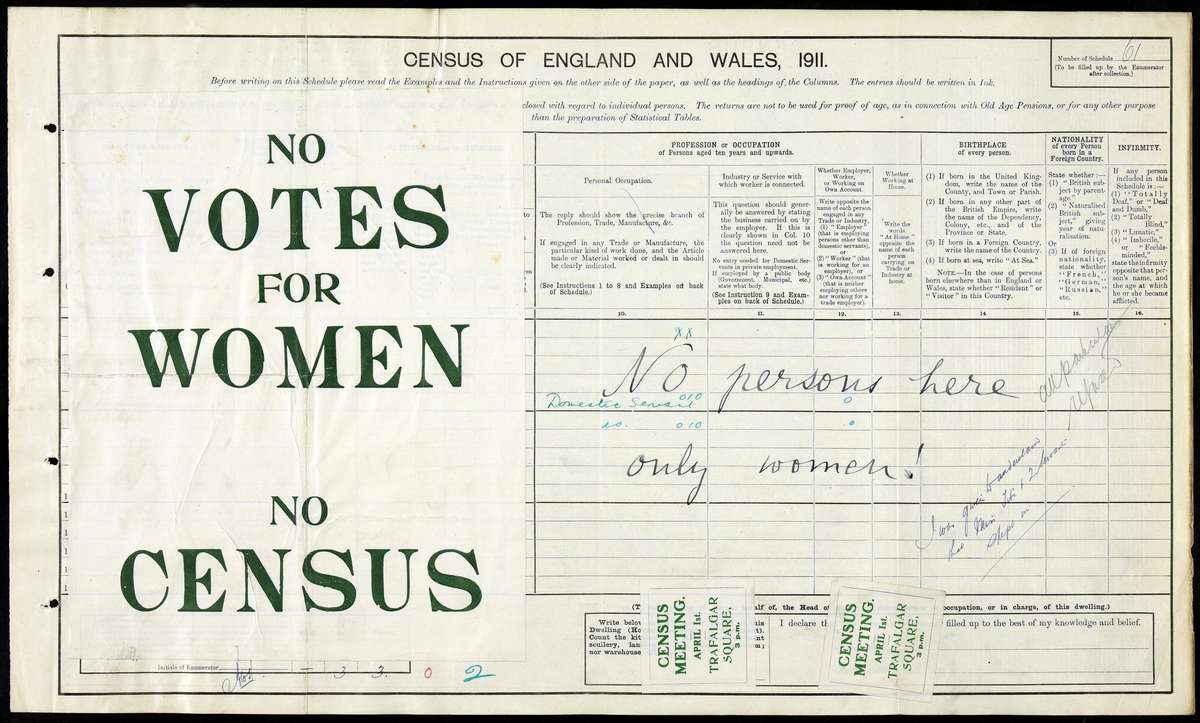
The biggest thing on the page is a sticker. Its block letters tie the demand for votes to the refusal of census information. Two smaller notices advertise a meeting in Trafalgar Square at three o’clock on 1 April, the day before census night. By the time an official read the return, the invitation had expired. It still did something that Tite’s handwriting alone could hardly have done. It gave the reader a time and a place where other people had gathered, or had been asked to gather, over the very question that had arisen in this house. [1]
Some supporters of the census boycott could keep their names off a household return simply by spending the night away. Tite’s sentence depended for its effect on somebody being home. The word “here” locates the women precisely where the census wanted to find them. The joke lies in “persons”. Any enumerator could recognise the absurdity of excluding women from the population. Tite left that reader to consider how ordinary it seemed to exclude those same women from the parliamentary electorate. Seven years passed before the franchise was extended to some British women in 1918. [1][2][3]
A second hand on the sheet
The official recorded that the household had refused particulars, then added a qualification worth reading slowly. “I was given to understand” is how the note introduces its account of who slept there. Someone had supplied enough information to place Tite and two servants in the house. The wording leaves the informant unidentified. The occupation entries describe domestic service, but the servants have no names in the official’s note. It would be easy to read the whole sheet as a declaration by three suffragists. Only one of the three can be identified as its author. [1][2]
A second return shows why the distinction matters. At Faraday House, Hampton Court, Princess Sophia Duleep Singh made her own objection to the census and signed it in large letters. An enumerator compiled a further sheet for her. He estimated her age and gave India as her birthplace. She had been born in London. A future reader looking up the princess could therefore find a birthplace in the official record precisely because she had declined to supply one herself. [4]
In South Kensington, the official was more candid about the limits of the information. The resulting sheet can support an estimate of how many people slept in the house. It can also tell us what Tite wanted the person collecting it to read. The two servants pose a harder question. We have a record of where they spent that Sunday night and of the work they did, yet neither left a word here about the vote. The most conspicuous voice on the page belongs to the woman whose name the archive could recover. [1][2]
Sources
- The National Archives, “Suffragettes on file, 1840–1912,” source 12. Image and transcription of the South Kensington return, RG 14/118.
- The National Archives, “Women’s suffrage.” Collection entry identifying Constance Tite and her household schedule.
- The National Archives, “RG14 – 1911 census returns.” Census night and the forms taken by the boycott.
- The National Archives, “Sophia Duleep Singh.” The princess’s return and the enumerator’s account, RG 14/3561.