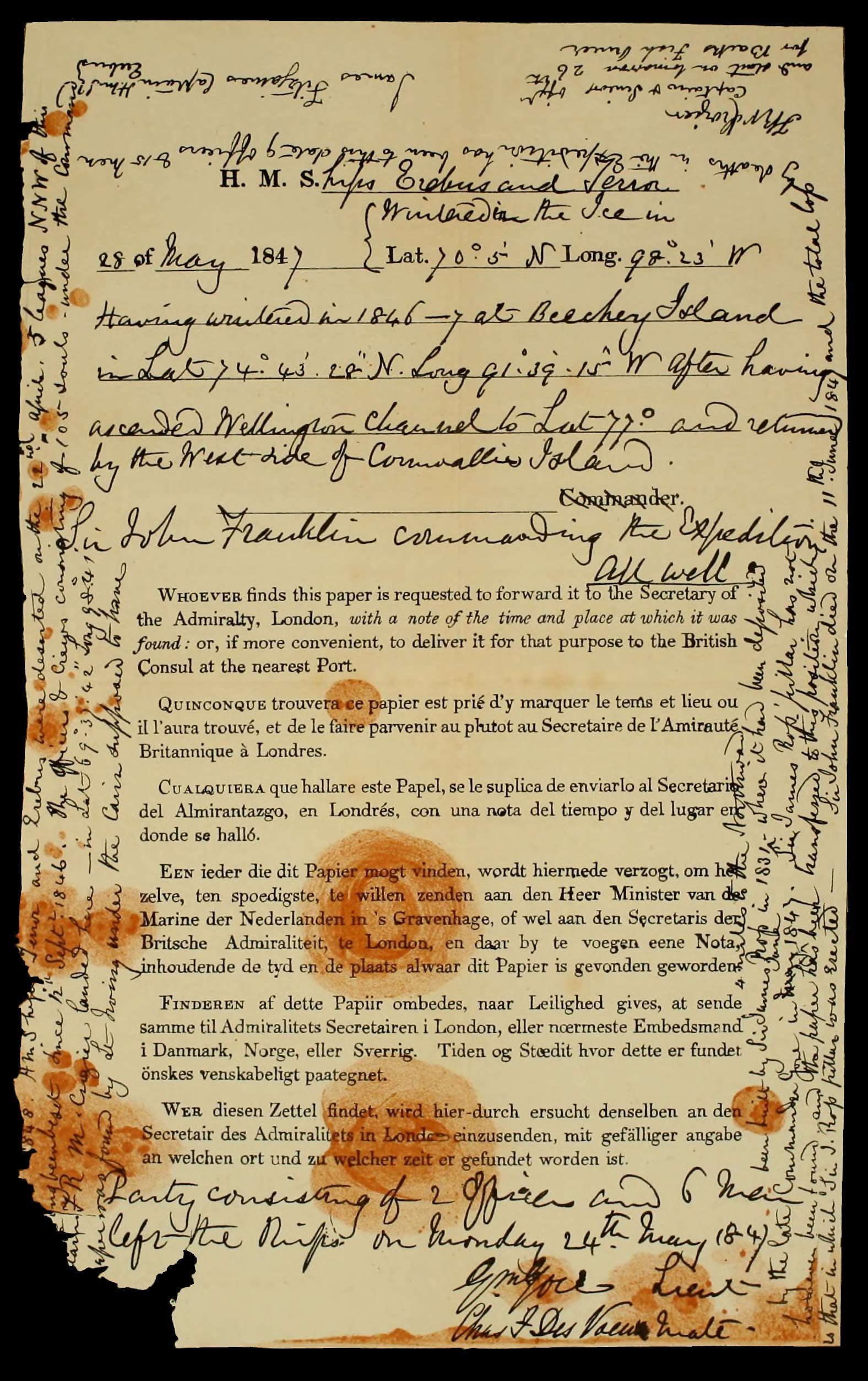
The Franklin expedition still invites master-key explanations. A modern reader sees 129 men vanish after leaving England in 1845, learns that the ships were trapped in ice, and then looks for the one fatal error or one hidden poison that can make the whole catastrophe legible.[1][2][4] For a long stretch, the most seductive answer was lead. It had laboratory force, it sounded precise, and it let the story collapse into one grimly elegant proposition: the expedition was technologically advanced, well supplied by Victorian standards, and then quietly poisoned by its own provisions and systems.[5][6][7]
That reading is no longer strong enough. The physical sheet shown in the article image, the Victory Point Note, is too abrupt and too incomplete to support a single-cause story by itself.[2][8] Inuit testimony gathered from the 1850s onward is too specific to be dismissed as rumor, especially after later searches and the discoveries of Erebus in 2014 and Terror in 2016 followed lines of knowledge preserved by Inuit communities.[3][4] And recent medical reappraisals do not erase lead exposure, but they do weaken the old claim that lead poisoning alone can explain why the expedition failed when it did.[5][6][7]
The sharper historical question, then, is not "What was the one cause?" It is: which interpretation best explains the widest range of surviving evidence without pretending that one surviving clue can do all the work?
Timeline anchors
- May 19, 1845: Franklin's expedition departed England with 134 officers and crew; by July, after the supply ship left Greenland, the voyage continued with 129 men aboard Erebus and Terror.[1]
- 1845-1846 winter: the expedition wintered at Beechey Island, where three men died.[1][2]
- September 12, 1846: the ships became beset in ice off the northwest coast of King William Island.[1][2][4]
- May 28, 1847: the first message on the Victory Point Note reported the expedition's route and ended with the phrase "All well."[2][8]
- June 11, 1847: Sir John Franklin died, according to the later addendum on the same note.[2][4][8]
- April 25, 1848: the second message reported that 24 men had died and that the surviving 105 had abandoned the ships and would head for Back's Fish River.[2][3][4][8]
- 1854: John Rae learned from Inuit that around 1848 a group of white men had been seen moving south on the western shore of King William Island and that bodies were later found farther south.[3][4]
- 1859: Francis Leopold McClintock's search expedition recovered the Victory Point Note from a cairn and found further traces of the retreat.[2][4]
- 2014 and 2016: Parks Canada and Inuit partners located the wrecks of Erebus and Terror, reinforcing the evidentiary value of Inuit knowledge in the reconstruction of the expedition's fate.[3][4]
Those dates show why the historiography has always been unstable. The expedition left plenty of relics and almost no direct narrative. One note survives. A long chain of searchers survives. Inuit testimony survives. Human remains survive. Wrecks survive. But the shipboard records that would settle the medical sequence do not.[2][4][7]
Why the lead story became so powerful
The lead theory became dominant because it solved two different problems at once. First, it offered a medical explanation for sudden collapse. Second, it offered a cultural explanation that kept authority inside British hands. If the real cause was toxic exposure from canned food, water systems, or solder, then the story's center remained on the ships themselves rather than on the longer and messier record of retreat, starvation, improvisation, and cross-cultural evidence.[5][6][7]
The appeal is understandable. Lead was found at elevated levels in remains associated with the expedition, and later scholarship had to take that seriously.[6][7] A toxic explanation also seems to fit the expedition's image: advanced ships, preserved provisions, heating systems, steam auxiliaries, and other pieces of Victorian confidence turning against the men who trusted them.[1][6] In narrative terms, it feels satisfyingly tragic. The Franklin expedition becomes a disaster produced by modernity's own hidden residue.
But historiography is not only about what can be imagined cleanly. It is about whether the clean explanation can carry the burden of the evidence. The trouble is that lead cannot bear that burden alone.
What the note and Inuit testimony force back into the picture
The Victory Point Note is the expedition's most famous clue because it compresses a reversal into one page.[2][8] The first message, written in May 1847, still presents a functioning expedition. The second, added around the margins in April 1848, records disaster: Franklin dead, the ships abandoned after being beset since September 1846, and 105 survivors starting south.[2][4][8] The note is crucial, but it does not name a cause. It tells us that the expedition deteriorated badly between those two moments. It does not tell us whether that deterioration came chiefly from lead, scurvy, cold injury, infection, hunger, exhaustion, or some combination of them.
That gap is exactly where Inuit testimony matters. Parks Canada summarizes the evidence chain clearly. Rae heard from Inuit in 1854 that roughly 40 white men had been seen on the western shore of King William Island heading south after their ships became trapped, and that bodies were later found near the mouth of the Back River.[3] Hall's later interviews gathered more specific information about one wreck farther south, while Parks Canada emphasizes that Inukpujijuk identified a wreck location later borne out by the discovery of Erebus in the region described.[3][4]
This evidence does not solve every argument, but it does change the scale of the story. It suggests the expedition's final phase was not one sealed shipboard medical event. It was an extended collapse across land, sea ice, drifting vessels, scavenged material, and repeated encounters recalled by Inuit witnesses and descendants.[3][4] Once that is taken seriously, monocausal explanations become less persuasive. The expedition did not simply die in place. It broke apart in stages.
The history of how Europeans received this testimony matters too. Parks Canada notes that Rae's report was attacked in Britain, with Lady Franklin pressing Charles Dickens to discredit both Rae and the Inuit accounts, especially the reports of cannibalism.[4] That reaction was not a side issue. It shaped the archive. Testimony that did not fit imperial dignity was treated as morally suspect before it was treated as evidence. The recent rediscovery of how accurate Inuit knowledge proved in locating the wrecks has therefore changed more than geography. It has changed which voices historians now trust when reconstructing the last phase of the expedition.[3][4]
What newer medical work actually says
The revision of the lead theory did not begin by pretending lead was absent. It began by asking more exact questions about timing, degree, and comparison. Millar, Bowman, and Battersby's re-analysis argues that the presence of lead in remains is real, but that its source and significance are much less certain than the classic theory assumed.[5] Lead exposure was widespread in Royal Navy contexts of the period, coming not only from soldered provisions but also from piping and even medicines.[5] That does not make lead harmless. It does make Franklin's men less exceptional on that one variable than the old master-key version required.
The 2018 PLOS One study sharpened the problem further. Its authors tested whether men who survived longer into the expedition should show evidence of later or more intense uptake, and whether bone forming near death should show a distinct spike.[6] Their findings did not support a simple expedition-specific late surge that could cleanly separate Beechey Island dead from King William Island dead.[6] In other words, the data weakened the claim that acute or escalating lead exposure during the expedition can, by itself, explain the catastrophe's timing.
The 2016 comparative study of nine Royal Navy Arctic crews pushes the same revision from another direction.[7] Using sick books from similar expeditions, it argues that some of Franklin's men likely suffered from scurvy-related pressures, but that there is no clear evidence that lead poisoning was incapacitating before the ships were abandoned.[7] It also finds no evidence that botulism explains the disaster.[7] The result is not a neat replacement theory. It is a narrowing of certainty. Lead stays in the picture, but not on the throne.
Two readings still compete
Reading one: lead poisoning is the master key
This reading treats the Franklin disaster as fundamentally an internal toxic failure. The trapped ships become the main stage, and later retreat becomes a consequence rather than an explanatory field. Its strength is narrative economy. Its weakness is that it asks one variable to do too much work across too many missing records.[5][6][7]
Reading two: the expedition failed through cumulative collapse
This reading begins with the same physical evidence but gives more weight to sequence. The ships were trapped from September 1846. Franklin was dead by June 1847. By April 1848, 24 men had died and the survivors were desperate enough to leave the ships.[1][2][4] Inuit testimony then places starving men farther south and points toward later ship movement and wreck locations that modern discoveries have helped validate.[3][4] In this version, malnutrition, cold, respiratory illness, exhaustion, injuries, and some degree of toxic burden may all belong in the picture, but none functions as a solitary villain.[5][6][7]
The second reading explains more with less distortion. It does not require us to pretend that one chemical fact overrides logistics, environment, delay, and the failure to turn technology into survival once the ice stopped the ships. It also fits the structure of the surviving evidence better. The Victory Point Note records reversal, not diagnosis. Inuit testimony records encounter, motion, wreck, and aftermath. New medical studies reduce the confidence of the lead master key without pretending the expedition was otherwise healthy.[2][3][5][6][7]
That is why the Franklin expedition now reads most strongly as a disaster of accumulation. The men did not die of one thing. They died inside a sequence: entrapment, waiting, weakening, abandonment, retreat, and then death scattered across a landscape that other people already knew how to read better than they did.[1][3][4][7] The historiographical shift is therefore not just medical. It is also archival and moral. It moves authority away from the fantasy of one dramatic hidden cause and toward a harder reconstruction built from partial paper, bodily traces, and testimony that earlier interpreters were too ready to discount.
Sources
- Parks Canada, "Franklin's 1845 expedition" - departure chronology, crew counts, Beechey Island wintering, September 1846 ice entrapment, and later wreck-discovery timeline.
- Canadian Museum of History, "A very special piece of paper" - the structure, date layers, and evidentiary importance of the Victory Point Note.
- Parks Canada, "Inuit traditional knowledge" - Rae's 1854 testimony record, later Inuit accounts, and the role of Inuit knowledge in locating the wrecks.
- Parks Canada, "Searching for Franklin" - Rae, Dickens, McClintock's 1859 find, Hall's interviews, and the 2014/2016 wreck discoveries.
- Keith Millar, Adrian W. Bowman, and William Battersby, "A re-analysis of the supposed role of lead poisoning in Sir John Franklin's last expedition, 1845-1848." Polar Record (2015).
- Tina Swanston et al., "Franklin expedition lead exposure: New insights from high resolution confocal x-ray fluorescence imaging of skeletal microstructure." PLOS ONE 13, no. 8 (2018).
- Keith Millar, Adrian W. Bowman, William Battersby, and Richard Welbury, "The health of nine Royal Naval Arctic crews, 1848 to 1854: implications for the lost Franklin Expedition." Polar Record (2016).
- Wikimedia Commons, "File:Franklinexpeditionnote.jpg" - public-domain image source for the Victory Point Note reproduction used as the article image.