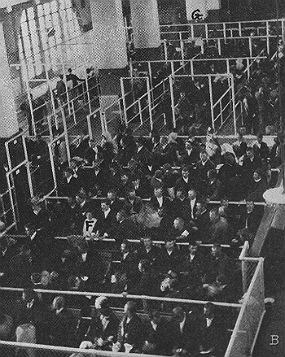
Ellis Island is often remembered as a gate, which makes the whole process sound like a door that either opened or shut. The sharper description is more mechanical. Between 1892 and 1924, the station worked because it broke immigrant inspection into stages, and each stage did a narrow job fast enough to keep the next one moving.[1][2][3][4][5]
That staged design matters because the popular image of Ellis Island usually centers on one dramatic room: the Registry Room, full of benches, interpreters, inspectors, and anxious families. The room was real, and the lead image shows it around 1906.[1] But the room only worked because other filters had already prepared the queue before each immigrant reached an inspector's desk. The system began with ship paperwork, continued through moving-line medical screening, and reserved slow, formal judgment for the smaller number of doubtful cases.[2][3][4]
The article's argument is therefore narrow. Ellis Island was not efficient because officials were unusually welcoming, and not efficient because they gave everyone deep individual attention. It worked, in administrative terms, because uncertainty was sorted in layers. The station tried to clear the easy cases quickly and push ambiguity sideways instead of letting ambiguity stop the whole line.[2][3][4]
Timeline anchors
- 1891: the Immigration Act of 1891 federalized immigration regulation and assigned immigrant health examinations to the Marine Hospital Service, later the Public Health Service.[1]
- January 1, 1892: the first federal immigration station on Ellis Island opened.[1]
- June 15, 1897: fire destroyed the original wooden complex.[1]
- December 17, 1900: the rebuilt Main Immigration Building opened, with the Registry Room on the second floor as the core processing hall.[1]
- 1921: the Emergency Quota Act imposed national quotas and sharply changed traffic through the island.[1]
- 1924: the Immigration Act shifted inspection of prospective immigrants to U.S. consulates overseas, reducing Ellis Island's role to a much narrower stream of detained and exceptional cases.[1][5]
These dates matter because they show that "Ellis Island" was not one unchanging ritual. It was an inspection machine built in one legal environment, physically rebuilt after the 1897 fire, and then partly bypassed after the quota regime hardened in the early 1920s.[1]
The system started before the immigrant reached the island
For most steerage passengers, the encounter with Ellis Island began long before the Registry Room interview. By the time an immigrant stood in line, the state already had a ship manifest containing answers recorded at the port of departure.[2] The immigrant inspector did not improvise from scratch. Sitting at a rostrum desk, the inspector checked the newcomer's spoken answers against that manifest and used the comparison to decide whether the person was, in the government's phrase, "clearly and beyond a doubt" entitled to enter.[2]
That is the first mechanism. Paperwork came before conversation. The manifest turned inspection into verification rather than free-form storytelling.[2] Even the famous question set described by the National Park Service as including name, birthplace, occupation, destination, and money carried worked as a cross-check, not a literary interview.[4][5] The state wanted consistency more than nuance.
This is also why Ellis Island should not be imagined as a completely uniform experience. The NPS overview notes that first- and second-class passengers usually disembarked directly in New York Harbor, while steerage passengers were ferried to Ellis Island for the fuller station process.[5] The island's most elaborate machinery was aimed above all at mass third-class traffic. Ellis Island was a sorting device built for scale, and scale meant the government concentrated its effort where it expected the most administrative risk.[5]
The stairs turned medicine into motion
The second mechanism was medical inspection, and its key feature was speed. As immigrants climbed toward the second floor, Public Health Service doctors watched for limps, labored breathing, weakness, and other visible signs of illness or impairment.[3] The NPS description of the "six second exam" is revealing: this was not a hospital consultation but a moving-line filter designed to separate the clearly healthy from the doubtful cases who needed fuller examination.[3]
That staged logic explains how Ellis Island processed huge volumes without collapsing into total delay. Doctors did not try to solve every case on the stairs. They scanned for reasons to pull people out of the stream. About 10 percent were held for additional medical examination, yet eventually all but about 1 percent were admitted to the United States.[3] The line was therefore strict in posture but selective in practical effect. Most people passed because the point of the initial screen was triage, not exhaustive diagnosis.[3]
This is where the phrase "gateway to America" can mislead. A gateway suggests one threshold. Ellis Island's real medical power lay in layered observation: stairs, line, second look, hospital if needed.[1][3] The system kept the main hall moving by refusing to treat every body as equally uncertain.
The Registry Room was a cross-check room, not a confessional
Once immigrants reached the Registry Room, officials repeated the same administrative principle in legal form. Inspectors asked about home town, occupation, destination, and available cash; interpreters handled the roar of different languages that many immigrants remembered as a "Tower of Babel."[4] Here again, the work was not to discover a full life story. It was to match the person in front of the desk to a record, a destination, and a legal category.[2][4]
The categories mattered. A person could be excluded as a contract laborer, a likely public charge, or someone falling into another barred class under U.S. immigration law.[2][4] Yet the key procedural point is that the main desk did not have to settle every difficult case immediately. Those detained for further legal examination waited for the Board of Special Inquiry, where doubtful admissibility could be argued more formally.[4]
That is the third mechanism: the main queue survived because the station had a side channel for exceptions. The Board of Special Inquiry absorbed the cases that would otherwise have clogged the hall.[4] If the medical line was built to spot suspect bodies quickly, the legal system was built to isolate suspect paperwork, suspect intentions, or suspect support networks without forcing the whole building to stop.
This is also why the Registry Room photograph matters so much.[1] The room looks crowded, but it is not simply crowded. It is organized crowding. Benches hold waiting families. Desks create review points. Interpreters and inspectors translate movement into files and files back into movement. What looks like chaos from afar is better understood as managed throughput.
Why the machine changed after 1921 and 1924
The system described above belonged to the age of mass European steamship migration. Once quota law changed the terms, the island's role changed too. The Emergency Quota Act of 1921 reduced admissions by nationality, and the Immigration Act of 1924 cut them further while shifting prospective inspection to American consulates overseas.[1] The NPS summary of Statue of Liberty and Ellis Island makes the institutional consequence plain: throughout the 1920s, only a much smaller number of detained immigrants passed through Ellis Island, and by 1954 the station closed.[5]
That shift confirms the main argument. Ellis Island's classic system was not a timeless symbol of immigration; it was a historically specific answer to one problem: how to inspect very large numbers of steerage arrivals in a short window after ocean travel but before entry into the city.[1][5] Once the state moved more of the screening abroad and cut the flow with quotas, the island no longer needed to function as the same kind of queue-management machine.[1][5]
Two readings still compete
Reading one: Ellis Island was mainly a democratic welcome hall
This reading emphasizes arrival, emotion, and upward mobility. It sees the station primarily as the room where millions of future Americans took their first formal step into the country.[1][5]
Reading two: Ellis Island was mainly a staged administrative filter
This reading accepts the emotional symbolism but treats the island's real historical distinctiveness as procedural. Manifests, medical triage, desk interviews, interpreters, and special inquiry formed a layered screen built to keep the easy cases moving and the doubtful cases contained.[2][3][4]
The second reading explains the evidence better. Ellis Island became iconic not because one room represented pure welcome, but because that room condensed a whole inspection architecture into a visible scene. The state had learned how to sort mass migration by splitting judgment into stages and by reserving deep attention for the minority of cases that triggered doubt.
That is why the Registry Room should be read less as a chamber of singular decisions than as the center of a moving system. Ellis Island worked when the line moved, when the manifest matched, when the doctor only had to detect, and when the doubtful case could be pushed into a different lane. Its history is therefore not only the history of arrival. It is also the history of administrative sequencing.
Sources
- National Park Service, "Immigration - Ellis Island" - federalization in 1891, opening in 1892, the 1897 fire, the 1900 rebuilding, and the 1921/1924 quota-law transition.
- National Park Service, "Immigrant Inspector" - manifest cross-checking, the rostrum desk, and the standard that inspectors admit only those "clearly and beyond a doubt" entitled to enter.
- National Park Service, "Historic Medical Inspection (2nd Floor)" - the moving-line medical exam, the six-second screen, and the proportions held for further examination versus eventually admitted.
- National Park Service, "Historic Legal Inspection (2nd Floor)" - interview topics, interpreters, public-charge review, and the Board of Special Inquiry path for detained cases.
- National Park Service, "New York: Statue of Liberty National Monument" - steerage transfer to Ellis Island, the 29-question legal inspection, and the post-1924 reduction of the island's role.