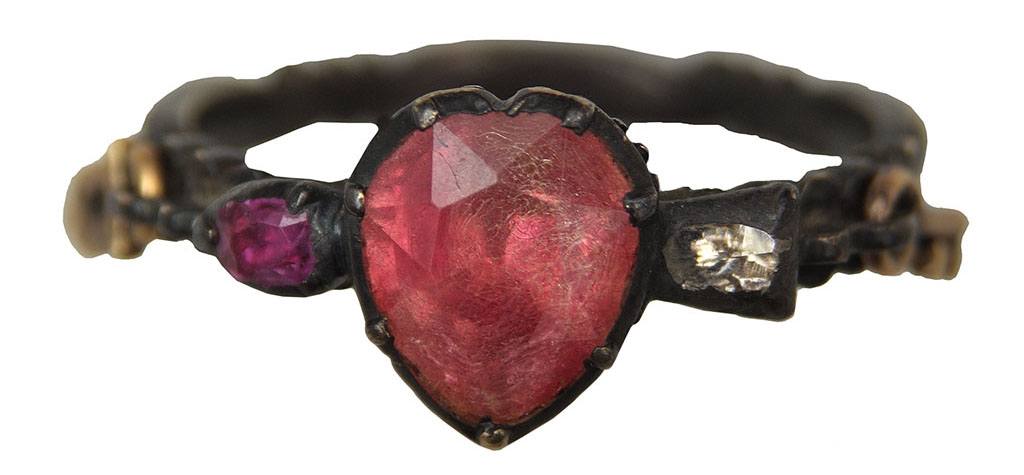
The little ring has a key on one side of its heart-shaped stone and a padlock on the other. Left at London's Foundling Hospital in 1752, it belonged to the admission of Harriet Littleton, whom the institution renamed Harriott Woodhall. A note accompanied it, describing the stones and enclosing a passage from the Psalms. The ring offered a material way to recognize a relationship after the child's name had changed.[1]
It is tempting to imagine such an object staying beside a child through an unfamiliar life. The Hospital kept its tokens in the archive. They were evidence held for a possible return, and their usefulness depended on being connected to the right paperwork.[3] How did that small arrangement preserve a parent's claim—and why could the claim still fail?
The record had to remember what the name concealed
The Hospital began admitting children on 25 March 1741. Demand soon exceeded the places available: in October 1742, admission became a lottery using coloured balls, followed by an examination of the infant. Receiving a child and preserving the possibility of a later claim were separate administrative tasks.[2]
For an admitted baby, staff completed a form called a billet. It recorded identifying details; the token was enclosed and sealed, or stored securely elsewhere if too large. A returning claimant would be asked to describe the object. Janette Bright's account for the Foundling Museum stresses that secrecy was part of the procedure.[2]
The practical logic is clear. A description supplied before the packet was opened could be checked against something already in the Hospital's custody. The object did not have to be expensive. It had to be recognizable, and the institution had to preserve its association with a particular child. A ring loose in a drawer could not do the same work as a ring attached to an admission record.
Cloth made an affordable identifier
Jewellery is conspicuous in a display case, but fabric dominates the surviving evidence. Historian John Styles identifies roughly 5,000 textile scraps in the Hospital's archives. Printed flowers, blue checks and coloured ribbons offered distinctive details in materials that working women could own. The plainest, coarsest cloth was less useful for recognition.[4]
These fragments complicate the idea that every token was a carefully prepared farewell. Styles explains that nurses and clerks sometimes cut identifying swatches from a baby's clothing when no token had arrived with the child, particularly during periods of heavy admissions. Other pieces carry names or initials deliberately sewn or written onto them. A yellow ribbon left with a boy in 1748 bears the words “My Name is Andrews.”[4]
The distinction matters. An inscription can support an argument about a parent's wish to preserve a name. An uninscribed scrap may instead record a clerk's effort to keep admissions distinguishable. Both could serve identification, but they do not authorize the same story about the moment of separation. The collection preserves institutional improvisation alongside deliberate personal messages.
Proof brought a claimant to another threshold
Coram's archival account describes claimants supplying their relationship to the child, the admission date, clothing and bodily marks. Staff compared these details with the billet. A token could be described or matched with a retained piece; receipts also came into use in the late 1750s. Identification drew on several kinds of evidence.[5]
Successful identification did not settle the child's return. The Hospital investigated a claimant's circumstances and could refuse someone it considered unable or unsuitable to provide care. There was also a financial obstacle: until 1764, claims incurred charges for the child's upkeep, accumulating during the separation. Coram reports that more children were claimed in the year those charges were abolished than in all the preceding years since opening.[5]
That sequence exposes a cruel difficulty. A parent who needed time to recover financially could face a bill that grew while they waited. Removing the charge changed access to reunion without making a token any more accurate as evidence. The institution's arrangements for recognizing a family and its conditions for restoring one could pull in different directions.
Two claims, different endings
One surviving silver disc bears the name Maria Augusta Handel. The child entered the Hospital in 1758 and became Ann Ketelby. In 1763, John Covert, identified as a friend of her parents, claimed her and offered £20 towards her care. The Museum documents a return involving someone beyond the parent-child pair, with money still part of the negotiation.[6]
Another token had once granted access to the king's private road. It arrived in 1756 with Nathaniel Lane, renamed Mark Fowler. In 1764, an adult also named Nathaniel Lane came to claim him. The record calls this man a friend of the mother; the Museum does not treat his paternity as established. The child had died only weeks after admission.[7]
These cases show why a recorded claim cannot automatically be counted as a reunion. Recognition might recover the history of a child whose life had already ended. Nor does a surviving token, by itself, tell us who returned, what resources they brought, or what answer they received. Those questions require the accompanying records.
Preserving the object could lose the connection
In the nineteenth century, Hospital governors put some tokens on display without recording which child each belonged to. The objects survived, but the link that had made them useful was damaged. The Museum's researchers have recovered some associations; others remain unknown.[3]
Ann Ketelby's disc illustrates the repair. Her admission billet merely recorded that a token was enclosed, offering little help once object and paper had been separated. The later claim form described the disc in enough detail for researchers to reconnect them.[6] A document produced for one act of recognition made another possible generations later.
The ring at the beginning of this story was also reconnected through a written description.[1] Its key and padlock invite an immediate emotional reading. Its history asks us to look beyond the metal: to the note, the sealed packet, the person making a claim and the officials deciding it. The token preserved something precious because people kept it with a record. Whether that record could lead a child home depended on much more than remembering.
Sources
- Foundling Museum, “Token: Child's ring” — object photograph, 1752 admission, Harriet Littleton/Harriott Woodhall and the note that restored the association.
- Janette Bright, “Becoming a Foundling Child,” Foundling Museum — opening and admission procedures, sealed billets and the secrecy of tokens.
- Foundling Museum, “Tokens” — renamed children, archival custody and the later separation of objects from their records.
- John Styles, “Textiles,” Foundling Museum — surviving fabric tokens, distinctive patterns, staff-selected swatches and inscribed names.
- Poppy Farr, “Claiming Children,” Coram Story, 2 May 2024 — evidence required for claims, investigations of claimants and the abolition of upkeep charges in 1764.
- Foundling Museum, “Token: Engraved disc” — Ann Ketelby's reclamation by John Covert and the claim form used to identify her token.
- Foundling Museum, “Token: King's Private Roads Pass” — Nathaniel Lane/Mark Fowler and the unsuccessful attempt to reclaim him after his death.