Benjamin Banneker wanted Thomas Jefferson to see the almanac in his own handwriting. Sending the manuscript before publication would let the secretary of state examine both the calculations and the hand that made them. The accompanying letter, dated 19 August 1791, asked him to examine his principles too.[1]
The exchange poses a question that praise alone cannot settle: what happens when someone answers a demand for equal treatment by admiring the petitioner's accomplishments?
Banneker was a free Black farmer in Maryland who had developed his astronomical knowledge with books and instruments made available by the Ellicott family. Earlier in 1791, he had assisted Andrew Ellicott's survey of the territory for the federal capital. His work included astronomical observations and maintaining the survey's regulator clock. Jefferson already had reason to know his abilities.[3]
The argument also had a specific target. Jefferson's Notes on the State of Virginia, published in 1785, had advanced claims of Black intellectual inferiority. An almanac supplied something those claims could be tested against: calculations produced by a named Black author. Yet Banneker's letter made a broader demand than recognition for a talented individual.[3]
The obligation inside the courtesy
Banneker's opening acknowledges Jefferson's rank and the prejudice facing his correspondent. Then courtesy becomes conditional. If Jefferson is as sympathetic as reported, Banneker argues, he must use his influence against oppression. Shared creation makes humanity a family; rights follow from that relationship.[1]
The letter next recalls the colonists' fear of British domination and returns the Declaration's equality principle to its author. Banneker accuses Jefferson of practising the oppression he condemned. His appeal through Job—“Put your Souls in their Souls stead”—asks the powerful reader to change places imaginatively with the enslaved. The argument begins with obligations Jefferson already professes, rather than asking him to invent a new moral standard.[1]
A reply about evidence
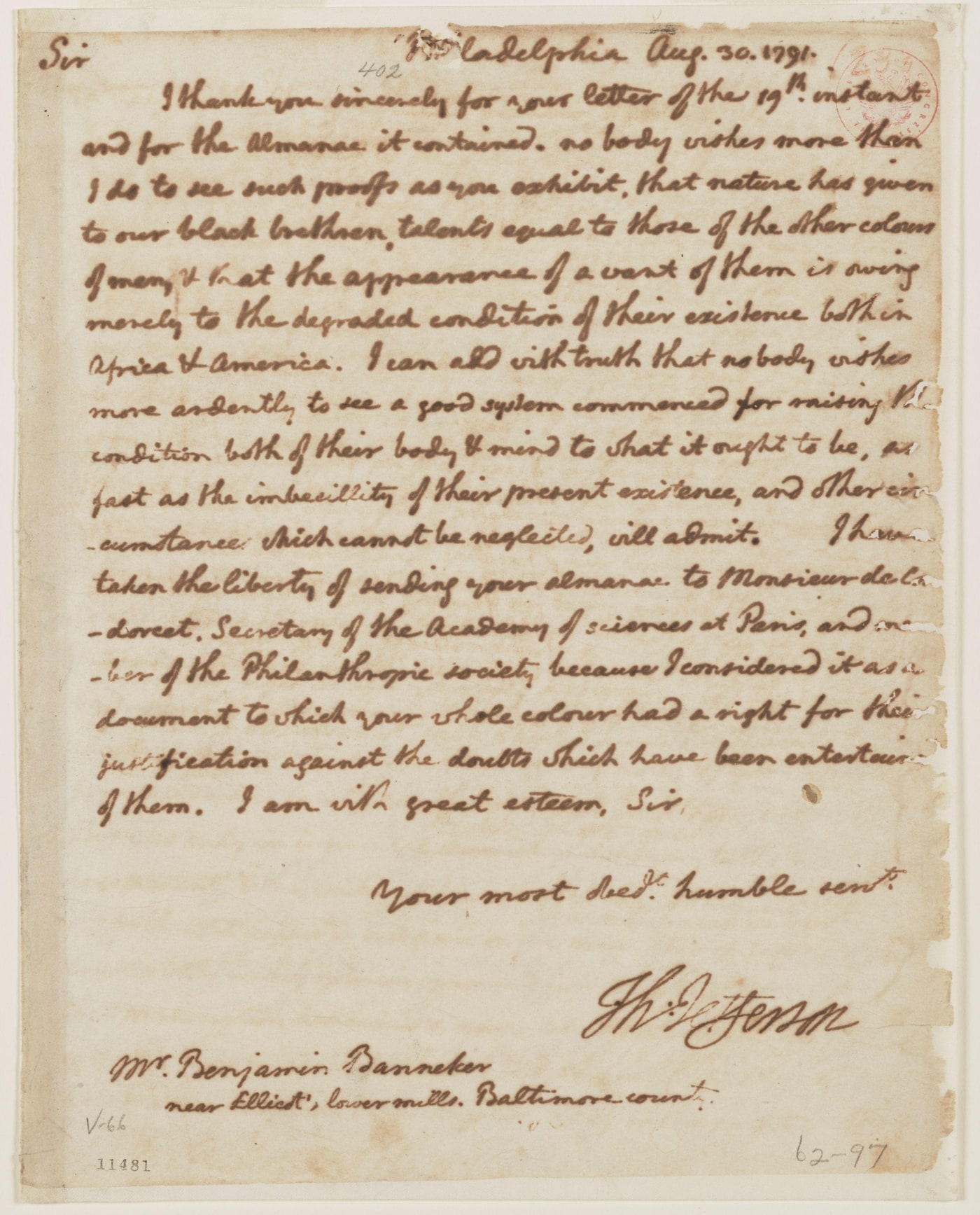
Jefferson's answer, written in Philadelphia on 30 August 1791, begins warmly. He welcomes the almanac as evidence that Black people possess equal talents, and attributes apparent differences to the conditions under which they live. Read alone, this is a meaningful admission from the author of Notes.[2]
But the verbs of action are limited. Jefferson wishes to see improvement; he has sent the almanac to the French mathematician and philosopher Condorcet. He offers no undertaking to free people he enslaves, support a particular measure, or answer the accusation about the Revolution's principles.[2]
The qualification attached to improvement matters: it should proceed as circumstances permit. Those circumstances remain unspecified. Banneker has pressed for the exercise of power; Jefferson describes a hoped-for process whose pace is left open.[2]
This is the central mismatch between the letters. The reply accepts Banneker as evidence in a discussion of intellectual capacity. Its reader must look elsewhere for a commitment to change the conditions under discussion. The difference is visible in what Jefferson promises, without requiring us to claim certainty about his private intentions.[2]
What the letter to Paris adds
A second letter written that day prevents us from treating the reply as empty politeness. Addressing Condorcet, Jefferson praises Banneker's mathematics, describes his survey work and says he is enclosing the handwritten almanac. He also commends Banneker's character. This was an endorsement addressed to another intellectual, not merely a compliment returned to the sender.[4]
Its wording nevertheless keeps the burden of demonstration alive. Jefferson hopes that examples of Black accomplishment will multiply until they establish that deprivation, rather than innate difference, explains supposed deficiencies. Banneker's work becomes one item in an accumulating case.[4]
The distinction is consequential. A person can receive serious scientific recognition while the observer continues to reserve judgment about the group to which that person belongs. The almanac gains an advocate, but the advocate retains control over how much evidence will count as enough.[4]
Recognition could be withdrawn
There is a further complication. In a letter to Henri Grégoire dated 25 February 1809, Jefferson explicitly separated talent from entitlement: “whatever be their degree of talent it is no measure of their rights.” The Library of Congress displays that statement alongside the Banneker exchange. It would therefore be misleading to say Jefferson could never articulate the distinction between intellectual achievement and human rights.[5]
Yet on 8 October 1809, writing to Joel Barlow, he diminished the very example he had promoted. He acknowledged Banneker's mathematical competence while raising a suspicion of assistance from Ellicott. He also dismissed Banneker's long letter as evidence of an ordinary mind. The passage supplies Jefferson's suspicion, not proof that someone else performed the calculations.[6]
The generous reading of 1791 rests on real evidence: the cordial response and the endorsement to Condorcet. The harder reading gains force from the absence of a concrete commitment and the later retreat into doubt. A claim of lasting conversion would need evidence of sustained changed judgment or action. The 1809 letter instead shows how readily recognition could be narrowed again.[2][4][6]
A reader beyond the recipient
The correspondence acquired an audience Jefferson could not address simply by replying to Banneker. In 1792, Philadelphia printer Daniel Lawrence published the exchange as Copy of a Letter from Benjamin Banneker to the Secretary of State, with His Answer. The surviving pamphlet, described and transcribed by the National Park Service, places the challenge and response in the same small publication.[7]
That arrangement gives later readers a task: compare what was asked with what was answered. The scientist's achievement earned acknowledgment. The moral demand remained available for judgment. Publication preserved both, allowing the courteous reply to be read against the obligation that had prompted it.[7]
Sources
- Benjamin Banneker to Thomas Jefferson, 19 August 1791, Founders Online, National Archives—letter transcription and editorial account of the surviving copies.
- Thomas Jefferson to Benjamin Banneker, 30 August 1791, Founders Online, National Archives—complete reply, including its qualifications and reference to Condorcet.
- Louis Keene, “Benjamin Banneker,” White House Historical Association—astronomical study, federal survey work and the context of the almanacs.
- Thomas Jefferson to Condorcet, 30 August 1791, Founders Online, National Archives—endorsement of Banneker and the stated enclosure of his almanac.
- Library of Congress, “Creating a Virginia Republic,” Benjamin Banneker section—archival image of Jefferson's reply and the 25 February 1809 letter to Henri Grégoire.
- Thomas Jefferson to Joel Barlow, 8 October 1809, Founders Online, National Archives—later doubts about Banneker and discussion of Grégoire.
- National Park Service, “The Letters of Benjamin Banneker & Thomas Jefferson—August 1791”—provenance and title-page transcription of Daniel Lawrence's 1792 pamphlet.