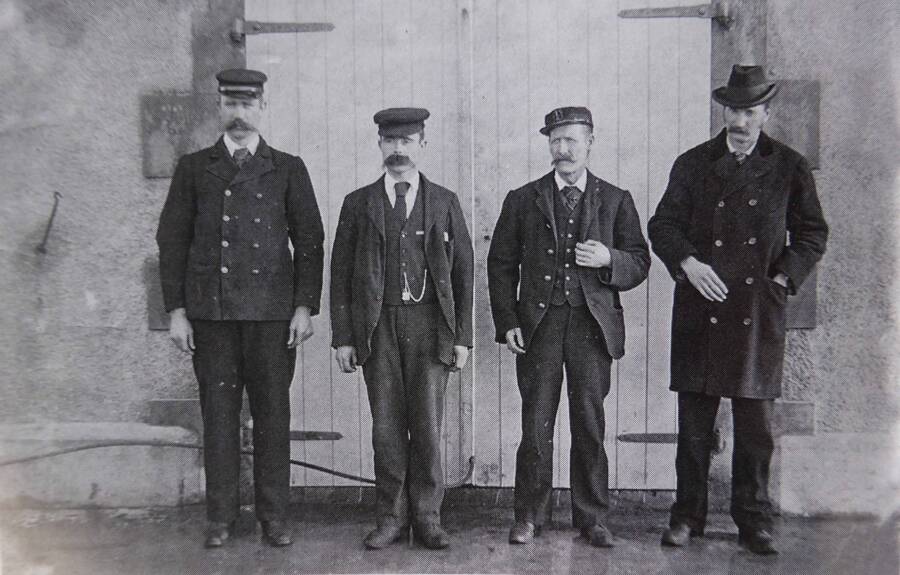
A table is laid with meat, cheese and bread. Nobody has eaten. A chair lies overturned. In Wilfrid Wilson Gibson's 1912 poem “Flannan Isle,” these objects make an empty lighthouse feel like the scene of an interruption: something has summoned three men away before their meal could begin.[1]
The official investigation offers a different kitchen. Superintendent Robert Muirhead's report of 8 January 1901 describes washed cooking utensils and a room put in order.[2] That difference changes the question. Before asking what frightened the keepers from their dinner, we need to establish whether such a dinner was found.
The tender Hesperus reached Eilean Mòr on 26 December 1900. Joseph Moore went ashore and found the station deserted: James Ducat, Thomas Marshall and Donald McArthur were missing.[3] The difficulty is separating that loss from details later recruited to explain it.
The meal was already a story
Gibson writes from inside the searching party. His repeated returns to the table give the reader something tangible to inspect after the island has yielded no men. The untouched food suggests a broken sequence; the fallen chair supplies haste. These are economical choices for a poem whose emotional force depends on the searchers imagining what might happen to them next.[1]
Yet correcting the poem requires care too. Historian Mike Dash found a report in the Oban Times of 5 January 1901 that already described an unfinished breakfast and chairs pushed aside. He reproduces the newspaper account in his documentary appendix and notes that its meal claim has no identified authority. The motif therefore predates Gibson's published poem.[4]
This matters because a neat debunking can become another misleading origin story. We can show that the poem gives the meal a memorable form. We cannot make the poet responsible for inventing a detail already circulating in print. Nor does a newspaper's closeness to the event make every reported detail an eyewitness observation. The useful distinction is between records of what people found and records of what people said had been found.
The work that had been completed
National Records of Scotland describes evidence of a working morning. The log had entries through 13 December; later observations, including readings at nine on the 15th, remained on a slate awaiting transcription. The prepared light and cleaned machinery supported an inference that the men disappeared later that day.[3]
A slate beside a logbook is less theatrical than a chair on the floor, but it is more useful for establishing sequence. It distinguishes work completed from work still awaiting entry. It also cautions against reading the last date in a bound volume as the precise moment its writer vanished. Recordkeeping can lag behind the activity it records.
Muirhead's report also contains an essential limit: the cause he proposed was the “most likely explanation.” His reconstruction placed the men near the west landing, trying to secure equipment before a large wave swept them away.[2] Those qualifying words belong with the theory whenever it is retold.
What the damaged landing could explain
The archival account describes twisted railings, a displaced heavy stone and a lifebuoy torn from its fastenings. Damage reached 110 feet above sea level.[3] Evidence of water reaching the island's structures supplied a reason to investigate the landing.
Muirhead considered the competing possibility that wind had blown the men away. He preferred the sea explanation because the westerly wind would have driven them uphill, where he thought they could have dropped to the ground. Missing outdoor clothing also pointed toward a trip to the landing.[2]
The two explanations were therefore weighed against the direction of the wind, the damaged site and the keepers' equipment. The wave account had the stronger physical case. But damage cannot tell us who stepped outside first, whether someone followed to help, or the exact place each man stood. A convincing mechanism still leaves an unwitnessed sequence. Further contemporary testimony or a securely attributable observation would be needed to narrow those gaps; an increasingly vivid retelling cannot do that work.
The archive has a boundary
One frequently overlooked fact makes precision especially necessary: National Records of Scotland does not hold the lighthouse logbook. Its research guide explicitly says the volume was absent from the records deposited by the Commissioners.[5] That statement describes the archive's holdings. It does not establish that no log ever existed or that every reference to it is unknowable.
We have investigators' accounts of what they read. We also have reason to challenge purported verbatim entries. Dash compares the dramatic log passages repeated in later mystery literature with the official chronology and finds incompatible claims about when entries were made.[4] A passage presented as a keeper's private terror needs a traceable document behind it. Repetition alone cannot supply one.
The surviving catalogue directs attention elsewhere as well: to replacement staff, insurance, pensions, widows' gratuities and a claim made by Marshall's father. Correspondence continued into 1902.[5] The administrative aftermath restores something the abandoned dinner can eclipse. These men belonged to households and a workplace; their disappearance created obligations that survived the search.
The clean kitchen leaves the story unresolved, but it changes its shape. Work had been done, people were missing, and investigators built a probable account from what remained. Keeping that uncertainty intact allows the keepers' loss to remain a human event without furnishing their rooms with evidence we cannot verify.
Sources
- Wilfrid Wilson Gibson, “Flannan Isle,” in Fires, Book I: The Stone, and Other Tales, Elkin Mathews, 1912 — primary literary text, digitized by Project Gutenberg.
- Northern Lighthouse Board, “Flannan Isles” — contemporary documents reproduced together, including Joseph Moore's letter of 28 December 1900 and Robert Muirhead's report of 8 January 1901; kitchen, competing explanations and evidentiary qualifications.
- Jocelyn Grant, “Flannan Isles Lighthouse Keepers: The disappearance,” National Records of Scotland, 12 December 2023 — archival synthesis of the keepers, slate observations and storm damage; source of the circa-1900 group photograph.
- Mike Dash, The Vanishing Lighthousemen of Eilean Mór — archival study, especially the discussions of the alleged log and meal, and appendix Document 7 reproducing the Oban Times of 5 January 1901; author-hosted PDF.
- National Records of Scotland, “Lighthouses: The mystery of the Flannan Islands Lighthouse” — finding aid for NLC2/1/88–89 and NLC3/1/1, including the missing logbook notice and correspondence about dependants.