
Pearl Harbor usually enters public memory already condensed into a sentence: a surprise attack, a sleeping fleet, a president asking Congress for war.[1][4] The archival footage from the morning of December 7, 1941 slows that memory down and gives it a harder physical shape. Before Pearl Harbor became a slogan, it became a harbor under conversion. Battleships sat moored side by side, aircraft crossed a basin full of stationary targets, one magazine explosion on USS Arizona threw smoke high enough to change what could be seen and done, and the water itself stopped behaving like open maneuver space.[1][2][3]
That is why the clip matters.[1][2] It does not begin with diplomatic chronology or with Roosevelt's voice the next day. It catches the attack at the level of surfaces and bottlenecks. Water, smoke, mooring lines, and ship placement do most of the explanatory work. The strongest historical reading of Pearl Harbor is not only that the United States was surprised. It is that a concentrated fleet inside a narrow harbor became vulnerable in exactly the way concentration always risks: one strike could disrupt several things at once.
Seen that way, the attack was not just a story of individual ships taking damage.[3][5] It was a story about how a base organizes force in peacetime and how that same order can turn into a liability once the first bombs arrive. The footage from the National Archives preserves that transition in miniature. It shows a fleet no longer arranged for inspection, readiness, or routine service, but abruptly rearranged by blast, smoke, and the problem of whether anything could still move through the harbor without making the situation worse.
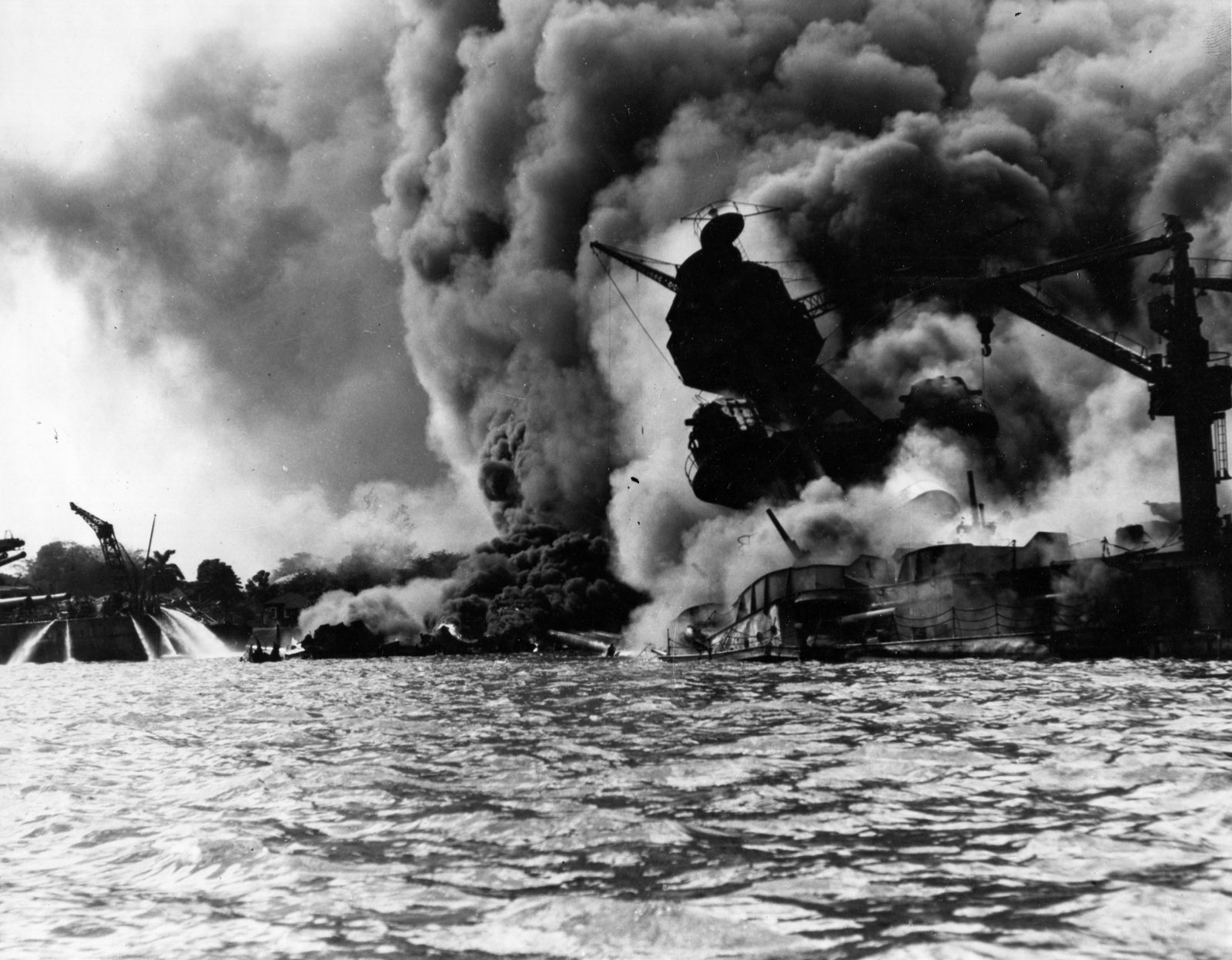
Image context: the cover uses a U.S. Navy photograph from the attack showing USS Arizona burning furiously after her forward magazines exploded, while men on USS Tennessee work hoses to push burning oil away from their ship.[6] It belongs here because the article's point is not simply that Arizona was destroyed. It is that one catastrophic hit instantly turned neighboring ships and the water between them into part of the same fire problem.
Historical context: Pearl Harbor gathered American naval power into one visible basin before war reached it
The longer road to December 7 ran through diplomacy, embargo, and miscalculation.[4] The Office of the Historian's summary of the years 1937-1941 shows the pressure clearly. As Japan deepened its war in China and pushed southward into Indochina, the United States tightened aid to China, froze Japanese assets, and moved from partial restrictions toward a full embargo on exports to Japan.[4] Japanese leaders, facing material shortages and unwilling to retreat from expansion, concluded that they had to act quickly. American leaders, meanwhile, still hoped negotiations might hold and doubted Japan had the military strength to attack U.S. territory directly.[4] That mismatch between Japanese urgency and American disbelief is the political background of the footage.
But the clip itself explains something slightly different: what a surprise attack meant once it hit a fleet at anchor.[1][2][3] Pearl Harbor was not a dispersed ocean patrol. It was a base. On Battleship Row, major ships were moored in sequence along Ford Island, close enough that damage, smoke, fire, and rescue problems could spill from one hull to the next.[3] The layout made administrative sense in peacetime. It concentrated capital ships where they could be serviced, watched, and organized. Under air attack, the same order became exposed geometry.
The National Park Service's Battleship Row history helps translate that geometry into consequences.[3] USS Arizona was struck early; a bomb penetrated her deck and ignited the forward ammunition magazines, killing 1,177 sailors and Marines.[3][5] USS Oklahoma capsized after multiple torpedo hits.[3] USS Vestal, moored beside Arizona, absorbed damage while her crew tried to rescue sailors from the wreck.[3] USS Nevada, moored just behind Arizona, became the only battleship to get underway; even that act had to end with deliberate beaching at Hospital Point to prevent the ship from blocking the vital harbor channel.[3] That last detail is especially revealing. Pearl Harbor was not only a target field. It was a traffic system. Even a surviving battleship could become a larger disaster if it closed the harbor's throat.
This is the frame that makes the footage more than spectacle.[1][2][3] A harbor concentrates power because it gathers ships into maintained readiness. The same concentration means that blast, smoke, and wreckage can very quickly become operational conditions rather than background scenery. Pearl Harbor on film is therefore a lesson in naval basing under sudden air attack: not abstract vulnerability, but visible crowding.
Video provenance
The embedded clip is "Japanese Planes Bomb Pearl Harbor, USS Arizona Explodes & Sinks," published on YouTube by the US National Archives.[1] The archive description identifies the footage as part of Record Group 428, gives the production date as December 7, 1941, and notes that the original was made on 16mm by Capt. Eric Hakansson before being blown up to 35mm.[1][2] That provenance matters for an archival spotlight. This is not a retrospective documentary rebuilt from maps and narration. It is archive-managed period footage whose historical value lies in exactly what it preserves and what it cannot yet explain: aircraft in the harbor sky, the Arizona blast, smoke, water, and the abrupt transformation of a naval base into a burning visual field.
Close reading: what the footage shows about concentration, smoke, and the problem of movement
The first thing the clip restores is the simple fact that ships in harbor do not fight with the freedom people later imagine when they hear "fleet."[1][2] In open-water memory, warships read as mobile power. In the Pearl Harbor footage, they read as anchored mass. Aircraft move quickly across the frame; the ships below them barely move at all. That asymmetry is the attack's basic truth. Surprise mattered because the fleet was there to be seen and struck before it could turn mobility into defense.
The second thing the footage clarifies is scale.[1][2][6] The Arizona explosion is often remembered as a single catastrophic moment, but on film it does more than destroy one ship. It changes the whole harbor's legibility. Once the smoke column rises, the eye stops reading neat ship outlines and starts reading obscuration, fire, and interrupted visibility. A base depends on clear lines: orders, signals, routes, sightlines, rescue movement. Smoke attacks all of those at once. Even readers who know the casualty number can miss that point until they see the blast alter the basin itself.[3][5]
That is why the cover photograph is such a good companion to the video.[6] The photo freezes what the moving footage makes easier to feel: Arizona burning, Tennessee close by, and men using hoses to push burning oil away. The important unit is not a single heroic ship. It is proximity. Harbor war is contagious. Fire crosses water through fuel; damage to one moored vessel pressures the crews beside it; rescue and survival are shaped by who is tied next to whom.
The Nevada episode, read alongside the footage, sharpens the same point.[3] The video is dominated by immobility and smoke, but the best measure of the harbor's stress is the one battleship that did move. Nevada's crew got underway, yet their success could not be pursued indefinitely. The ship had to be beached rather than risk sinking in the channel and sealing the harbor.[3] That is an extraordinary detail. It means that under attack the category of "escape" was inseparable from the category of "obstruction." Movement remained possible only if it did not close the narrow route everyone else might need.
The footage therefore works as a close lesson in basing vulnerability, not just in aerial destruction.[1][2][3] Pearl Harbor's danger was not only that Japanese planes found their targets. It was that the targets were arranged in a tight operational landscape where blast, fire, visibility, and channel access were all linked. The film preserves the moment when those links become impossible to ignore.
Legacy: why this footage still matters now
Later American memory had good reason to elevate Pearl Harbor into rhetoric.[4] The shock was real, the dead were many, and the attack immediately reorganized U.S. foreign policy, war aims, and public opinion. Yet rhetoric can flatten mechanics. "Day of Infamy" tells us what the attack meant. The footage helps explain how the attack worked as an event lived in real time.[1][2][3]
That is also why the later USS Arizona memorial remains part of the same historical arc.[5] More than 900 of the dead still rest in the wreck, and the memorial spanning the ship asks visitors to encounter the site as a grave as well as a national turning point.[5] The film shows the instant of violent transformation; the memorial shows what it meant for that transformation to remain physically present in the harbor decades later.
Pearl Harbor still matters in 2026 because the clip resists abstraction.[1][2][3][5] It returns the event to water, smoke, channel risk, and the packed geometry of Battleship Row. That is a stricter memory than the slogan alone. It reminds us that states go to war through physical systems, and that on December 7, 1941, one of those systems became visible while it was breaking.
Sources
- US National Archives, "Japanese Planes Bomb Pearl Harbor, USS Arizona Explodes & Sinks," YouTube video.
- National Archives Catalog, Identifier 76168, "Japanese Planes Bomb Pearl Harbor, USS Arizona Explodes & Sinks" - record metadata identifying the footage, production date, and original film format.
- Pearl Harbor National Memorial, "Battleship Row" - ship-by-ship history of Arizona, Nevada, Oklahoma, Vestal, and the harbor-channel constraint during the attack.
- Office of the Historian, U.S. Department of State, "Japan, China, the United States and the Road to Pearl Harbor, 1937-41."
- Pearl Harbor National Memorial, "USS Arizona" - casualty count, memorial history, and the continuing grave status of the wreck.
- Wikimedia Commons, "File:Pearl Harbor Attack, 7 December 1941 - 80-G-19942.jpg" - source page for the U.S. Navy archival photograph used as the cover image.