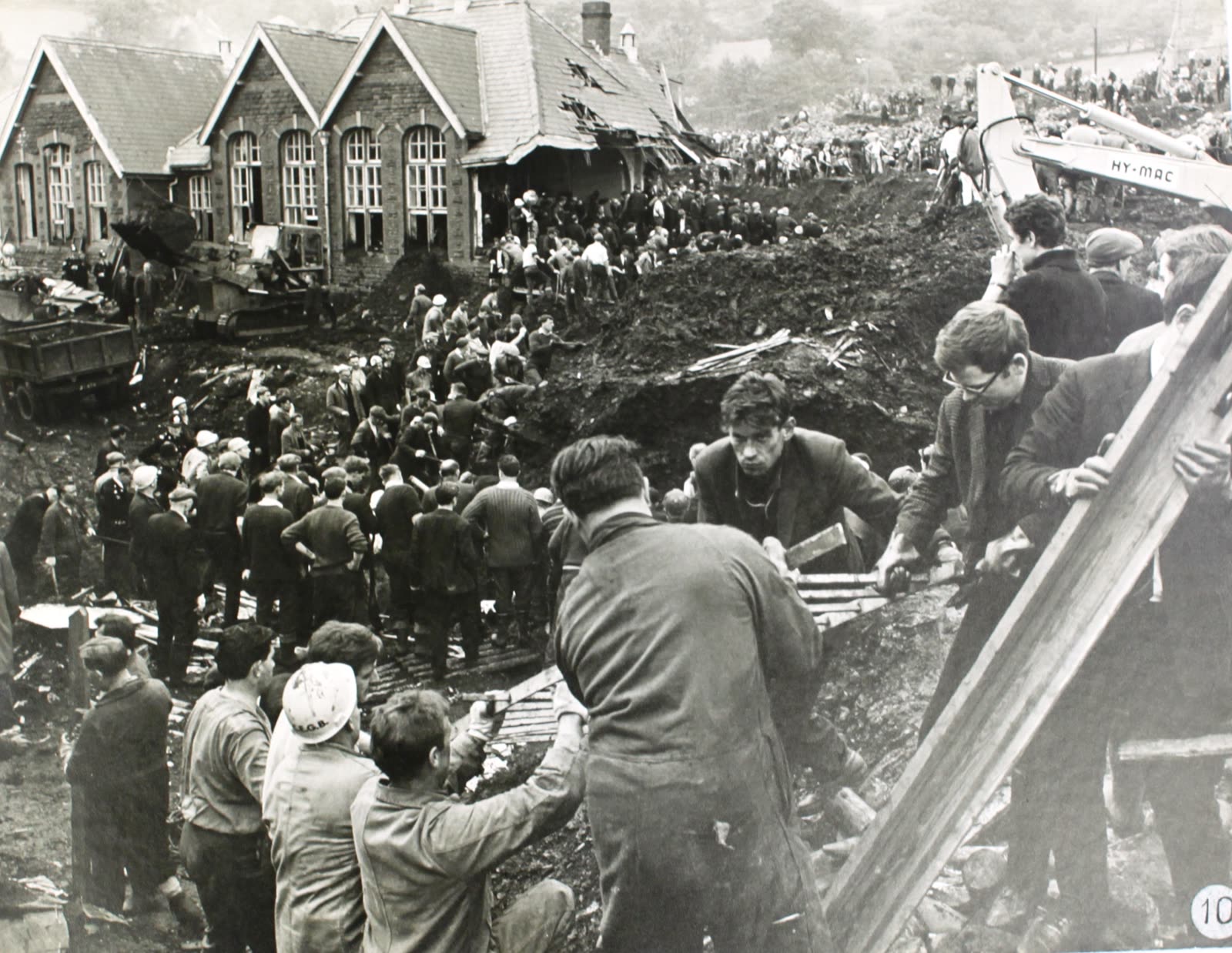
The Aberfan disaster is sometimes flattened into a sentence about a coal-tip landslide after heavy rain. That sentence is not false, but it makes the event sound too natural. The sharper history is mechanical and administrative. On 21 October 1966, a spoil tip above a South Wales mining village moved downhill, liquefied, struck houses and Pantglas Junior School, and killed 144 people, including 116 children.[1][2][3] Rain helped trigger the movement. It did not explain why a known mass of colliery waste had been built where water could destabilize it above a school.
The mechanism matters because Aberfan was not an unknowable mountain accident. It was a disaster made by the interaction of four things: accumulated spoil, underground water, weak tip control, and a broken warning chain. If any one of those had been treated with engineering seriousness, the morning might still have been wet and frightening. It need not have become a village-scale catastrophe.
The Short Chain
- 1916 onward: the Merthyr Vale Colliery ran out of valley-floor tipping space, and seven tips were eventually built on the hillside above Aberfan.[2]
- Easter 1958: Tip No. 7 began; by 1966 it was the only active tip at the site.[2]
- Before 7:00 a.m., 21 October 1966: Tip No. 7 started to move.[2]
- Around 9:00 a.m.: on the final day of term at Pantglas Junior School, the destabilized spoil moved into the village below.[3]
- 9:15 a.m.: British Geological Survey places the final runout on Aberfan Road after the slide had destroyed houses, Pantglas Junior School, and part of the neighboring secondary school.[2]
- After 11:00 a.m.: no more survivors were found.[2][3]
- 1967: the tribunal report was debated in Parliament, with its first finding summarized in Hansard as: "Blame for the disaster rests upon the National Coal Board."[4]
Spoil Became an Engineering Structure Without Being Treated Like One
The first failure was conceptual. A colliery spoil tip can look like waste, but once enough material is placed on a hillside above people, it becomes an engineered structure whether anyone calls it that or not. British Geological Survey records that the seven Aberfan tips contained about 2.1 million cubic metres of colliery spoil.[2] That is not a background feature. It is a landscape remade by industrial storage.
Tip No. 7 was the active one in 1966.[2] The National Library of Wales describes it as beginning to move a little after 9 a.m.; BGS gives the more technical sequence, saying it had started to move before 7 a.m. and later avalanched into the village.[1][2] The time gap is important. Catastrophe did not begin only when the school was hit. It began when the tip's internal condition and the saturated ground under it had already crossed into movement.
The later policy lesson was stated plainly in Parliament. The tribunal's recommendations, as summarized by the Secretary of State for Wales in the 1967 debate, treated tips as potentially dangerous and argued that they should be handled as engineering structures, with the site investigation and control customary in civil engineering.[4] That recommendation is the retrospective key to Aberfan. The danger was not simply that too much spoil existed. It was that the system that placed it did not act as though placement, drainage, inspection, and failure mode belonged to one discipline.
Water Changed the Material
The second failure was hydraulic. Loose spoil on a slope is already a risk; loose spoil interacting with water is a different material. The National Library of Wales account says Tip No. 7 collapsed after destabilization from an underground spring and liquefied as it slipped into the village.[3] BGS describes the outcome in more physical terms: 107,000 cubic metres of black slurry struck the disused canal, fractured a water main, leapt the old railway embankment, destroyed 18 houses, and entered the school complex before coming to rest.[2]
That sequence is the core mechanism. Water did not merely lubricate a surface. It helped turn stored industrial waste into a fast-moving slurry, then added further water when the slide broke the main.[2] The disaster therefore moved through transitions: spoil heap, moving mass, liquefied flow, impact wave, rescue morass. Each transition made ordinary response harder.
This is why the word "landslide" is useful but incomplete. A landslide can be imagined as earth moving downhill. Aberfan was spoil, water, infrastructure, and village fabric colliding in one narrow runout path. The fact that the last child brought alive from the debris emerged at 11:00 a.m. shows how short the rescue window became once the material settled.[2][3]
Warnings Had Nowhere Effective To Land
The third failure was institutional. Aberfan had local anxiety before 1966. Hansard's debate over the tribunal report records complaints about Tip No. 7 and notes that Merthyr Corporation correspondence in 1963 referred to danger from coal slurry near the Pantglas schools.[4] The political argument after the disaster was not simply whether anyone had ever noticed risk. It was whether concern could compel action from the authority that controlled the tip.
That distinction matters. A warning is not a safety system unless it can change behavior. Local people and municipal officials could complain, but the National Coal Board owned the relevant industrial apparatus and held the technical authority.[4] The 1967 parliamentary debate repeatedly returns to communication, responsibility, and false reassurance because Aberfan exposed a governance gap: those closest to the hazard did not have the same power as those managing it.
The tribunal process itself shows how large that gap had become. Parliament was told that written statements were taken from about 250 witnesses, that 136 also gave oral evidence, and that the tribunal sat publicly for 77 days.[4] Those numbers do not prove the conclusion by themselves, but they show the scale of reconstruction required after the fact. The system had to spend months rebuilding, in public, a risk chain that should have been legible before the tip failed.
The Disaster Continued After The Slide Stopped
Aberfan's causal mechanism did not end when the material came to rest. The village then entered a second phase: rescue, grief, investigation, and the politics of making remaining tips safe. The National Library of Wales digital exhibition emphasizes the massive rescue effort by the local community and by people across Wales, while also noting the brutal limit: many were saved, but no survivors were found after 11 a.m.[3] Hansard's opening account likewise describes rescuers pouring into Aberfan from South Wales and beyond, but says no one was taken out alive later than two hours after the first movement of the tip.[4]
The aftermath also changed the state. Parliament recorded inspections of tips after the disaster, potential instability found elsewhere, derelict-land work, changes inside the National Coal Board, and planned legislation to strengthen mine and quarry tip oversight.[4] These measures matter because they reveal what Aberfan had exposed: tip safety was not a local housekeeping problem. It required legal authority, technical competence, drainage knowledge, inspections, and a route for local authorities to act when they feared danger.[4]
The most useful historical reading therefore avoids two simplifications. Aberfan was not an act of weather, as if rain alone chose the school. It was also not only a morality play about one bad morning. It was a systems failure in which an industrial landscape had been normalized until its stored risk became invisible to the institution responsible for it and painfully visible to the people beneath it.
What Aberfan Still Explains
Aberfan remains hard to write about because the losses were so intimate: classrooms, teachers, children on the last morning before half term. But the mechanism should not be softened. The tragedy became possible because spoil was placed above a village, water behavior was underestimated, warnings did not become control, and accountability arrived after the slide rather than before it.[1][2][3][4]
That is why the photograph of rescue workers at Pantglas is more than an image of aftermath.[5] It shows the point where every prior abstraction became physical: tip policy became slurry, drainage became rubble, organizational communication became a desperate search by hand. The lesson is not that every slope is dangerous or that every industrial landscape is doomed. The lesson is narrower and more demanding: when waste storage, water, and settlement meet, the burden of proof belongs on the institution creating the hazard, not on the community living below it.
Sources
- National Library of Wales, "Aberfan disaster" - learning resource background on Tip 7, liquefied spoil, the school impact, deaths, and community response.
- British Geological Survey, "The Aberfan disaster, 1966" - landslide case study with tip history, volumes, movement timing, runout path, damaged structures, rescue window, and casualty figures.
- National Library of Wales, "Aberfan Disaster 1966" - digital exhibition background on the underground spring, Tip No. 7, Pantglas Junior School, rescue effort, and archive project.
- UK Parliament, Hansard, "Aberfan Disaster" debate, 26 October 1967 - parliamentary debate on the tribunal report, findings, recommendations, inspections, and proposed safety reforms.
- People's Collection Wales, "Rescue workers following the Aberfan disaster, 1966" - source page for the archival photograph used as this article's image.