Clara Barton usually enters American memory in motion: a supply wagon near the front, a battlefield hospital, a bundle of bandages under fire, and later the founding of the American Red Cross.[1] That version is true, but it leaves out the chapter that best explains her unusual force as an organizer. Between 1865 and 1868, Barton ran the Missing Soldiers Office from rooms in her Washington boardinghouse and built a working answer to one of the Civil War's cruelest bureaucratic facts: tens of thousands of families did not know whether husbands, sons, or brothers were dead, buried, imprisoned, recovered, or simply gone.[1][3]
The sharper historical importance of Barton lies in what she did with that problem. She did not solve it by sentiment, and she did not solve it by one heroic field trip. She solved it by building a paper system. Letters came in by the thousands. Names were copied, standardized, grouped by regiment and state, pushed into printed rolls, compared against prison and burial records, and then sent back out into the country as answers or as requests for more information.[1][3] In that sense the Missing Soldiers Office was not an afterthought to her war work. It was her bridge from battlefield relief to modern humanitarian administration.
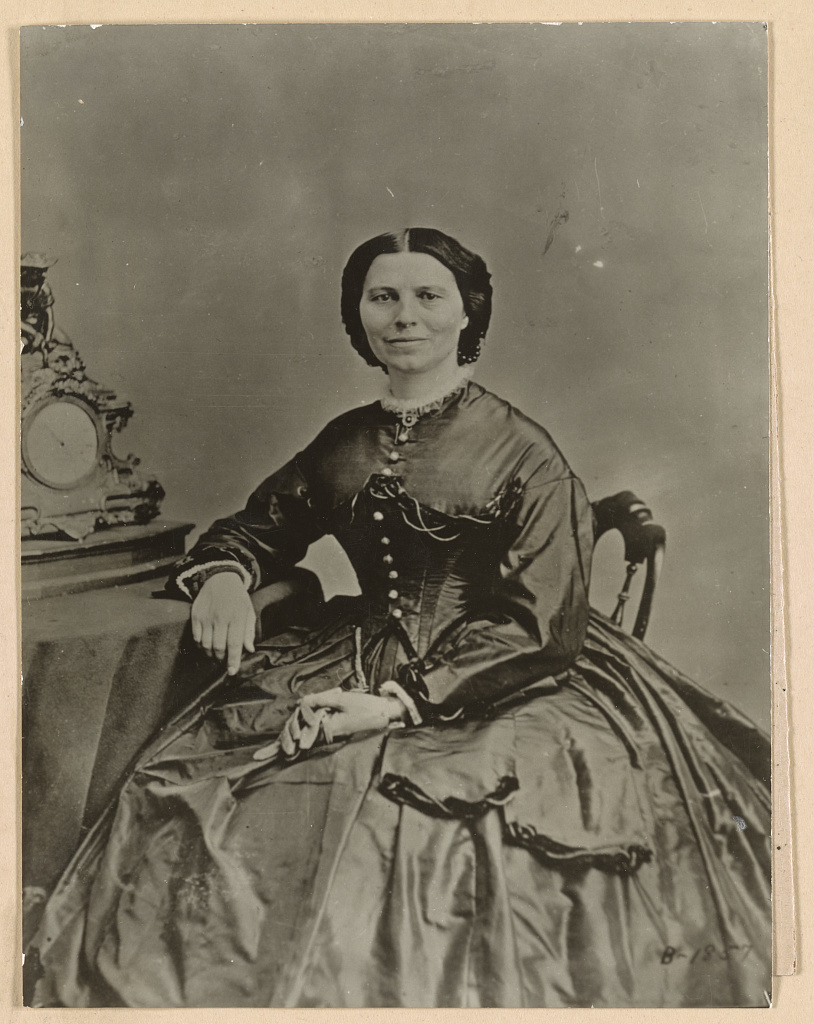
The lead image shows Barton seated in a nineteenth-century portrait.[5] It belongs with this story because the office on Seventh Street depended on a quality portraits often hide: clerical endurance. The famous battlefield nurse became, for several intense postwar years, a manager of grief moving through envelopes, broadsides, and ledgers.
Timeline anchors
- March 1865: with presidential approval, Barton opened what became the Missing Soldiers Office and began the work from Washington that would continue into 1868.[3]
- June 1, 1865: the first printed "Roll of Missing Men" was issued; VA history says it carried 1,533 names and was reproduced widely.[1]
- In June-August 1865, Barton joined the Andersonville expedition with Dorence Atwater's records, helping notify families of the dead while graves were marked.[1][2]
- In 1866, Congress reimbursed Barton with $15,000, allowing the office to continue after her personal funds had been exhausted.[1][3]
- By the end of the office's main run in 1868, VA history says Barton and her clerks had received more than 63,000 inquiries, answered over 41,000, and helped locate more than 22,000 missing soldiers.[1]
These dates matter because they keep the office from dissolving into a vague story of kindness. The operation had a start date, a print workflow, a financing crisis, and a final statistical report. Barton built something closer to a temporary information bureau than to a purely private charity.
Before the office: the war had produced absence faster than the state could name it
The Civil War generated missing men at a scale older administrative habits could not absorb. Record-keeping was inconsistent, prison exchanges were chaotic, and without modern identification practices many dead soldiers could be buried before their names moved cleanly through official channels.[1][3] By early 1865, when exchanged prisoners began arriving at Camp Parole near Annapolis in terrible condition, Barton saw the problem in its rawest form. Men who survived could name comrades who had not returned; families who wrote northward or to Washington often knew only that a letter had stopped coming.[1]
That gap between battlefield event and family knowledge is the real subject of this microhistory. Barton matters because she understood that the missing were not only an emotional category. They were an information failure. If the state could not tell a mother or wife what had happened, then the war remained unfinished in thousands of parlors and county offices. Her response was to seek presidential approval for an office that could correspond on behalf of the missing, and in March 1865 she got it.[3]
The office that followed was built on a practical instinct that runs through Barton's life. She took the best source available, even if it was imperfect. At Annapolis that meant questioning returned prisoners because the official records were too incomplete to stand on their own.[1] On Seventh Street it meant combining personal contacts, army channels, prison registers, and public appeals instead of waiting for one clean master list that did not exist.[1][3]
Andersonville changed the scale of the search
The most famous turning point came through Dorence Atwater, the former Union prisoner who had secretly copied Andersonville burial records while working in the prison hospital.[1][2] His list did not eliminate uncertainty everywhere, but it gave Barton something rare in the postwar months: a documentary base dense enough to turn rumor into identification. According to VA history, the first roll of missing men appeared on June 1, 1865, and later that summer Barton went with Atwater on the Army expedition to Andersonville.[1]
The historical importance of that journey is easy to exaggerate, and the National Park Service usefully narrows it. Barton did not personally do all the grave identification work that popular legend later credited to her.[2] What she did do was nearly as important. While laborers and soldiers marked graves, Barton worked through letters and records, wrote to families, and helped convert Atwater's knowledge into usable notification.[2] This is a better measure of her role anyway. Barton was strongest when she linked evidence to communication.
Andersonville therefore mattered less as a single dramatic pilgrimage than as proof that the office's methods could work at national scale. NPS says that by the time the Missing Soldiers Office closed, Barton and her staff had identified more than 20,000 missing soldiers, including nearly 13,000 connected to Andersonville; VA history describes the Andersonville expedition as the moment when over 13,000 graves were formally recorded and tied back to grieving households.[1][2] Either way, the principle was the same. When records existed, however partial, Barton could move them into circulation and make them count.
Seventh Street: grief became workflow
The center of the story remains Barton’s boardinghouse office in Washington. NPS and VA history together make the mechanics plain enough. Barton ran the office from her boardinghouse, worked with a small staff, and faced a volume of correspondence large enough to require a system rather than occasional charitable replies.[1][3] That matters because it reveals what kind of operation this was. The office did not merely comfort correspondents. It triaged, copied, sorted, and answered them.
When a case could not be solved through direct correspondence, Barton escalated it into public print. VA history says the office issued five rolls containing more than 6,000 names; the broadsheets were posted in public places and often reprinted in newspapers, effectively turning the country itself into an auxiliary search network.[1] That move is the core of the article's argument. Barton transformed private grief into shared searchable information. One family’s uncertainty became a printed prompt that comrades, clerks, veterans, or local readers elsewhere might be able to resolve.[1]
The numerical scale in the surviving summaries makes the same point in harder form. Over four years the office received more than 63,000 inquiries, answered over 41,000, and helped identify more than 22,000 missing soldiers.[1][3] Those are not the numbers of an improvised side project. They describe a communications machine built out of rented rooms, paper stock, and labor that Barton initially financed herself.
Money, in fact, was one of the office's decisive constraints. After the Andersonville work, the operation nearly stalled because Barton had exhausted her own resources.[1][3] Only the 1866 congressional reimbursement of $15,000 allowed her to continue staffing the search.[1][3] That appropriation matters historically because it shows how her work hovered between personal initiative and state dependence. The office was born from Barton's drive, but it could not keep functioning at scale without public funds.
Why the answers mattered: closure, pensions, and the state's moral ledger
The Missing Soldiers Office did not usually produce happy reunions. VA history states the blunt truth: more often than not, Barton’s letters brought confirmation of death, not rescue.[1] Yet that bad news still had administrative force. Once a death and burial place were known, wives and dependent children could begin pension claims, and families could stop living inside the suspended grammar of "missing."[1] The office's work therefore belonged as much to governance as to compassion.
That is why Barton’s postwar achievement should not be reduced to benevolence. She helped create legibility where the wartime state had left confusion. The missing soldier was a painful emotional figure, but he was also a broken record in need of repair. Barton’s office repaired enough of those records to let thousands of families move from rumor to certificate, from waiting to mourning, and from uncertainty to a claim on the government that had sent the soldier to war.[1][3]
The office also marked a transition in Barton's own career. Once she had spent years turning casualty uncertainty into a manageable information problem, it makes sense that she would later be drawn toward the Red Cross model, where relief also depends on coordination, records, and organized response rather than goodwill alone.[1] The Missing Soldiers Office was not a detour before the "real" Clara Barton story. It was the administrative workshop in which the later humanitarian was made.
Why the room still matters
The legacy survives not only in Barton's reputation but in the building itself. GSA's account of the site's preservation records that Barton occupied the structure from 1861 to 1868, and that when the long-hidden spaces were rediscovered, surviving details included the original mail slot cut into her door for the flood of inquiries, along with papers, wallpaper, and office materials from her years there.[4] Those remnants matter because they return scale to something that can otherwise sound metaphorical. The letters were real enough to shape architecture.
That physical afterlife sharpens the final judgment on Barton. Her greatness did not come from standing outside bureaucracy. It came from making a humane bureaucracy where one did not yet exist. On Seventh Street she converted missing men into names, names into lists, and lists into answers strong enough to carry grief, pension claims, and historical memory. That is a less romantic image than the angel of the battlefield. It is also, in many ways, the more modern one.[1][3][4]
Sources
- U.S. Department of Veterans Affairs, "Clara Barton and the Missing Soldiers Office" - office timeline, printed rolls, congressional funding, identification totals, and pension implications.
- National Park Service, "Clara Barton and Andersonville" - Dorence Atwater, the 1865 Andersonville expedition, and the boundaries of Barton's role there.
- National Park Service, "Organization is Key" - Barton's Civil War logistics work, the creation of the Missing Soldiers Office, its March 1865-December 1868 run, and the scale of inquiries it handled.
- U.S. General Services Administration, "The Conservation of the Clara Barton Building" - the rediscovery and preservation of the Seventh Street office spaces and surviving physical evidence of the correspondence operation.
- Library of Congress, "(Clara Barton, three-quarter length portrait, seated, facing front)" - source page for the archival portrait used as the article image.