If you compress the Cuban Missile Crisis into one day, 27 October 1962 is the point where structure matters more than drama. The usual memory is emotional and cinematic: a U-2 is shot down, officials panic, a secret deal appears, catastrophe is somehow avoided. That memory is not wrong, but it is incomplete. The day is better understood as a sequence problem: several escalation tracks accelerated at once, while the available bargaining channels narrowed, and the White House had to produce a response that could be read differently by three audiences at the same time—Moscow, NATO allies, and the U.S. military chain of command.
What follows is an event reconstruction of that sequence. The value is not in retelling “thirteen days” in miniature; the value is identifying the mechanism that made de-escalation possible after conditions had already moved into what participants themselves treated as a near-war window.
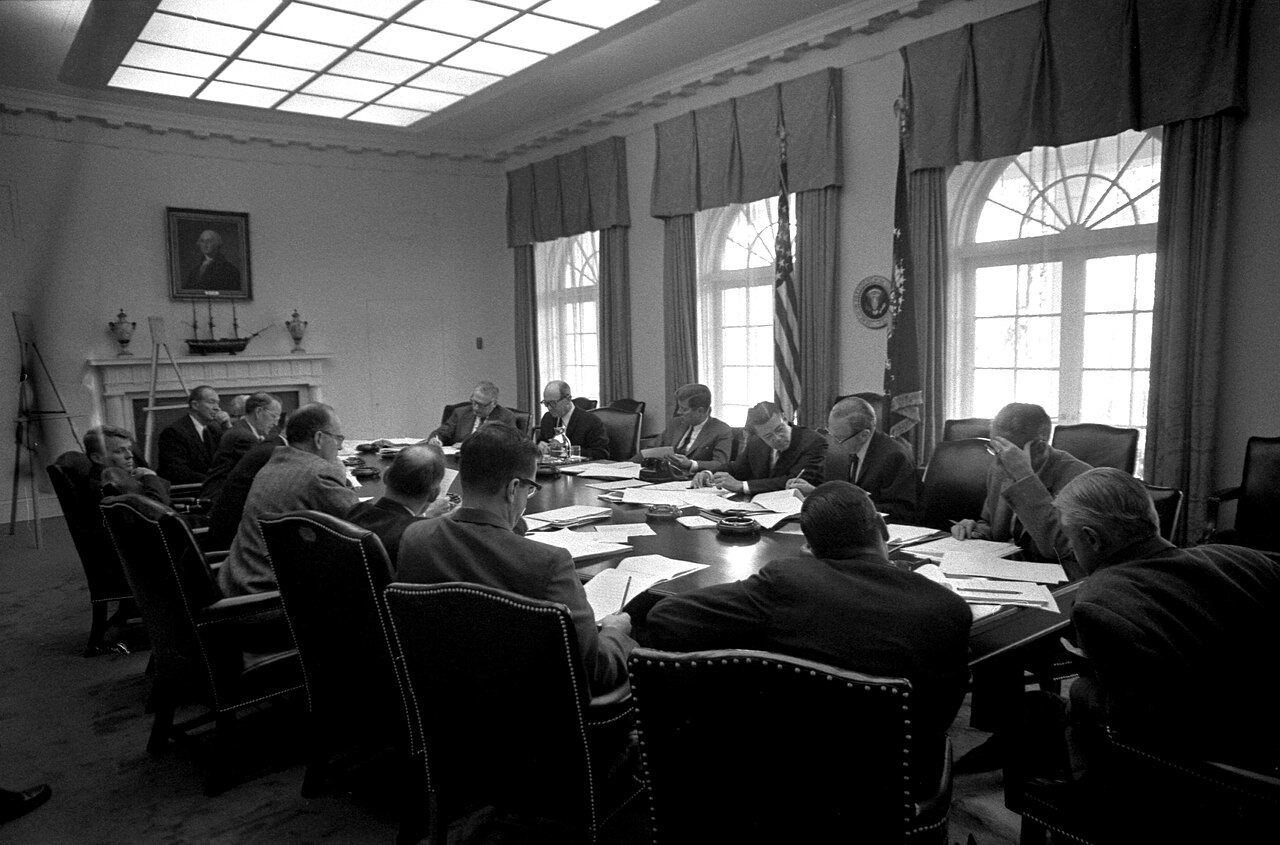
Image note: the cover photo shows an ExComm meeting on 29 October 1962, used as decision-room context for the 27 October reconstruction rather than as a same-hour visual record.
Timeline anchors: the day did not begin on a blank slate
Three earlier moves framed every decision made on 27 October:
- 22 October 1962: Kennedy publicly announced the quarantine and warned that a missile launch from Cuba would be treated as a Soviet attack on the United States.[1]
- 26 October 1962: Khrushchev sent a first, relatively conciliatory message centered on missile withdrawal in exchange for a U.S. non-invasion assurance.[2][3]
- Morning, 27 October 1962: A second message from Moscow demanded removal of U.S. Jupiter missiles in Turkey as part of settlement terms.[3][4]
By dawn on 27 October, Washington was no longer handling a single bargaining text. It was handling two Soviet messages with different political implications, under active military timelines.
10:00 a.m. ExComm: bargaining and force options were discussed in the same room
The seventh ExComm meeting on the morning of 27 October captures the core tension. Officials discussed quarantine operations and boarding plans, while also debating the Turkey missile issue and how to respond to the hardening Soviet public position.[4] The meeting record shows Kennedy and advisers confronting an immediate diplomatic dilemma: if they publicly accepted a Turkey-for-Cuba framing, alliance credibility could fracture; if they refused any Turkey channel, the bargaining lane with Moscow could close.
This was not a philosophical disagreement about prestige. It was an operational constraint. The U.S. had already mobilized coercive pressure through quarantine and reconnaissance. Any diplomatic text had to arrive fast enough to shape military tempo, but slowly enough to avoid signaling allied abandonment.
The same meeting record also matters for another reason: it reveals that Jupiter withdrawal was not an improvisation created after the U-2 shootdown. The issue was already being actively discussed before the afternoon crisis spike.[4]
Afternoon shock: two airborne incidents multiplied escalation risk
The eighth ExComm meeting at 4:00 p.m. reflects a sudden jump in uncertainty. One U-2 mission over Cuba was overdue and reports of ground fire were incoming; at roughly the same time, officials discussed a separate accidental U-2 overflight into Soviet airspace near Wrangel Island after navigational error.[5] In one meeting frame, Washington had to process:
- A possible hostile kill over Cuba,
- An accidental penetration over the Soviet Far East,
- Ongoing pressure to keep reconnaissance flights active.
This is the least appreciated part of Black Saturday: escalation was no longer one-directional. It was not just U.S.-Cuba theater risk. It became simultaneous Caribbean and Arctic signaling risk, with each side capable of reading events as intentional provocation.
The public memory usually foregrounds Major Rudolf Anderson’s death over Cuba, and rightly so.[3] But from a control perspective, the accidental Arctic overflight was almost as dangerous because it created the possibility of an unintended U.S.-Soviet aerial clash outside the main crisis theater.[5]
Military planning moved from “limited” language to invasion architecture
As the afternoon progressed, force options hardened. ExComm records document discussion of major strike planning, with references to large sortie packages and follow-on invasion logic.[5] By the 9:00 p.m. meeting, Kennedy approved calling up 24 air reserve squadrons, involving roughly 14,000 personnel and around 300 troop carriers—a concrete mobilization move tied to invasion contingency planning.[6]
Those numbers matter because they show that the U.S. was not merely speaking in deterrent abstractions. The machinery of war was being materially prepared while diplomacy continued. This dual-track pressure is often described as “brinkmanship,” but that word can hide the structural reality: mobilization itself creates bureaucratic momentum. Once reserve activation and shipping mobilization begin, the political cost of reversing course rises unless a credible settlement signal appears quickly.
In other words, Black Saturday was not dangerous because everyone lost control. It was dangerous because they still had partial control, but only briefly.
The letter problem: Washington chose which Soviet text to answer
The key diplomatic move that evening was selective response. Rather than negotiate publicly on the second, tougher Soviet message, the U.S. answered the earlier, softer line: missiles out of Cuba under verification in exchange for a non-invasion assurance.[3][7] That maneuver gave Washington a public framework it could defend without openly conceding a Turkey swap.
This often gets caricatured as “ignoring one letter.” It was more precise than that. The U.S. did not ignore the Turkey issue in substance; it displaced it into a different channel and a different publicity level.
The distinction between channel and substance is the mechanism here.
Backchannel compression: RFK–Dobrynin converted a public deadlock into a private bridge
The evening meeting between Robert Kennedy and Soviet Ambassador Anatoly Dobrynin is the hinge. U.S. and Soviet-era records, as assembled in later documentary work, indicate a structured understanding: the U.S. public position would remain focused on non-invasion for missile removal, while Jupiter withdrawal from Turkey would occur on a separate, non-public timetable.[8]
The point was not secrecy for its own sake. Secrecy solved two simultaneous veto risks:
- Alliance veto risk: a public quid pro quo could be read as sacrificing NATO positioning under pressure.
- Kremlin credibility risk: Moscow needed evidence that pressure had produced a strategic gain beyond words.
A purely public bargain risked collapsing one side’s domestic/alliance coalition. A purely private assurance without public diplomatic form risked collapsing trust on the other side. The hybrid arrangement, fragile as it was, cleared both thresholds just enough for acceptance on 28 October.[3][9]
Why 27 October did not end in war: mechanism, not miracle
A lot of commentary describes Black Saturday as luck plus restraint. Luck was certainly present. But the reconstruction suggests a tighter causal chain:
- Pressure stayed real (quarantine, reconnaissance, reserve activation), so diplomatic signals were costly and therefore credible.[4][5][6]
- Public and private channels were separated, allowing each side to preserve different political narratives while moving toward compatible outcomes.[7][8]
- Decision-makers prioritized sequence over purity: they accepted an asymmetric information structure (public non-invasion terms, private Turkey timing) rather than insisting on one fully transparent grand bargain.[8][9]
This is not an argument that escalation was planned or smoothly managed. It is an argument that de-escalation required institutional design under time pressure: text choice, channel choice, and ordering choice.
What the reconstruction changes in practice
If you read Black Saturday only as a morality tale (“leaders stepped back from the abyss”), you miss the operating lesson. The day demonstrates that near-war environments are rarely resolved by one dramatic concession. They are resolved when decision-makers can construct a settlement whose components are legible to different stakeholders at different visibility levels, before mobilization timetables outrun diplomacy.
That logic also explains why this episode remains difficult to summarize in one sentence. The settlement was simultaneously public and deniable, immediate and deferred, coercive and conciliatory. None of those pairs is elegant. All of them were necessary.
By the morning of 28 October, Radio Moscow announced acceptance of the core settlement path—Soviet missile withdrawal in exchange for U.S. non-invasion assurances, with the broader crisis de-escalating from that point.[9] The world usually remembers this as the moment nuclear war was avoided. The harder historical point is that the avoidance was assembled, step by step, in the previous evening’s narrow decision window.
Sources
- U.S. Department of State, Office of the Historian — “The Cuban Missile Crisis, October 1962”
- JFK Library Microsite — October 26, 1962 (daily crisis record)
- JFK Library Microsite — October 27, 1962 (daily crisis record)
- JFK Library Microsite — Summary Record of the Seventh ExComm Meeting (Oct 27, 10:00 a.m.)
- JFK Library Microsite — Summary Record of the Eighth ExComm Meeting (Oct 27, 4:00 p.m.)
- JFK Library Microsite — Summary Record of the Ninth ExComm Meeting (Oct 27, 9:00 p.m.)
- JFK Library Microsite — Translation of Khrushchev’s October 27 Letter
- National Security Archive — “Anatomy of a Controversy: Anatoly Dobrynin's Meeting with Robert F. Kennedy, Saturday, 27 October 1962”
- JFK Library Microsite — October 28, 1962 (settlement announcement and ExComm response)
- National Security Archive Electronic Briefing Book No. 75 — “U.S. and Soviet Naval Encounters During the Cuban Missile Crisis”
- Wikimedia Commons image source — “EXCOMM meeting, Cuban Missile Crisis, 29 October 1962”