The easiest way to flatten American immigration history is to speak about Ellis Island and Angel Island as if they were twin gateways with different coastlines. They were not. Both were federal inspection stations. Both subjected migrants to medical screening, legal questioning, and the possibility of exclusion. Yet they operated with different presumptions. At Ellis Island, the state was trying to move a mass queue through a sorting hall, and for most arrivals that process ended within hours.[1][2][3] At Angel Island, especially in the age of Chinese exclusion, the state was far more likely to treat the arriving migrant as a doubtful claim that had to be detained, cross-examined, and held apart from the mainland while officials decided whether the story of identity and entitlement would stand.[4][5][6]
That difference matters because it reveals that the United States did not build one immigration gate in the late nineteenth and early twentieth centuries. It built at least two operational models. Ellis Island became the best-known Atlantic machine for rapid inspection under mass migration, even though it could still separate families and refuse entry.[1] Angel Island became the Pacific station where race, exclusion law, and paperwork anxiety hardened inspection into confinement.[4][5][6] The stronger comparison is therefore not sentimental, and not simply geographic. It is administrative. One island mostly processed a line. The other was deliberately designed to hold a case.
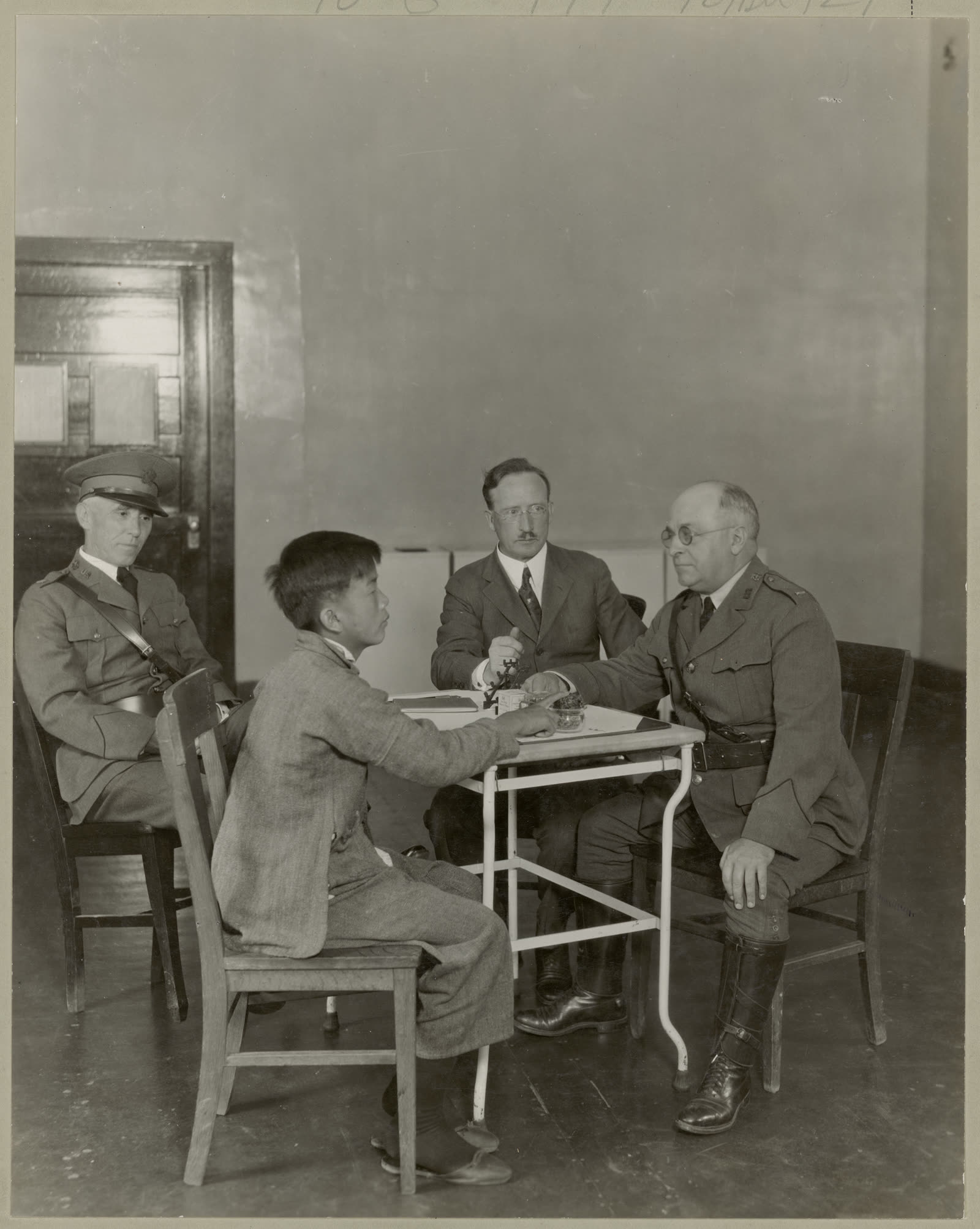
Image context: the cover uses a 1923 National Archives photograph of an immigration interview on Angel Island.[8] It fits this essay because the article is comparing regimes rather than scenery. A harbor view would make both islands look like romantic thresholds. This image shows the real hinge: admission as an act of questioning, record-checking, and unequal power.
Timeline anchors
- May 6, 1882: Congress passes the Chinese Exclusion Act, the first major federal immigration law to target a specific nationality and race, creating the legal atmosphere that later shaped Angel Island's logic.[4]
- January 1, 1892: Ellis Island opens as the federal immigration station in New York Harbor and eventually becomes the country's largest and most active processing center.[1]
- January 21, 1910: Angel Island Immigration Station opens in San Francisco Bay as the main Pacific inspection and detention site for many immigrants, especially those arriving from Asia.[5]
- 1924: Ellis Island's peak era as a mass-processing station effectively closes with the new restrictionist quota regime, even though the site remains in federal use afterward.[1]
- August to November 1940: a fire destroys Angel Island's administration building, remaining detainees are moved to mainland facilities, and the station closes that fall.[5][6]
These dates matter because they show the two islands sitting inside one national story but under different political clocks. Ellis Island belongs above all to the age of European mass migration. Angel Island belongs more sharply to the age of exclusion, suspicion, and exception.
Ellis Island was built to inspect quickly and admit in bulk
The National Park Service summary of Ellis Island gives the basic scale. From 1892 to 1924, more than 12 million immigrants were processed there, and the average inspection took about 3 to 7 hours.[1] That figure does not mean the island was easy or humane for everyone. Ellis could still become what the Park Service calls an "Island of Tears" for those denied entry, hospitalized, or separated from relatives.[1] But the number does tell us what the machinery was trying to do. It was not built around long detention as the normal outcome. It was built to move a very large flow of arrivals through medical and legal checks fast enough to keep the Atlantic gateway working.[1][2][3]
The internal procedure reinforces that point. On the legal side, immigrant inspectors worked from passenger manifests and questioned arrivals face to face from elevated desks in the Registry Room, checking whether the newcomer's answers matched the ship's records and whether the person fell into any barred class under federal law.[2] On the medical side, Public Health Service doctors performed the rapid "line inspection," scanning moving queues for signs of contagious disease, physical weakness, pregnancy, or mental disability; those who raised concern could be marked with chalk and pulled aside for more extensive examination.[3]
This was a severe system, but it was a system of triage under volume. The queue itself was the governing image. Ellis Island's architecture, especially the Registry Room, assumed that the state would see migrants first as a stream to be examined at speed and only secondarily as special cases requiring detention or appeal.[1][2][3] Even exclusion at Ellis often took the form of branching away from a main flow that was otherwise meant to continue.
Angel Island was designed to detain first and decide later
Angel Island operated under a different logic because the law behind it was different. The Chinese Exclusion Act of 1882 did more than block most Chinese labor immigration for ten years. It established the principle that federal immigration law could be organized around racialized suspicion, documentary proof, and the need to distinguish a narrow set of exempt categories from a much larger population that lawmakers wanted kept out.[4] By the time Angel Island opened in 1910, that legal inheritance had already reshaped Pacific enforcement.
The Angel Island Immigration Station Foundation states the design purpose bluntly: the station was built "to detain, rather than welcome, newcomers," and federal officials chose the island for its isolation so detainees could not easily escape or communicate with friends and relatives in San Francisco.[5] That sentence is the most important point in the comparison. Ellis Island and Angel Island both inspected. Only one was intentionally sited and organized around the presumption that confinement itself was part of the screening method.[5][6]
The processing sequence on Angel Island makes the difference visible. According to AIISF, passengers were separated by race, gender, and class. European and first-class travelers were often processed aboard ship and allowed to disembark immediately, while Asian and Pacific Islander immigrants, particularly those traveling in steerage, were ferried to the island for invasive medical exams and interrogations.[5] The same page notes that under exclusion law only a few Chinese categories such as merchants, students, teachers, diplomats, clergy, and dependent children of U.S. citizens could legally enter, which made identity itself the battleground.[5]
That is why Angel Island became bound up with the history of the so-called paper sons. After the 1906 San Francisco earthquake and fire destroyed many records, some Chinese residents claimed children abroad and sold those identities to families trying to send sons or daughters to America.[5] At Angel Island, the consequence was an interrogation regime in which applicants had to memorize family histories, village layouts, and household details well enough to survive comparison with witnesses and paperwork.[5] Some waited weeks, others months, and some even years for a decision.[5] At that point the border was no longer a line moving through a hall. It was a sustained test of narrative consistency under confinement.
The two islands produced different emotional geographies
Architecture mattered because it taught migrants what the state thought they were. Ellis Island's central scene was the large hall, with lines, desks, and doctors moving quickly along a crowd.[1][2][3] Angel Island's defining spaces were the detention barracks, interrogation rooms, locked doors, and monitored communications.[5][6] The National Park Service description of Angel Island emphasizes that detainees lived in confined dormitories, could not leave without an escort, had their letters and packages inspected, and were denied visitors until their cases cleared.[6]
That setting produced a different historical archive. Ellis Island left behind manifests, inspection routines, and a public memory dominated by arrival photographs and the image of the Great Hall.[1][2] Angel Island left those things too, but it also left the extraordinary wall poems carved into the barracks by detainees. The NPS and California State Parks both treat those poems as a central surviving record of the station's prison-like character, and California State Parks notes that visitors can still see nearly 200 Chinese poems preserved in the barracks museum today.[6][7] The emotional geography of Angel Island was therefore not only bureaucratic. It was carceral enough to generate inscriptions of frustration, loneliness, resentment, and endurance directly on the building itself.[6][7]
This is also where the common shorthand starts to break down. Calling Angel Island simply the "Ellis Island of the West" hides the strongest evidence.[5][6] The phrase makes the two sites sound interchangeable, as though one were merely the Pacific branch office of the other. In practice they sorted people through different national anxieties. Ellis Island's central problem was how to process enormous volumes of European migration without stopping the port. Angel Island's central problem, as defined by exclusion law and Pacific politics, was how to keep undesirable entrants out while making the few legally admissible categories prove themselves in exhausting detail.[4][5][6]
The bounded comparison
This comparison needs one caution. Angel Island was not exclusively Chinese, and Ellis Island was not uniformly welcoming. AIISF notes that migrants from more than 80 countries passed through Angel Island's orbit, including people from Japan, India, the Philippines, Mexico, Russia, Australia, New Zealand, and, in the late 1930s, several hundred Jewish refugees reaching San Francisco through Asia.[5] Ellis Island, for its part, could still hospitalize, detain, and deport people who failed inspection or lacked the means to support themselves.[1][2][3]
Even with those boundaries, the larger historical contrast holds. Ellis Island and Angel Island reveal two different federal answers to the same basic question of admission. Ellis answered by building a fast Atlantic sorting machine that usually assumed clearance after inspection.[1][2][3] Angel answered by building an isolated detention regime shaped by exclusion, one that assumed many Pacific arrivals had to prove a right to land before they could even reach the mainland.[4][5][6] The United States did not merely receive immigrants at two famous islands. It taught different groups of migrants two different lessons about what the border was.
Sources
- U.S. National Park Service, "History & Culture - Ellis Island" - on the 1892-1924 peak era, more than 12 million processed immigrants, and the average 3-7 hour inspection window.
- U.S. National Park Service, "Immigrant Inspector" - on manifest-based legal inspection, inspector questioning, and barred classes at Ellis Island.
- U.S. National Park Service, "Doctor" - on Ellis Island's line inspection, chalk marks, and rapid medical screening procedures.
- National Archives, "Chinese Exclusion Act (1882)" - on the law's exclusionary structure, certificate requirements, and its place in federal immigration history.
- Angel Island Immigration Station Foundation, "History of Angel Island Immigration Station" - on the station's opening, isolation logic, race/class separation, paper-son interrogations, and long detention periods.
- U.S. National Park Service, "U.S. Immigration Station, Angel Island" - on prison-like detention conditions, monitored communications, poems in the barracks, and restoration/preservation history.
- California State Parks, "Visiting the Island" - on the surviving detention barracks museum and the preserved collection of nearly 200 Chinese poems.
- Wikimedia Commons / U.S. National Archives, "Immigration Interview on Angel Island" - source page for the 1923 archival photograph used as this article's image.