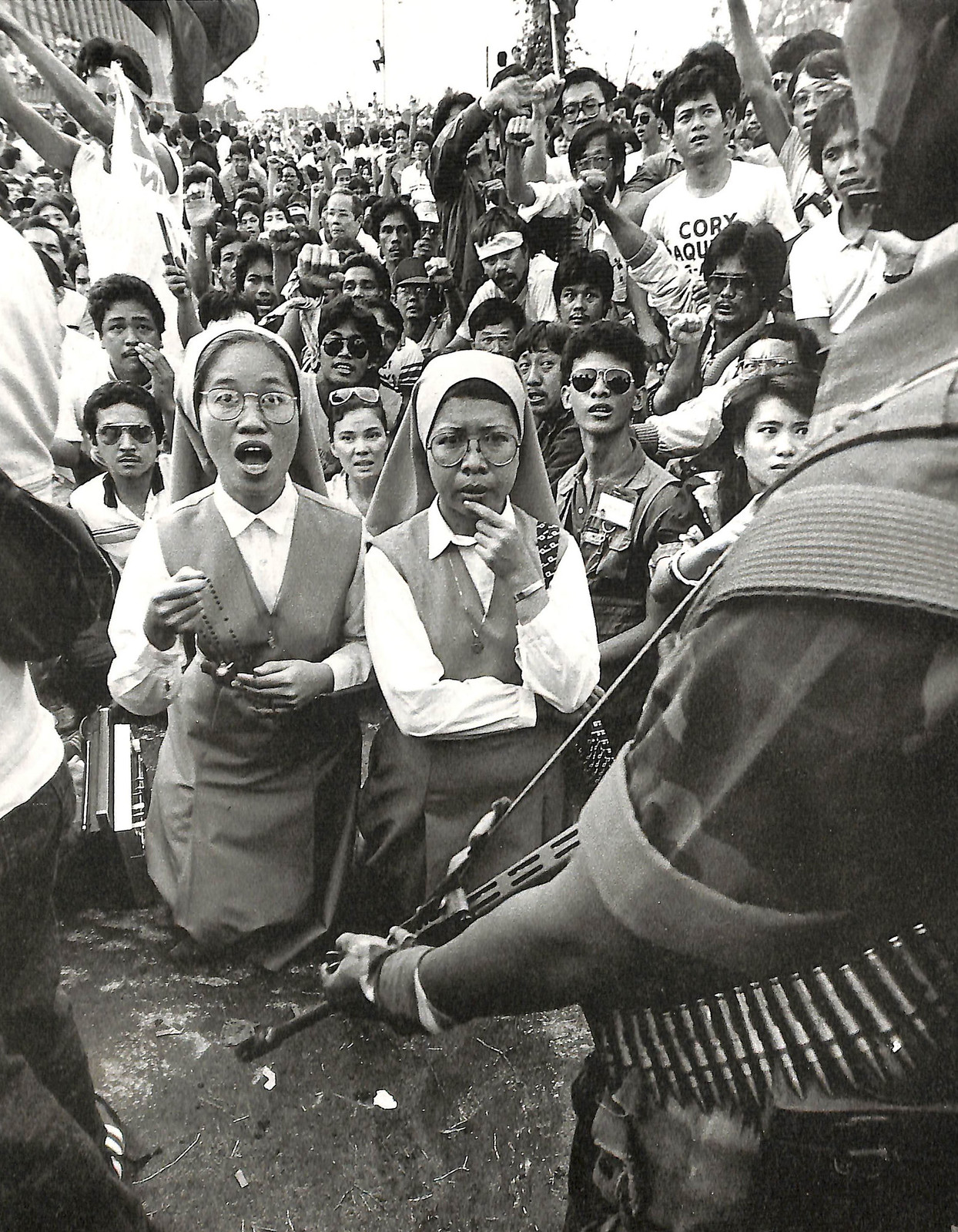
The soldier in Pete Reyes's photograph has a rifle, ammunition across his chest, and a crowd behind him. Two nuns kneel in front of him with almost nothing between their bodies and his weapon. Yet the picture does not show a private encounter. Faces pack the background; a reporter watches at close range; a camera is present. The confrontation on Epifanio de los Santos Avenue—EDSA—was powerful partly because force had acquired an audience.[5][6]
That audience did not appear from nowhere. Ferdinand Marcos had been president since 1965 and ruled under martial law from 1972 to 1981; repression and concentrated power continued after its formal lifting. The 1983 assassination of opposition leader Benigno “Ninoy” Aquino Jr. widened a movement already built by organizers, journalists, clergy, workers, students, and families of victims. When Marcos called a snap presidential election for February 7, 1986, the National Citizens' Movement for Free Elections mobilized more than 500,000 volunteers. Its parallel count challenged the official result that declared Marcos the winner over Corazon Aquino.[3]
On February 22, Defense Minister Juan Ponce Enrile and armed-forces vice chief Fidel Ramos withdrew their support from Marcos and gathered with a small rebel force in Camps Aguinaldo and Crame. Their break followed the collapse of a military plot; it was not itself a democratic transfer of power. Cardinal Jaime Sin then used Radio Veritas to ask civilians to protect the defectors. People moved onto the broad highway between and around the camps, bringing food, prayers, news, and their own bodies.[2][4]
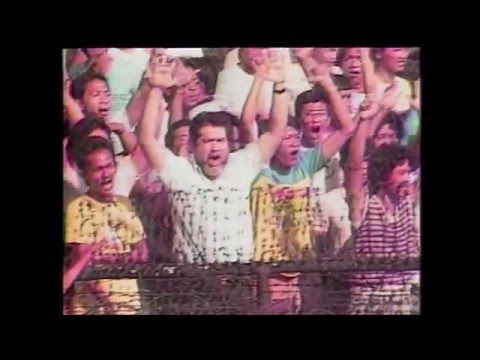
For four days, the road became more than a rally site. It was a protective corridor around an uncertain military defection, an information network, and a stage on which soldiers had to act under mass observation. The archival film below is valuable because it preserves that unstable mixture. It does not prove that unarmed people simply “defeated tanks.” It shows how a crowd changed the political and moral conditions in which orders could be carried out.
Provenance: Manila seen through an NHK news report
The 7-minute, 31-second video is an NHK report prepared for News Weekly on March 2, 1986, five days after Marcos left the Philippines. GovPH, the Philippine government's archival YouTube account, uploaded this copy on March 2, 2016 and credits NHK for the footage.[1] The upload gives no restoration, transfer, or editing history, so none should be assumed. It is a later government custody copy of a Japanese broadcaster's near-contemporary report, not raw film presented without mediation.
The narration and on-screen captions are in Japanese. English-speaking viewers can still follow the visual argument; the analysis here supplies context rather than pretending the words are transparent. The upload's high-resolution thumbnail is revealing: U.S. Secretary of State George Shultz stands before a White House emblem while Japanese text reports American recognition of the Aquino government. Before the viewer even presses play, the revolution has been framed as an international change of state. NHK's outside lens and GovPH's later republication are both part of what we are watching.[1]
Watch the scale of politics change
Across the report, authority appears in tight, recognizable images: a government spokesman at a lectern, political leaders, officers, a palace. The street footage works differently. It repeatedly widens the unit of action. People extend across the roadway and deep into the frame; vehicles that normally command traffic become fixed objects inside human space. A tank is still dangerous, but its driver no longer encounters an empty route. Every meter forward has become a decision involving civilians, witnesses, and other soldiers.[1]
Watch, too, for the work hidden inside the word crowd. The surviving photographic archive shows ropes used to keep groups together, sandbags and improvised barricades, people arriving with provisions, and civilians positioned kilometers from the camps.[6] Those details prevent the wide shots from dissolving into an anonymous mass. The occupation had duration because people supplied it, relayed information through it, and kept returning. Its density was made, not merely felt.
The film's cuts between officials and streets create a useful tension. Diplomatic recognition and elite defections mattered; so did decisions inside the armed forces. But the highway supplied a public arena in which those decisions became visible and difficult to reverse quietly. The crowd was neither scenery nor the only cause. It was an instrument that converted a fragile split at the top into a sustained national crisis.[1][4]
Radio made the corridor larger than the road
The UNESCO Memory of the World nomination for the Radio Broadcast of the Philippine People Power Revolution inventories a remarkably granular audio record. The tapes include the Enrile-Ramos press conference, Cardinal Sin's appeal, situational reports, phone patches, requests for food and medicine, warnings about troop and tank movements, announcements of military defections, and reports on the takeover of Channel 4.[2] Radio did not simply summon a finished “people.” It helped listeners decide where to go and what to do from hour to hour.
The network was also vulnerable. Radio Veritas signed off at 6:57 p.m. on February 23 after its transmitter was disabled. Broadcasters including June Keithley continued from a clandestine station soon known as Radyo Bandido, whose February 24–25 recordings form a large part of the preserved collection.[2] That handoff matters. A single famous appeal helped fill EDSA, but distributed reporting helped the occupation survive changing threats. Sound made the corridor extend into homes, churches, vehicles, and military posts beyond the camera's frame.
This is where the video archive has a productive blind spot. Film excels at showing proximity: civilians beside armor, soldiers surrounded by faces, streets that have ceased to function as ordinary streets. The radio archive preserves coordination that cannot be photographed. Put together, they show nonviolence not as passivity but as a sequence of practical acts—listening, moving, feeding, blocking, reporting, persuading, and refusing to leave.[1][2]
The photograph freezes a negotiation
Reyes's photograph of Sisters Porfiria Ocariza and Teresita Burias concentrates the street's altered power relation into one vertical frame. The soldier stands; the nuns kneel. His rifle points away from them, but his cartridges remain conspicuous. Their lowered position looks vulnerable, yet it also blocks the route. Behind all three, onlookers turn the encounter into a public test: what will an armed man do when the people in his path are praying, watching, and being photographed?[5][6]
It is tempting to make the nuns an emblem of innocence magically disarming violence. The wider record argues for something harder. Civilians built barricades; commanders issued and withdrew orders; units defected; broadcasters kept information moving. The photograph captures one negotiation inside that system, not a supernatural substitute for it. Its force comes from the unresolved second before coercion either advances or yields.
That distinction also protects the history from the label “bloodless revolution.” The four days at EDSA were overwhelmingly nonviolent, but they followed years of detention, torture, disappearances, political killing, and resistance. Calling the outcome a miracle can honor participants' faith; used alone, it can erase the organizing and danger that made the outcome possible.
Four days, and an unfinished legacy
On February 24, helicopter crews defected and the balance inside the armed forces shifted further. On February 25, Aquino took the presidential oath at Club Filipino while Marcos held a rival inauguration at Malacañang. Marcos and his family left the palace that night. A dictatorship ended, but not through one actor or one cinematic moment. Election monitors had made fraud harder to conceal; opposition networks had contested authoritarian rule; broadcasters coordinated movement; civilians protected a military rupture; and further defections made repression less executable.[2][3][4]
The sequence matters because its coalition was also its limit. The people on EDSA opened democratic space, but they did not dissolve entrenched wealth, military power, or every institution formed under dictatorship. Nor should the prominent roles of Enrile and Ramos turn the story into a rescue performed by generals. The archive is strongest when it keeps all of these forces in the same frame.
Forty years later, the NHK report and Reyes photograph remain useful precisely because they are partial. The film shows a revolution being translated for viewers abroad, beginning with recognition in Washington. The still photograph reduces thousands of negotiations to one soldier, two nuns, and a crowd. The radio tapes restore the invisible flow between those scenes. Together, they make a sharper claim than the familiar image of flowers conquering guns: EDSA worked when ordinary people made coercion public, logistically difficult, and politically uncertain—and sustained that condition long enough for choices elsewhere to change.[1][2][5]
Sources
- GovPH, “Footages from the 1986 EDSA People Power Revolution” — NHK's March 2, 1986 News Weekly report, republished on YouTube.
- UNESCO Memory of the World, “Radio Broadcast of the Philippine People Power Revolution” — nomination form and itemized inventory of Radio Veritas and Radyo Bandido recordings.
- National Democratic Institute, “Philippines—Embracing International and Citizen Election Observation in Defense of the People's Vote” — history of NAMFREL's 1986 volunteer operation and quick count.
- Gemma Nemenzo, “77 Hours: The Behind-the-Scenes at the 1986 EDSA People Power Revolution” — a sourced reconstruction of the four-day sequence.
- Cultural Center of the Philippines, Encyclopedia of Philippine Art, “Two Nuns of Edsa” — catalog record identifying the photographer and subjects.
- Presidential Museum and Library, “1986 EDSA People Power Revolution” — archival photograph album containing Reyes's image and the wider visual record.