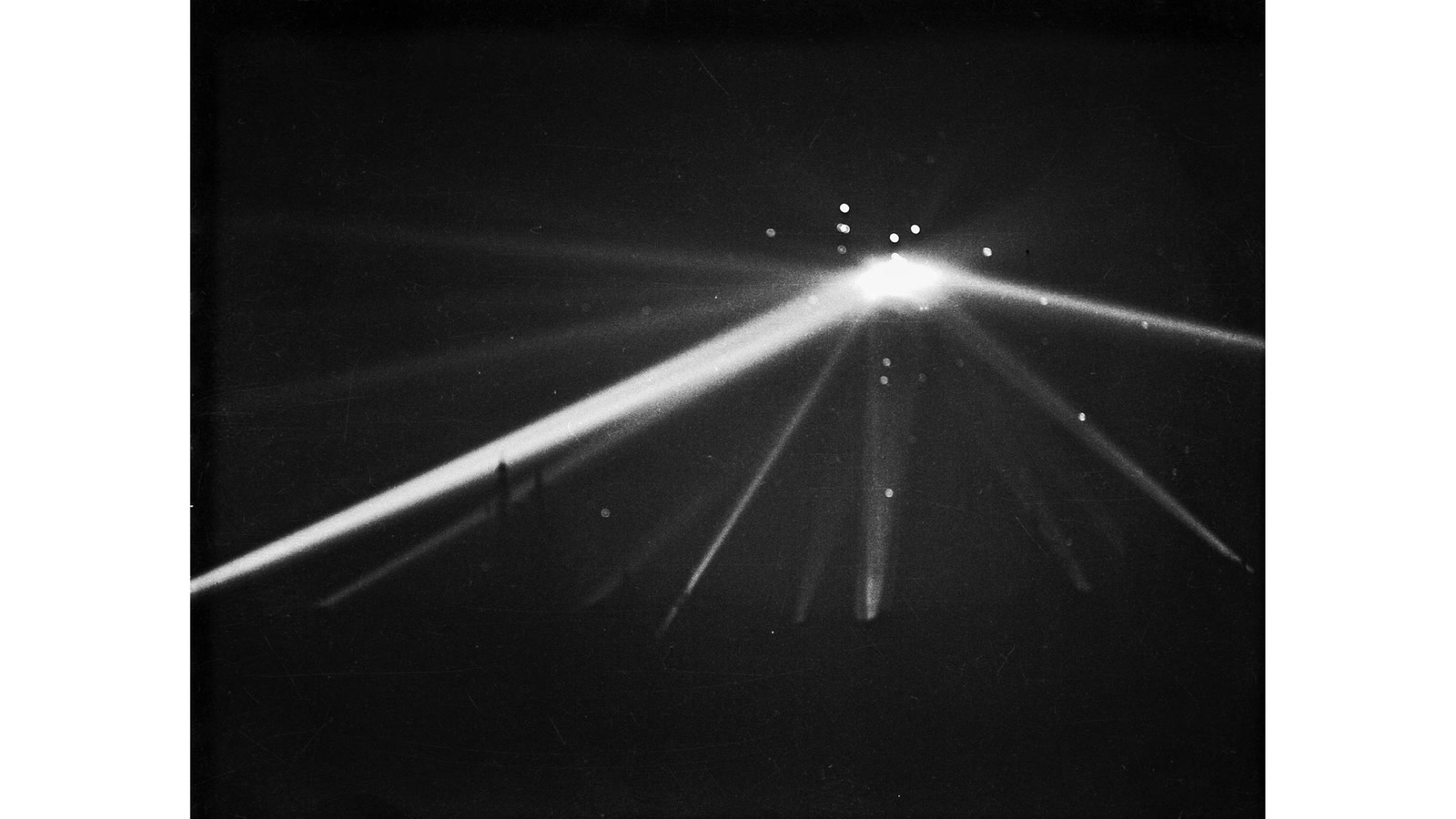
The photograph seems to contain an answer. Searchlights climb from several directions and meet in a white knot above Los Angeles. Bright points hang around the crossing beams. Once the eye finds the knot, it is hard not to turn glare into an object and convergence into proof that the gunners had found what they were seeking.
That is precisely what the picture cannot establish. The version used here is the unretouched scene presented by the Los Angeles Times, not the more dramatic print the newspaper published on February 26, 1942. It shows that searchlights converged while anti-aircraft fire marked the sky. It does not identify an aircraft inside the light.[4]
The same distinction governs the surviving written record. Something prompted alerts on the night of February 24–25, 1942. A balloon with a red flare was observed immediately before four batteries opened fire. Gun crews then reported targets that multiplied, changed speed, changed altitude, and vanished without dropping a bomb or leaving a wreck. The Navy called the episode a false alarm, while the Army publicly defended the possibility of aircraft. William A. Goss's 1948 Army Air Forces history favored meteorological balloons followed by misread shell bursts and smoke; the Army's 1964 account called the first target probably a meteorological balloon but retained the wartime conclusion of one to five unidentified planes.[1][2][3]
These are not three equally supported stories. The hostile-aircraft case explains why commanders were afraid, but it lacks the physical and operational traces an actual raid should have left. The balloon-and-feedback case explains both why firing began and why testimony became less coherent after it did. Its limit is important: it cannot identify every reported light or resolve the earlier radar return. The best historical conclusion is therefore a mechanism with a remainder, not a named craft with a complete itinerary.
The alert existed before the visible target
Los Angeles did not invent the possibility of attack out of nothing. Japan had struck Pearl Harbor on December 7, 1941. The U.S. official history of continental defense describes a West Coast system short of trained personnel, aircraft, guns, ammunition, and reliable radar coverage during the first months of war. Its defenders faced a real problem: a carrier force could approach through Pacific weather faster than the available patrol network could find and stop it.[1]
Then the threat came physically close. On February 23, 1942, the Japanese submarine I-17 surfaced near Santa Barbara and fired thirteen shells toward the Ellwood oil installations. The damage was slight, but the act demonstrated that an enemy vessel could reach the California coast. The following day, naval intelligence warned that another attack might occur within ten hours.[1][2]
The warning set a sequence in motion before the famous photograph was possible. An alert began at 7:18 p.m. on February 24 after reports of flares and blinking lights near defense plants; it was lifted at 10:23 p.m. At about 2 a.m., radar operators reported an unidentified target roughly 120 miles west of Los Angeles. Anti-aircraft batteries were alerted at 2:15 and put on Green Alert—ready to fire—a few minutes later; the regional controller ordered a blackout at 2:21. The offshore return was tracked toward the coast, then apparently disappeared. Reports from human observers nevertheless continued to pour into the information center.[2]
This chronology matters because “the target” was never one continuous object followed by every instrument and observer. The radar return, the later visual reports, the flare-bearing balloon, and the shapes inferred inside smoke were joined into a single raid after the fact. They may have shared a cause; the record does not demonstrate that they did.
At 3:06, firing began to manufacture evidence
At 3:06 a.m., observers saw a balloon carrying a red flare over Santa Monica. Four anti-aircraft batteries opened fire, and people watched the engagement along a broad stretch of coast. Sources give slightly different ammunition totals—about 1,400 in the Army history, 1,430 in a contemporary report, and 1,440 in the Air Force history—but agree on the scale: well over a thousand three-inch shells went into the night.[1][2][3]
The act of shooting changed the conditions of observation. Searchlights illuminated shell bursts. Explosions produced smoke that drifted through beams. Batteries looking into the same sky could interpret another unit's fire as confirmation that a target was present. Reports expanded from a small number of possible planes to “swarms,” with estimates ranging from one object to hundreds and with speeds ranging from very slow to more than 200 miles per hour. Some witnesses reported aircraft shot down, including one supposedly burning at a Hollywood intersection. No wreckage appeared.[2]
This is stronger evidence for a feedback loop than for a large formation. A real group of aircraft can be miscounted, especially at night, but it does not plausibly become both a nearly stationary balloon and hundreds of fast planes while dropping no bombs and suffering no confirmed losses under concentrated fire. By contrast, a noisy network of searchlights, bursts, smoke, overlapping batteries, telephone reports, and primed observers predicts exactly that kind of divergence.
The human cost was not imaginary. Later reconstructions by the Los Angeles Times and Smithsonian count five deaths associated with the alarm: three people killed in traffic crashes during the blackout and two who died of heart attacks. Falling fragments damaged buildings and vehicles; people hurrying to civil-defense posts were injured.[4][6] Calling the raid false does not make its consequences unreal. It identifies where the violence came from.
The two departments published incompatible skies
On February 25, Secretary of the Navy Frank Knox said his information showed a false alarm. The next day, Secretary of War Henry Stimson offered the public a very different account. A contemporary wire report printed by the Eugene Register-Guard said Stimson described as many as fifteen aircraft, neither Army nor Navy, flying at varied speeds and altitudes. He suggested commercial planes operated by enemy agents and said they might have been testing defenses or civilian morale. He also acknowledged that no bombs fell, no aircraft were shot down, and no U.S. fighters went up.[3]
The postwar Air Force history exposes even more movement inside the Army's position. It says the Fourth Air Force initially believed there had been no planes. A Western Defense Command message predicted that earlier reports would prove greatly exaggerated. After commanders examined witnesses, however, the local conclusion shifted to between one and five unidentified aircraft; Stimson then supplied possible origins for them. The public claim was not a stable result delivered by instruments. It was an institutional answer assembled while the services were already arguing over what their defenses had done.[2]
Each position carried institutional consequences. Knox's false-alarm verdict preserved the proposition that no enemy force had penetrated the coast, but it risked depicting the Army's barrage as incompetence. The Army's aircraft theory made the decision to fire appear more defensible, but created harder questions: where had the planes come from, why did they drop nothing, why were they not intercepted, and how did every one escape? Newspapers asked those questions immediately. The Register-Guard placed Knox's denial beside Stimson's claim on the same front page, preserving disagreement as part of the event rather than as a later mystery imposed upon it.[3]
The conflict should not be averaged into “maybe half a raid.” One account needs aircraft; the other needs mistaken perception. The evidence required by those claims is asymmetric. An aircraft theory should produce correlated tracks, recognizable silhouettes, mission records, bombs, damage from attack, wreckage, or a credible route away. A false-alarm theory needs only an initial ambiguous stimulus plus a system capable of amplifying it. The record contains the latter mechanism in detail.
Three readings, with unequal burdens of proof
Hostile aircraft from sea
The strongest version of the aircraft case is not Stimson's secret fleet of civilian planes. It is a small reconnaissance aircraft launched from I-17. The submarine was real, nearby, and capable of carrying a plane. The Army's official history allows that possibility, then says it was very unlikely such an aircraft flew inland over the coast. The postwar Japanese account reported no flight over Los Angeles that night.[1][2]
This reading has contextual plausibility but little event-specific support. The shelling at Ellwood proves Japanese reach, not a Los Angeles sortie. The offshore radar return is suggestive but cannot by itself establish type, nationality, or continuity with the later visual reports. Neither official history cites an attack or reconnaissance record connecting I-17 to the barrage. If a Japanese operational log or correlated track were found, the balance would change. In the record those histories present, possibility is doing most of the work.[1][2]
Aircraft operated by enemy agents
Stimson's public theory proposed ordinary aircraft flown from hidden fields in California or Mexico. It explained the absence of bombs by assigning the mission a psychological or reconnaissance purpose. It also moved the source of danger from an enemy platform offshore to suspected enemies within civilian society.[2][3]
The theory is weakest where it should be most testable. Fifteen commercial planes require pilots, fuel, airfields, departures, landings, and many witnesses on the ground. The official histories present no such chain. Varied eyewitness estimates cannot substitute for it. Without that material evidence, the proposal had the effect of preserving the rationality of a barrage after no attacking force could be found.[2][3]
A balloon followed by a feedback loop
The balloon case has three evidentiary advantages. Meteorological balloons were known to have been released over Los Angeles. A flare-bearing balloon was reported at the place and minute where firing began. Anti-aircraft units were later criticized for spending ammunition on targets moving too slowly to be planes. Once the barrage developed, the acting brigade commander revised his own first impression of fifteen aircraft and concluded he had been looking at smoke; experienced correspondents watching the sky could not identify a plane.[2]
That does not prove that the 2 a.m. radar return was the same balloon, nor does it turn every witness into a fool. It explains why competent people working under reasonable fear could produce bad collective knowledge. Their instruments and organizations were not merely recording a scene. After 3:06, they were adding light, smoke, noise, and authoritative expectation to it.
The balloon reading is therefore strongest when stated as a chain, not as a punchline: real threat context led to a high alert; an ambiguous radar return sustained it; a visible balloon precipitated fire; the barrage generated new ambiguous stimuli; reports from different positions validated one another; the Army–Navy dispute then helped preserve an aircraft hypothesis after the physical search found none. Removing any one link makes the episode harder to explain.[1][2]
The photograph shows why the archive can mislead
The best-known image of the battle acquired its evidentiary force in the newspaper darkroom. In 2011, Scott Harrison of the Los Angeles Times examined two negatives associated with the scene. One preserved the flat, soft, underexposed image before print retouching; the other copied a retouched print. The bright points around the convergence appeared in both, but artists had widened and lightened many beams and removed others so the photograph would reproduce clearly on newsprint.[4]
Retouching was ordinary newspaper practice, not proof that the event itself was fabricated. Yet the editorial work changed what later viewers thought the photograph could bear. Broader beams create a harder-edged enclosure around the white center. A reproduction choice made to improve legibility can make an unidentified patch of glare look more like a bounded thing.
The unretouched version is valuable because it returns uncertainty to the frame. It still shows an extraordinary material event: a blacked-out city sending light and explosive shells upward. It shows why observers looking along different beams could believe they shared a target. What it cannot do is supply distance, scale, motion, or a continuous outline for the brightness at the center. The photograph is evidence of coordinated looking. Treating it as an identification exceeds what a single exposure can record.
The empty sky was not socially empty
The debate over aircraft unfolded inside a campaign already directed at Japanese American residents. President Franklin D. Roosevelt signed Executive Order 9066 on February 19, 1942, six days before the barrage. The Navy had announced on February 14 that people of Japanese ancestry must leave Terminal Island, beside the Port of Los Angeles, by March 14; on February 24 it accelerated the deadline to February 27. According to the National Park Service's history, twenty Japanese Americans were arrested during the air-raid alarm for supposedly signaling invaders.[5]
The sequence prevents a careless causal claim. The Battle of Los Angeles did not cause Executive Order 9066, and the removal of Terminal Island had begun before the guns fired. The episode instead reveals how the same evidentiary habit operated at street level and in the sky: an anticipated enemy made ambiguous lights look like hostile signals, and suspicion triggered action before verification. No aircraft wreckage emerged. The National Park Service account records no verified signaling and notes that no U.S. resident of Japanese ancestry was convicted of serious wartime espionage or sabotage.[5]
That context also changes how Stimson's “enemy agents” theory should be read. It was not an abstract placeholder. In Los Angeles in February 1942, the category could attach to neighbors already being removed under military authority. An institutional explanation that made the gunfire look justified could enlarge danger for people who had no role in producing it.
What the record can actually support
The archive does not permit absolute closure. The early radar return remains unidentified. Witness testimony cannot be made perfectly consistent. The official histories were written by institutions with an interest in explaining their own performance, and the AAF history's balloon explanation is a retrospective synthesis rather than a recovered object tagged at the scene.[1][2]
But uncertainty has shape. The record strongly supports a flare-bearing balloon at the start of firing, observations degraded by the barrage itself, no confirmed hostile aircraft, no bombs, no enemy wreckage, and official claims that changed as the Army and Navy defended different institutional positions. It weakly supports a small enemy reconnaissance flight and does not substantiate the larger formations described during the shooting.
The “Battle of Los Angeles” endures because the noun battle promises an opponent. The evidence offers something more unsettling: an air-defense system could turn readiness into perception, perception into fire, and fire into apparent confirmation. Its gunners did not need to invent fear. They needed only to mistake the effects of their own response for proof that the feared event had arrived.
Sources
- Stetson Conn, Rose C. Engelman, and Byron Fairchild, Guarding the United States and Its Outposts, chapter IV, U.S. Army Center of Military History (1964) — West Coast defense limits, the I-17 shelling, alert sequence, ammunition total, and the Army–Navy split; archived academic mirror of the former Army CMH web edition.
- William A. Goss, “Air Defense of the Western Hemisphere,” in Wesley Frank Craven and James Lea Cate, eds., The Army Air Forces in World War II, vol. 1, pp. 277–286 (1948; Office of Air Force History reprint, 1983) — detailed official reconstruction of the radar track, balloon, reports, departmental disagreement, and postwar assessment; Museum of the City of San Francisco transcription.
- Eugene Register-Guard, home edition, February 26, 1942, p. 1 — contemporary wire report placing Stimson's aircraft claim, Knox's false-alarm statement, ammunition count, and unanswered operational questions in the same news cycle.
- Scott Harrison, “From the Archives: The 1942 Battle of L.A.,” Los Angeles Times (February 23, 2017) — casualty and damage reconstruction plus comparison of the unretouched archival photograph used here with the retouched newspaper print.
- National Park Service, “A Brief History of Japanese American Relocation During World War II” — Executive Order 9066, signaling arrests during the alarm, and the acceleration of the Terminal Island removal deadline.
- Lorraine Boissoneault, “The Great Los Angeles Air Raid Terrified Citizens—Even Though No Bombs Were Dropped,” Smithsonian (January 19, 2018) — secondary account of the barrage, casualty count, and official disagreement.