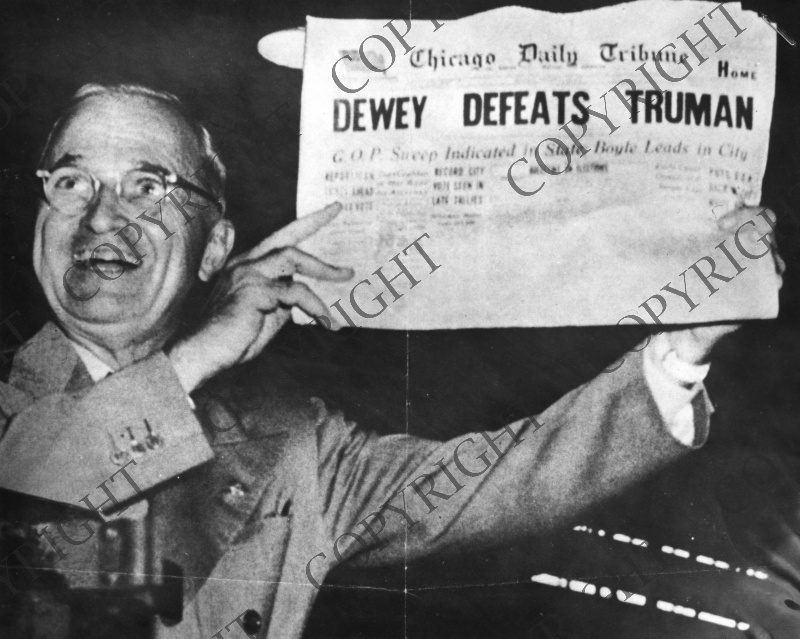
The photograph of Harry S. Truman grinning behind the Chicago Daily Tribune headline "Dewey Defeats Truman" has become the standard image for electoral embarrassment.[1][2][3] Read quickly, it seems to prove that the country, the press, and the pollsters had all settled the 1948 election before voters did.
That memory is too smooth. A sharper historical question is this: what does the photograph actually prove, and what has later memory added to it? The evidence points to a narrower, more useful answer. The image does not show that everyone knew Thomas E. Dewey would win. It shows a more specific chain of failure: one newspaper locked in an early edition before polls closed, Gallup issued a confident late forecast that Dewey would win by a substantial margin, and Truman's upset victory exposed how badly quota-based polling and premature closure could misread a live electorate.[1][3][4][5]
Image context: the lead image was taken on November 4, 1948, at Union Station in St. Louis, after Truman had already won. It fits this article because the photograph is not raw election-night evidence. It is a next-day act of historical framing, with Truman deliberately turning a mistaken headline into a trophy.[1]
Timeline anchors
- November 1, 1948: Gallup's press release predicts that Dewey will win the next day's election by a "substantial margin."[4]
- November 2, 1948: the Chicago Daily Tribune prints its "Dewey Defeats Truman" front page before any polls close; later reporting attributes the early deadline to a printers' strike.[3]
- November 3, 1948: the mistaken Tribune issue carries its printed date, preserving the error as a physical object now held in major collections.[2][3]
- November 4, 1948: Truman holds up the paper for photographers at Union Station in St. Louis, producing the image that will outlive most of the campaign itself.[1]
- After the election: pollsters and archives treat 1948 as a methodological break, because the result discredits quota sampling and pushes polling toward later fieldwork and more defensible sampling logic.[4][5]
Those dates matter because they break the myth into stages. The wrong headline came first. The famous photograph came after. Historical memory tends to fuse them into one instant of mass certainty, but the sources show a sequence.
The picture is famous because it simplifies a messy result
The Truman Library's photo record is unusually useful here because it strips the event down to the basics: Truman, the newspaper, Union Station, November 4, 1948.[1] The Smithsonian object page does the same from the artifact side, treating the newspaper itself as a museum object rather than a joke.[2] Together they show how much the image depends on compression. A long, contingent campaign gets reduced to one piece of paper and one victorious smile.
That compression is part of the afterlife of the event, not just its documentation. The photo makes the election look as if it were decided in one clean reversal: elites believed one thing, reality delivered another, Truman laughed last. But elections do not usually misfire so elegantly. By the time Truman lifted the paper, the mistaken headline had already become a prop. The photograph is therefore a record of political theater as much as a record of political error.[1][2]
This does not make the image false. It makes it selective. It preserves the moment when Truman converted someone else's certainty into his own public performance. What it leaves out is the infrastructure behind the certainty.
What the headline actually was: an early edition under deadline pressure
The most durable myth says the headline proves the press had already called the race in full. The evidence is narrower. Library of Congress reporting says the Tribune printed the front page "before any polls closed," and notes that, according to the paper's own later explanation, a printers' strike forced editors to go to press hours earlier than usual.[3] That matters because an early edition is not the same thing as a final omniscient verdict. It is a deadline artifact.
This is the first place where the photograph distorts the event. When readers see Truman holding the paper, they are looking at a frozen object. The object feels categorical. Yet the historical condition that produced it was logistical and time-bound: a newsroom had to lock type early, and it locked it around the most widely expected outcome.[3]
In that sense, the wrong headline belongs to the history of production schedules as much as to the history of punditry. It records not only confidence, but also the hazards of industrial newspaper timing. The error became immortal because Truman posed with it. Without the photograph, the headline would still matter. With the photograph, it became the whole story.
What the polls actually got wrong
The polling record is clearer, and more damning, than the newspaper story alone. The Truman Library's guide to the American Institute of Public Opinion records states that in a press release dated November 1, 1948, Gallup "confidently predicted" Dewey would win by a substantial margin.[4] After Truman won, the same archive notes, the institute investigated its procedures and Gallup later tried to explain what had gone wrong.[4]
That archival summary is important because it marks 1948 as more than a one-night embarrassment. It was a methodological rupture. A Roper Center chapter on polling history states the lesson bluntly: Truman's come-from-behind victory "discredited quota sampling" in the United States and underscored the need to continue polling as late as possible.[5]
Taken together, those sources move the story away from the lazy moral that "polls are useless." The stronger reading is more precise. Polls failed here because a specific way of constructing samples, combined with a campaign still moving late, produced too much confidence too soon.[4][5] That final clause is partly an inference from the sources rather than a single quoted statement: the archives establish the forecast, the post-election investigation, and the methodological lesson. The causal chain linking them is the historically responsible inference.
The result was an upset, but not a magic trick
The National Archives' official Electoral College page shows Truman winning 303 electoral votes to Dewey's 189, with 39 going to Strom Thurmond.[6] The Library of Congress summary adds the popular-vote scale and the state-level hinge: Truman carried California, Ohio, and Illinois, while Dewey won New York, Pennsylvania, and Michigan.[3] That is still an upset. It is also a structured political outcome, not a bolt from nowhere.
This matters because the photograph encourages a cartoon version of the result. The cartoon says elites floated above the country in total illusion, then reality struck them all at once. The evidence suggests something tighter. Dewey was widely expected to win. Gallup said so directly.[4] The Tribune committed that expectation to print too early.[3] But the final outcome still ran through real state coalitions, electoral arithmetic, and a campaign that did not stop moving just because many observers wished it had.[3][6]
That is why the image remains so seductive. It turns a complex democratic process into an almost comic before-and-after. Historians should resist that flattening, even while acknowledging why the image stuck.
Two interpretations of the photo's meaning
Interpretation A: the photograph proves elite arrogance
This reading emphasizes the visible humiliation. Gallup's confident forecast, the Tribune's giant headline, and the sheer durability of the image all seem to support a simple conclusion: the institutions that claimed to measure or interpret opinion had mistaken their own confidence for fact.[3][4]
This interpretation captures something real. The forecast was overconfident, and the headline was wrong. If one wants a visual shorthand for premature certainty, the photograph earns its fame.
Interpretation B: the photograph proves how prediction systems close uncertainty too early
This reading gives more weight to mechanism. The newspaper was an early edition shaped by strike-era production constraints.[3] The polling failure became historically important because it exposed the weaknesses of quota sampling and the danger of stopping too soon.[4][5] On this view, the image is less a morality tale about hubris than a case study in how institutions translate live uncertainty into fixed outputs before they should.
This interpretation is stronger because it explains more. It accounts for the headline, the poll failure, and the later methodological afterlife at the same time.[3][4][5]
Working assessment
The photograph endures because Interpretation A is emotionally irresistible. But the better historical reading is Interpretation B. The image is not best understood as proof that "everyone thought Dewey had it won." It is better understood as the afterimage of prediction systems that froze an unsettled electorate too early.[1][3][4][5]
Why the image still matters
The "Dewey Defeats Truman" photograph remains useful because it teaches a disciplined lesson about democratic knowledge. Institutions do not fail only by being biased or foolish. They also fail by closing the file before the event is actually over. In 1948, a newspaper edition, a polling method, and a public expectation all hardened too early. Truman's grin matters because it caught that hardening in retrospect and made it visible forever.[1][3][4][5]
That is a better lesson than simple mockery. The photograph does not tell us that elections are unknowable. It tells us that certainty has a production history. Once that is visible, the image becomes more interesting than the joke.
Sources
- Harry S. Truman Library & Museum, "Truman Displaying the Chicago Daily Tribune Headline 'Dewey Defeats Truman'" (photo record; Union Station, St. Louis, November 4, 1948).
- Smithsonian National Museum of American History, "Dewey Defeats Truman" (object record for the newspaper artifact).
- Library of Congress Blog, "Stop the Presses!" (on the early Tribune edition, the printers' strike explanation, and the 1948 result summary).
- Harry S. Truman Library & Museum, "American Institute of Public Opinion Records" (on Gallup's November 1, 1948 Dewey prediction and the post-election investigation).
- Humphrey Taylor, "Reading the Electorate: Internet-Based Polls Were Shown to Work," Public Perspective via the Roper Center (historical note on 1948 discrediting quota sampling and the need to poll later).
- U.S. National Archives, "1948 Electoral College Results."