Dazzle camouflage is easy to misremember because the word camouflage invites the wrong test. We expect hiding. We imagine a ship trying to disappear into sea and sky like an animal in reeds. Then the archival photographs seem almost absurd: huge black, white, and gray angles thrown across a hull, funnels, bridge, and bow. Nothing about them looks invisible.
That is the clue. World War I dazzle was not mainly a disappearing act. It was an aiming problem. From 1917 into 1918, when German submarines made merchant shipping and naval movement a crisis, British and American camouflage planners were trying to interfere with a U-boat commander's split-second estimate of course, speed, range, and heading.[2][3][4] A ship could not be made invisible on the open ocean for long. Smoke, wake, silhouette, light, weather, and movement betrayed it. But if paint could make the bow harder to read, the stern harder to locate, or the angle of travel less obvious through a periscope, a torpedo solution might be just wrong enough.
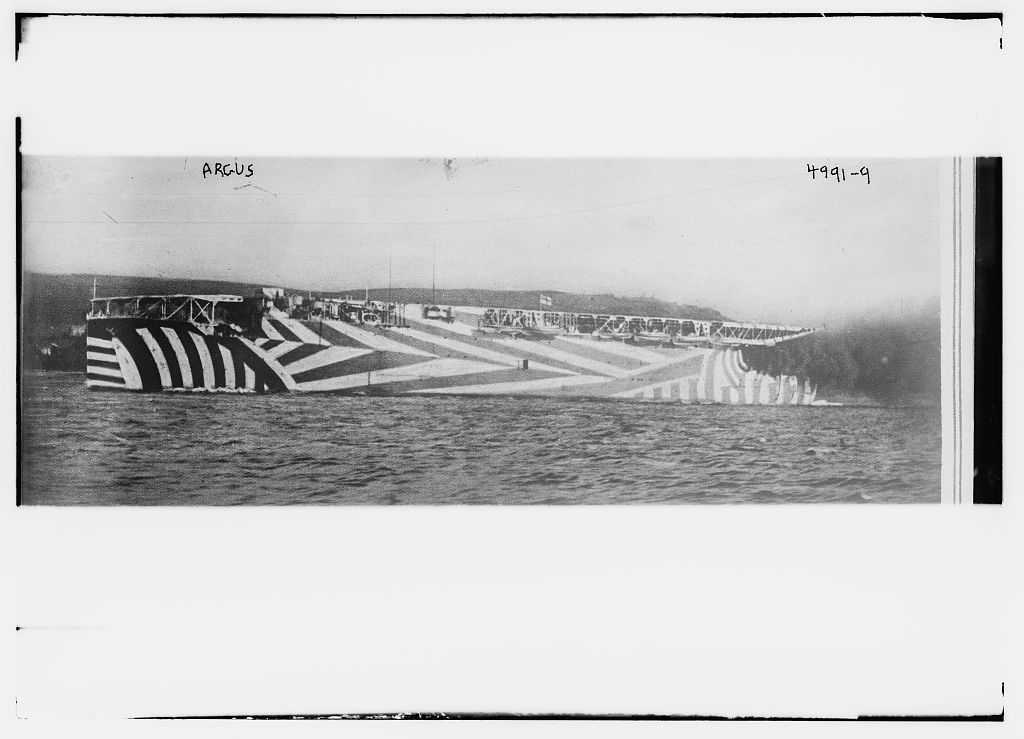
Image context: the cover photograph shows HMS Argus in dazzle paint, not because it is the most elegant pattern, but because it makes the historical point at a glance. A plainly visible ship has been turned into a confusing set of planes, strips, and false edges. Visibility remains; interpretation is attacked.[1][2]
Myth: Dazzle Was Supposed To Hide A Ship
The strongest evidence against the invisibility myth is visual. Dazzle ships were conspicuous. The Library of Congress blog's description of HMS Argus emphasizes a "swirling" and sharply graphic disguise rather than a naturalistic one.[2] The National Archives' discussion of British dazzle templates similarly frames the scheme as disruptive patterning: high-contrast geometry applied to hulls so the observer's reading of the vessel became less reliable.[3]
That was a practical response to ocean conditions. A cargo ship or warship could not be painted the color of every sea state, under every cloud bank, from every angle, while moving and producing smoke. Even if a color blend worked for a few minutes, a submarine attack depended on geometry. The attacker needed to know not only that a ship existed, but where it was going and how fast it would reach a future point.
So the better question is not "could the ship be seen?" It is "could the ship be solved?" The U-boat commander was not a gallery viewer. He was turning a moving sight picture into an attack calculation. Dazzle attacked that calculation by breaking up ordinary cues: bow wave, stern line, funnel alignment, apparent length, and the angle between the ship's course and the submarine's position.[2][3]
This is why the patterns look anti-camouflage to modern eyes. The paint was not trying to imitate water. It was trying to create false confidence or hesitation. A visible target could still become a poor target if its motion was misread.
Evidence: The Problem Was Torpedo Timing
Norman Wilkinson, the British marine artist usually credited with proposing dazzle, mattered because he translated a naval gunnery and submarine problem into a visual one.[2][3] His proposal arrived during the 1917 shipping crisis, when unrestricted submarine warfare had made the protection of merchant traffic a central Allied problem. The point was not simply to make ships artistic. It was to use visual design against a weapon that depended on prediction.
The National Archives' post on hand-painted British dazzle templates is especially useful because it shows the intermediate step between idea and ship. These were not random hull murals. They were templates: design documents that could be transferred, adapted, and recorded.[3] The existence of such patterns matters because dazzle was a system, not a mood. A ship's paint scheme had to fit a particular profile, be applied by workers, and survive enough operational use to be worth the labor.
The National WWI Museum and Memorial's teaching resource reduces the idea to its essential double move: the patterns used lines, shapes, and color either to blend with the ocean or to make a ship's exact location harder to pinpoint.[5] That summary is useful because it keeps the practical ambiguity in view. Dazzle did not live on a flat canvas. It had to work while a hull rolled, turned, smoked, and appeared briefly in a periscope's field.
The United States adopted the practice in March 1918, and the National Archives' essay on women in World War I camouflage places American dazzle work inside a larger naval Camouflage Section that included artists, draftsmen, model makers, and women who helped turn designs into usable ship plans.[4] That detail matters because the history is often told as one inventor's brilliant idea. The evidence points instead to a production chain: observation, pattern design, scale models, ship plans, paint application, and operational reporting.
Myth: The Paint Alone Won Or Failed
The hardest part of dazzle history is measurement. If a dazzle-painted ship survived, did the paint save it, or did convoy routing, weather, zigzagging, escort protection, submarine positioning, crew judgment, or luck do the work? If a painted ship sank, did the paint fail, or was the attack geometry already too favorable to overcome?
The National Archives' American camouflage essay gives numbers that are tempting but dangerous to overread: U.S. Navy camouflage work expanded rapidly, and records discussed ship losses among camouflaged and uncamouflaged vessels after the American adoption period.[4] Those figures are useful as administrative evidence that the program was large and tracked. They are weaker as a laboratory test. The ocean was not controlled. Ships did not sail identical routes under identical escort conditions for the sake of statistical purity.
That uncertainty should not be treated as embarrassment. It is the historical lesson. Dazzle was introduced into a changing anti-submarine system. By 1918, convoy practice, escort coordination, routing intelligence, hydrophones, mines, aircraft patrols, and enemy adaptation all affected survival. Paint was one layer in a moving defense. It could not be isolated cleanly from the rest of the system.
The best conclusion is therefore narrower than either fan or skeptic wants. Dazzle was plausible enough to be adopted at scale, visually and administratively serious enough to produce templates and models, and uncertain enough that its exact effect remains difficult to prove. It was not magic. It was not merely decoration. It was an attempt to buy error in a weapon system that punished accurate prediction.
Evidence: Artists Were Useful Because Perception Was Tactical
Dazzle also corrects a second myth: that art entered the war as a strange extra, separate from military rationality. In fact, the artistic skill was useful because perception itself had become tactical.
The Library of Congress and National Archives sources both show a world in which artists, designers, and naval officers overlapped.[2][3][4] Wilkinson's marine-art background mattered because he understood ships as seen objects: profiles, shadows, motion, and sea conditions. The American Camouflage Section needed people who could draft, model, test, and translate visual ideas into repeatable schemes.[4] That is not art floating above war. It is applied perception under pressure.
This does not mean dazzle should be romanticized. Its patterns may look modernist, and later viewers often connect them to Cubism or Vorticism, but the naval problem was not to stage an avant-garde exhibition. The problem was to make an enemy look once, decide quickly, and decide slightly wrong. The aesthetic shock was a byproduct of a practical premise: the eye does not simply receive a ship; it interprets one.
By late 1918, the archival trail already included hundreds of British design templates and a U.S. naval camouflage organization trying to turn visual judgment into repeatable ship work.[3][4] That scale makes the experiment historically significant even if the exact protective effect remains contested. The Allies were not only building ships and escorts. They were trying to redesign the moment of recognition.
What The Myth Gets Wrong
The invisibility myth survives because it is simpler than the real idea. "Camouflage hides things" is easy. "Camouflage can also distort the observer's estimate of an object's movement" is less memorable, but it is closer to the evidence.
The difference changes how the photographs read. HMS Argus does not look like a failed attempt to hide a ship. It looks like a successful attempt to make a ship visually argumentative. The hull refuses to present a clean answer. The bow and stern do not settle immediately. The superstructure and side paint compete for attention. A viewer can identify a vessel, but the vessel will not cooperate in becoming an easy diagram.
Dazzle's afterlife also makes more sense this way. Its fame does not rest only on whether any one submarine missed any one torpedo shot because of paint. It rests on a broader historical turn: modern war had made seeing into a technical contest. Rangefinders, periscopes, aerial cameras, smoke screens, convoy routing, and camouflage all treated perception as part of the battlefield. Dazzle was one bright, awkward, fascinating answer to that condition.
So the myth should be retired carefully. Dazzle camouflage did not make ships vanish. It tried to make them hard to aim at. That smaller claim is stronger, stranger, and more interesting. It turns the painted hull from a visual joke into a historical instrument: a ship made visible in order to make certainty harder.
Sources
- Library of Congress image service, "H.M.S. Argus, British Aircraft Carrier," Bain News Service photograph - direct archival JPEG used as the cover image.
- Library of Congress Picture This blog, "Caught Our Eyes: A Dazzling Disguise" - interpretive note on HMS Argus, World War I dazzle, and visibility versus confusion.
- U.S. National Archives, "Now You See Me, Now You Still See Me: Hand-Painted British Dazzle Camouflage Templates from WWI" - archival templates, Wilkinson context, and British dazzle design process.
- U.S. National Archives, "Hidden Women: The Art of WWI Camouflage Photos" - American naval camouflage organization, March 1918 adoption, personnel, and operational records.
- National WWI Museum and Memorial, "Razzle Dazzle: Dazzle Camouflage" - educational resource on Royal Navy dazzle camouflage and the visual confusion premise.