In September 1947, Richard Howard, provost of Coventry Cathedral, handed his counterpart in the German port of Kiel a cross small enough to hold up in one hand. Its three nails had once held timbers together in Coventry’s cathedral roof. Howard asked for something he could take home. A stone from the ruins of Kiel’s church of St Nikolai would do. He had a place in mind for it, by his own altar. [1][2]
A visitor looking at the nails in Kiel could learn what German bombers had done to an English church. Howard was asking worshippers in England to make room for a piece of a church that British bombs had helped bring down. For the exchange to work, each congregation had to let the other choose something it would see at home. [1][2]
Two crosses in the rubble
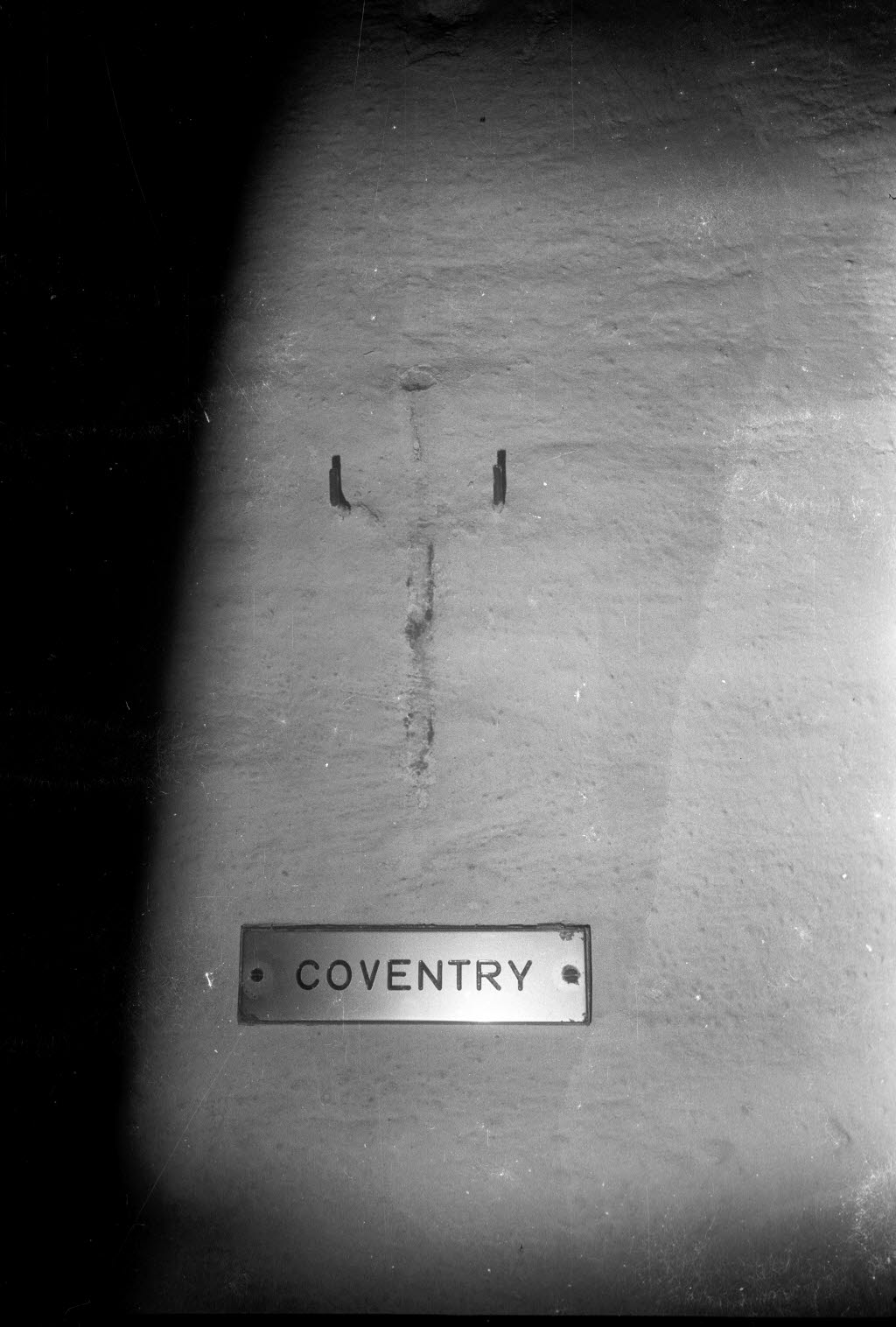
The Luftwaffe raid of 14 November 1940 burned the roof off St Michael’s Cathedral in Coventry. Among the things recovered were two charred beams that had fallen across each other. Bound together, they stood behind the altar in the ruins. A local priest, Arthur Wales, made a much smaller cross from three medieval roofing nails. Its size allowed for a different way of remembering the raid. Someone could make another cross from the same wreckage and carry it to a place whose people might never visit Coventry. The original nail cross is now at the high altar of Coventry’s new cathedral. [4][5]
Kiel had its own supply of rubble. The city housed naval shipyards and a German naval base, and Allied aircraft bombed it repeatedly. A raid on 22 May 1944 severely damaged St Nikolai. By the time Howard came, Kiel lay in the British occupation zone. A British clergyman could arrive as a guest, but the citizens who received him still lived under the authority of his country. That distinction gives some weight to the question of who first extended an invitation. [2]
The invitation from Kiel
Kiel’s mayor, Andreas Gayk, had proposed a Society of Friends of Coventry. On 2 April 1947, months before Howard’s visit, the society came into being. Its programme ran from the intimate to the ambitious. Members wanted people to exchange letters and visit one another. They also wanted the University of Kiel to teach peace studies. George Briggs, the mayor of Coventry, had written back to Gayk in favour of visits. When he and Howard came to Kiel that September, they were answering people who already had plans of their own. [6]
A German press release from December records Howard’s instructions for the cross. When the parish had restored St Nikolai, he wanted the nails placed on its altar. That future tense catches the occasion better than a photograph of a finished church could. The parish could accept the gift at once. Fulfilling the request depended on the long, expensive business of putting a building back together. The Kiel clergy in turn gave Howard the stone he had asked for. A piece of each church could now outlast the visit in the other city. [1][2]
Kiel’s municipal archive records a gap of four years before a delegation made the return trip to Coventry in 1951. The first pupil exchange followed in 1956. The cities formally declared their partnership in 1967, twenty years after the gift. Those intervals help put the ceremony in proportion. Mayors and clergy could arrange for a few pieces of rubble to cross the North Sea while arranging for schoolchildren to stay with families on the other side was still several years beyond them. [6]
A stone from St Nikolai had little to tell anyone who happened across it in Kiel in 1947. There were pieces of the church all around. Beside an altar in Coventry, the same stone would need an explanation. Someone would have to name the German parish, say how its church came down and remember who had offered the fragment. Howard’s request gave that work of recollection to the people who would be hearing him preach. [1][2]
Sources
- Nordkirche, exhibition panel reproducing a December 1947 press account of Howard’s presentation and request for a stone.
- “Urban internationalism,” Urban History, on the two gifts and the beginnings of the Coventry–Kiel partnership.
- Friedrich Magnussen, “Nagelkreuz aus Coventry,” Stadtarchiv Kiel, photograph 67.027, November 1975.
- Coventry Cathedral, “The Ruins,” on the raid, the charred timbers and Arthur Wales.
- Coventry Cathedral, “Our story of forgiveness,” on the two Coventry crosses and the location of the original nail cross.
- Kiel City Archives, history of the Society of Friends of Coventry and the visits that followed its founding.