On October 16, 1902, Edward Marsh of the 10th New York Battery claimed a photograph of himself. He had put it in the mail some forty years earlier. It had outlasted the journey it was supposed to make and the war in which he had served. For most of that time, the United States Post Office had been waiting for someone who knew his face. [1]
A dead-letter clerk ordinarily had two people to look for. If the address defeated the local post office, a specialist in Washington could try to locate the recipient. If that failed, something inside the envelope might identify the sender. Civil War portraits presented a third possibility. Someone quite apart from the original correspondence might know the man in the picture. The difficulty was getting it in front of that person. [1][2]
What a clerk could learn from an envelope
During the war, mail routes through seceded states were interrupted, postage requirements changed, and soldiers who had scarcely had occasion to address an envelope began writing home. Some failures could be put right at a desk. An 1899 account in the Saturday Evening Post describes clerks consulting directories and reference books to work out what a writer had put on the outside. Opening the envelope came later. The authority to do that belonged to the Dead Letter Office, where clerks could search for an owner and recover valuables. Unclaimed letters usually ended up burned or reduced to pulp. [2][3][4]
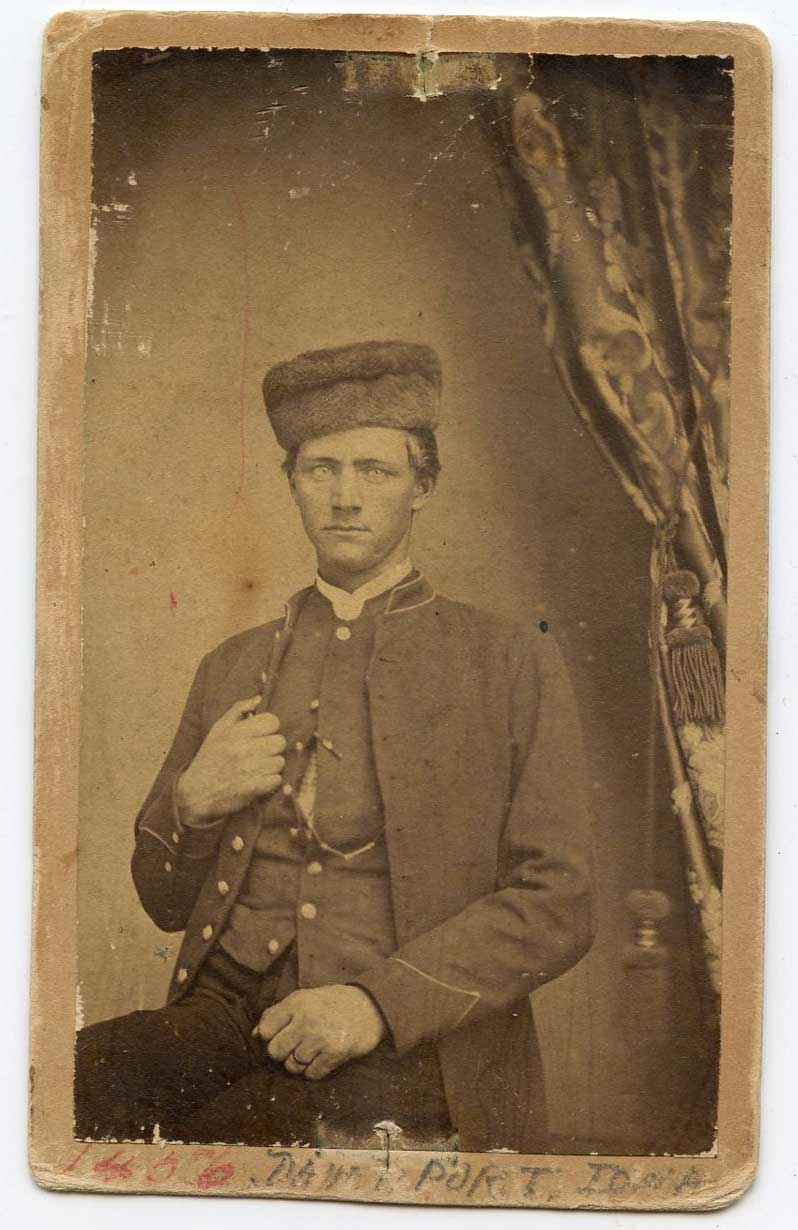
Thousands of soldiers’ photographs had accumulated by the end of the war. A clerk could read every word on a photographic mount and still have little to go on. Consider the Davenport portrait above. The sitter may have come to town just long enough to have his likeness taken. Even someone who could establish where he lived would still have to work out whom he had meant to send the picture to. Filing it away preserved the likeness while leaving the clerk with precisely the same puzzle. [1]
A receipt in the space behind the picture
Postal official Alexander Zevely proposed bringing the portraits out of storage and displaying them in the Dead Letter Office Museum in Washington. Clerks arranged them in four rows of nine on each panel, held them with brass clips and gave each a number in red ink. A visitor who recognized a man could point to a particular print among thousands. The visitor supplied the knowledge the office lacked. The number made it possible for a stranger and a clerk to agree on exactly whose picture they were discussing. [1]
The most informative part of a surviving panel can be an empty space. When a print was claimed, a clerk removed it and recorded the date, the claimant’s name and where the claimant lived. One entry records that F. Poplain took the portrait of Lieutenant S. Roderick of the 19th Iowa Infantry on June 17, 1874. The entry preserves two names with distinct roles. It tells us who sat for the photograph and who went away with it. Whether Poplain had been the intended recipient is a question the entry leaves open. [1]
The arrangement favored anyone who could get to Washington. In the early 1890s the office had the panels bound into an album, one to a page. Now the pictures could travel together to world’s fairs, still attached to their numbers and the record of earlier claims. A veteran who had never visited the postal museum might turn a page and find someone from his battery. Yet every year that brought a new audience also took away people who could have recognized a face. The fairs produced only a handful of recoveries. [1]
In March 1899 the Saturday Evening Post reported that clerks had found more than 23,000 photographs in opened letters in a single year. That figure measures what passed through the office. It offers no count of the Civil War portraits restored to families. The records of individual claims preserve a different kind of detail. On one October day in 1902, the person who could finally collect a soldier’s long-stranded likeness was the man who had once sent it away. [1][4]
Sources
- American Battlefield Trust, “Lost in the Mail: Dead Letter Office Photos.” Portrait, panel records and exhibition history.
- Commonplace, “‘Dead Letters—By a Resurrectionist’: Liberty and Surveillance in the Tombs of the U.S. Post Office.” Archival research on clerks’ authority and disposal of correspondence.
- The Manuscript Society, “Dead Letter Office Photos – The Civil War’s Lost Sentiments.” Wartime changes to mail service.
- The Saturday Evening Post, March 11, 1899, page 587. Contemporary account of address readers and photographs recovered.