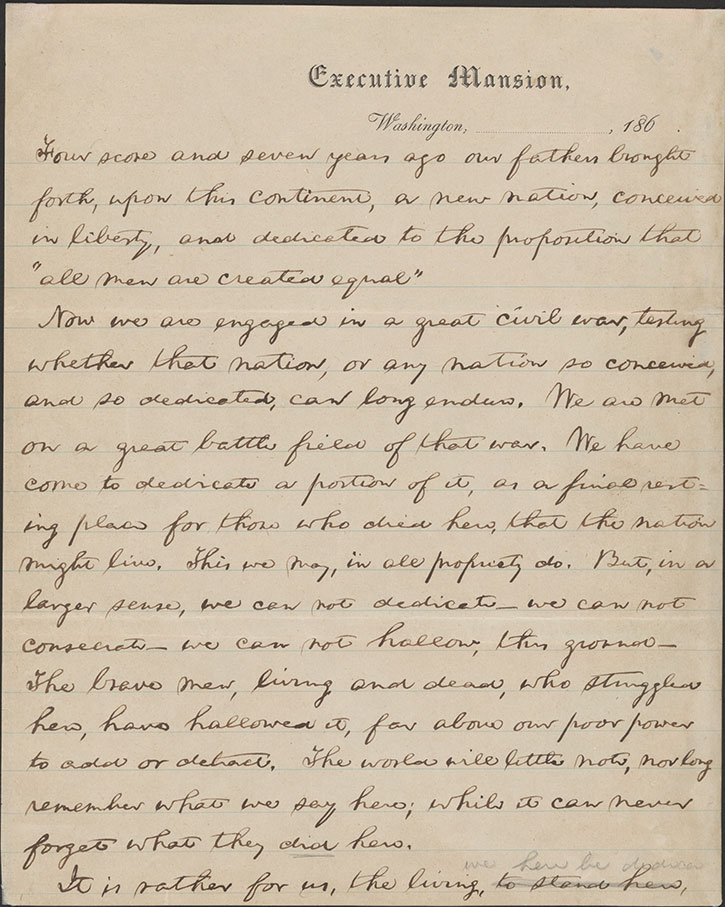
Most readings of the Gettysburg Address treat it as a quote machine. The primary-source record suggests a more precise claim: Lincoln’s speech is engineered to move listeners across three clocks at once—founding time (1776), war time (1863), and obligation time (what the living must do next).
That framing matters because the speech was delivered in a tight historical sequence: the Battle of Gettysburg (July 1–3, 1863), David Wills’s invitation to Lincoln (November 2, 1863), the cemetery dedication speech itself (November 19, 1863), and Edward Everett’s next-day letter praising Lincoln’s brevity (November 20, 1863).[1][2]
Image note: The header image is the first page of the Nicolay copy preserved by the Library of Congress, used here to ground this reading in the manuscript record rather than later quotation culture.[1]
1) The text’s first move: compress 87 years into one sentence
The opening line—"Four score and seven years ago"—does more than sound biblical. It re-anchors the nation in 1776 and the Declaration’s equality claim, rather than beginning with constitutional procedure or battlefield logistics.[3]
As a source move, this is strategic compression:
- It turns elapsed time into a political test.
- It frames the Civil War as a referendum on whether the founding proposition can survive.
- It narrows interpretive space before Lincoln names present duties.
In close-reading terms, Lincoln does not start with grief. He starts with a constitutional-ethical premise, then forces grief to serve that premise.
2) The middle move: from ceremony language to limitation language
The speech then appears to perform a standard dedication act, but immediately undercuts that frame: "we can not dedicate—we can not consecrate—we can not hallow—this ground."[3]
This is not rhetorical ornament only. It is a jurisdictional claim about who has authority to define national meaning. The living officials on stage are explicitly demoted; the dead soldiers’ action is elevated as the site’s real consecration.
Read as primary evidence, this is a transfer of legitimacy from officeholders to collective sacrifice. That transfer helps explain why the speech still works in civic rituals outside Civil War memory: it builds a repeatable rule about political authority under extreme loss.
3) The final move: convert mourning into forward program
The last section rejects closure. Instead, Lincoln stacks a sequence of obligations: "unfinished work" → "great task" → "new birth of freedom" → democratic survival formula ("of the people, by the people, for the people").[3]
The crucial mechanism is temporal: the dead are honored, but the speech’s grammatical center is future-facing. In other words, remembrance is presented as a production system for future action, not as a terminal act.
That mechanism becomes clearer when placed against wartime timing. By November 1863, Union victory was not guaranteed, and mass casualties were already politically destabilizing. A speech that merely mourned would stabilize sentiment for a day; a speech that redefined duty could stabilize purpose for longer.
4) Manuscript evidence: why the five-copy record matters
The source base does not stop at one fixed text. The Library of Congress notes five known manuscript copies (Nicolay, Hay, Everett, Bancroft, Bliss), with the first two closely tied to the November 19 event and later copies prepared for charitable/public circulation.[1][2]
This record supports two serious interpretations:
- Stable-core interpretation: the conceptual architecture is consistent across versions, so minor wording variation does not alter the speech’s political logic.
- Revision-as-meaning interpretation: punctuation/wording shifts between drafts and later copies show Lincoln refining cadence and emphasis for posterity, not just transcription.
What would change the assessment? A newly authenticated pre-delivery draft with materially different argument structure would. Existing manuscript evidence instead points to high conceptual continuity with controlled textual adjustment.[1][2][5]
5) Myth vs evidence (brief): did Lincoln write it on the train?
The popular train-writing story remains attractive because it matches the speech’s brevity. But manuscript evidence and draft history point to advance preparation in Washington plus revision around the Gettysburg trip, not pure improvisation in transit.[2][4][5]
The better evidence-based boundary is: spontaneity in delivery feel, preparation in composition.
Bottom line
As a primary source, the Gettysburg Address is best read as a time-discipline document. Lincoln binds 1776 principle, 1863 loss, and future democratic duty into one compact argument. Its durability comes less from one quotable line than from that three-clock structure.
Sources
- Library of Congress, Gettysburg Address exhibition overview
- Library of Congress, Exhibition Items - Gettysburg Address (Wills invitation, Nicolay/Hay drafts, Everett letter)
- Yale Law School Avalon Project, Gettysburg Address text
- HISTORY, The Gettysburg Address (context, timing, reception overview)
- Abraham Lincoln Online, The Gettysburg Address manuscript-version comparison
- Library of Congress Prints & Photographs, Abraham Lincoln at Gettysburg, November 19, 1863 (Brady-Handy collection item page)