The most familiar version of the Christmas Truce of 1914 arrives as a single perfect scene. British and German soldiers climb from their trenches on Christmas morning, meet in no man's land, play one football match, exchange gifts, and briefly discover that ordinary men can stop a war their leaders insist on fighting.
Almost every element in that scene has evidence behind it. The combination is the myth.
There was no front-wide ceasefire, no central agreement, and no one match that explains what happened. There were several local truces along parts of the Western Front. Some began with songs or shouted greetings on December 24. Some produced face-to-face meetings on December 25; others amounted only to reduced fire. Men exchanged tobacco and souvenirs, retrieved and buried bodies, repaired positions, carried materials in daylight, and in a few places kicked balls or ball-like objects around. Nearby units could remain in combat while a truce unfolded within earshot.[1][3][4]
That correction does not drain the event of wonder. It shows where its real power lay. The truces were built from below, sector by sector, by soldiers who could suspend violence locally but could not turn that suspension into peace. Their achievement was genuine precisely because its boundaries were so hard.
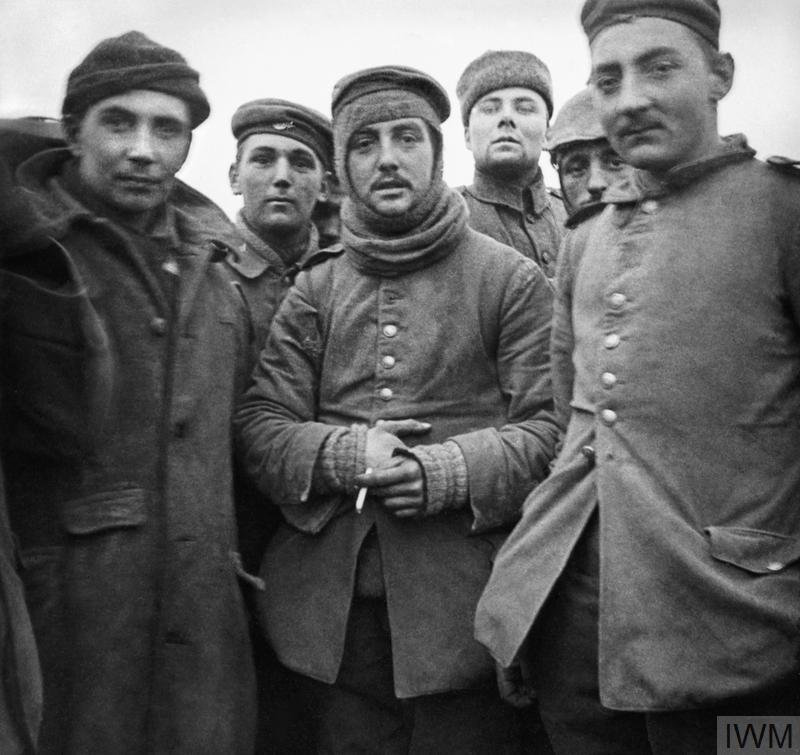
The cover photograph preserves those boundaries. Rifleman R. W. Turner photographed British and German soldiers together at Ploegsteert, Belgium, on December 25, 1914. The image is physical proof of fraternization in one place. It is not proof of one ceremony everywhere—and it contains no football.[4][6]
Myth: one ceasefire swept the Western Front
The singular phrase the Christmas Truce encourages us to imagine a coordinated event. Contemporary records instead read like reports from different worlds.
One British war-diary report preserved by the UK National Archives describes an informal meeting near La Petite Douve Farm involving about 200 British soldiers and an even larger German group. Yet the same report says British firing continued on Christmas Day until around 2 p.m., while the Germans opposite did not return it. The local truce was not a switch thrown at midnight. It emerged unevenly out of shouting, invitations, hesitation, and one side's decision not to answer fire.[1]
A different account comes from Edward H. W. Hulse of the Scots Guards. Writing to his mother on December 28, Hulse reconstructed his sector almost hour by hour. His battalion had taken over on December 23; ordinary firing continued on December 24; by roughly 8 a.m. on Christmas Day it had largely died away near him. Four unarmed Germans then approached. Hulse went out to meet them, established a halfway point, and returned later to find several mixed groups spread along the line.[2]
The contrast between the two documents matters. Near La Petite Douve, firing and non-response overlapped well into the day. In Hulse's sector, an improvised rule—meet halfway and come unarmed—gave the pause a temporary shape. Neither record can be enlarged into a map of the whole front. Together they reveal a mosaic.
The National Army Museum reaches the same conclusion from soldiers' diaries: Christmas 1914 brought a series of unofficial truces, not one coordinated affair. Some men stayed behind their parapets; some met; some played football; and fighting continued across other parts of France and Belgium.[3] Historian Alexandre Lafon likewise places German, French, and British accounts in the plural. The evidence is not for a universal miracle but for repeated local decisions under related conditions.[4]
Evidence: each truce had practical work to do
Once the event is broken into sectors, its activities stop looking like a ceremonial program and start looking like adaptations to trench war.
In some places, carols and greetings established contact. The National Army Museum cites Rifleman William Eve's diary for a day of conversation, souvenir exchange, football, and no firing in his area; it also cites Lieutenant-Colonel Schoolbred's record of bugles, candle illuminations, and shouted Christmas greetings on the previous evening.[3] Shared ritual supplied a language, but it did not dictate what followed.
Burial could be the stronger reason to cooperate. Hulse's letter describes British and German officers arranging the recovery of men killed in an attack on December 18. Twenty-nine British dead were buried halfway between the lines, while personal effects and identity discs were collected. This was not abstract reconciliation. It was a negotiated answer to a material problem created by close trenches and exposed ground.[2]
The lull also made ordinary military labor safer. Hulse recorded both sides bringing forward wood and straw, improving dugouts, and working on obstacles. His own company repaired barbed wire after dark while sentries remained alert. The ceasefire therefore contained two truths at once: men used it to fraternize, and units used it to become more defensible when fighting resumed.[2]
Lafon's broader interpretation helps explain that apparent contradiction. Fraternization could be a form of individual and collective disobedience, but it also belonged to a wider family of front-line practices often called “live and let live”—limited accommodations that reduced violence in particular times and places without dissolving armies or their command structures.[4] A local truce did not need a shared theory of peace. It needed enough reciprocal confidence to make one bounded action—singing, burial, exchange, repair—less dangerous than shooting.
The football question has two different answers
Did soldiers play football? The strongest answer is yes, in some sectors. Did British and German teams stage the single organized match preserved in popular memory, perhaps complete with a recorded score? The evidence is much weaker.
The positive case is not based only on later sentiment. Eve's contemporary diary says football was played in his sector.[3] Other accounts describe informal games or kickabouts, and Lafon's international synthesis notes that German, French, and British testimony includes impromptu football.[4] Iain Adams's focused study of the Argylls and Saxons concludes that some combatants probably did play during the break.[5]
But “football occurred” is not the same claim as “the truce was a football match.” Adams found it difficult to triangulate the famous game into a formal contest between identifiable teams. His reconstruction supports casual play under unusual conditions, not the tidy fixture of later commemoration.[5] The distinction is supported by the source pattern: references to greetings, cigarettes, photographs, burial, and conversation are more plentiful and often more specific than accounts of organized football.[2][3][5]
The two interpretations are therefore not evenly matched. One says that scattered, improvised play became possible within some local truces; it has contemporary support. The other compresses many truces into one regulation-style match and sometimes gives it a definitive score; it asks fragmentary evidence to carry far more detail than it can bear. A contemporaneous record naming both units, a precise location, agreed teams, rules, and a score corroborated from both sides would strengthen that larger claim. The surviving record is better suited to kickabouts than to a fixture list.
Football dominates the memory because it is an efficient symbol. A ball turns enemies into players, supplies familiar rules, and makes peace visible without explanation. Burial negotiations, half-way lines, sentry orders, and the hauling of timber are less picturesque. They are also more revealing of how the truces actually worked.
Myth: fraternization meant the soldiers had left the war behind
The warmest retellings treat the truces as a mass refusal waiting to become permanent. A colder reaction treats them as meaningless because the men returned to combat. Both readings flatten the evidence.
Hulse's letter shows how close fellowship and military purpose remained. He exchanged cigarettes and listened to songs, but he also used the meeting to observe the German position. He negotiated a reciprocal pause, reported to headquarters, limited where men could meet, doubled vigilance, and strengthened his wire. On December 26, contact continued in reduced form, with only a few men allowed out; by December 27, uncertainty about whether the lull still held coexisted with alarms and artillery fire.[2]
This was neither simple mutiny nor empty theater. Men temporarily asserted control over the intensity of violence in front of them. At the same time, they stayed inside units, obeyed many orders, collected information, guarded positions, and expected the war to resume. Lafon treats fraternization as soldier agency constrained by military supervision, wartime norms, and continuing hostility.[4] Adams reaches a compatible conclusion from the football evidence: whatever holiday the participants made, they returned to fighting.[5]
Commanders understood the danger of even that limited autonomy. The National Army Museum notes that senior officers opposed friendly intercourse, although junior officers sometimes tolerated it and some local ceasefires continued beyond Christmas Day.[3] Subsequent controls made another display on the same scale harder. Yet smaller accommodations did not vanish from trench warfare. The exceptional feature of Christmas 1914 was not that soldiers invented reciprocity for one day; it was that many local arrangements became unusually open, social, photographed, and reportable at once.[3][4]
The photograph proves the event—and corrects the legend
Turner's photograph is unusually useful because it does two jobs at once. It defeats the claim that fraternization was merely a later fable: British and German soldiers really did stand together at Ploegsteert, and a camera carried that fact beyond the trenches.[4][6]
It also resists the most polished myth. The frame offers a crowd, not rival teams; a particular location, not the entire front; one instant, not a permanent peace. The men remain dressed as soldiers. Their meeting is extraordinary, but the war has not disappeared from the picture.
This is the better history of the Christmas Truce. On December 24–27, 1914, soldiers in separate sectors tested how far reciprocity could travel across no man's land. Sometimes it reached only silence. Sometimes it reached burial parties, shared songs, souvenirs, family photographs, practical work, or a ball. Elsewhere it did not travel at all.[1][2][3]
The truces did not fail because they failed to end the First World War. Ending the war was never within the power of one exposed sector. What the soldiers proved was narrower and still unsettling: the machinery of violence depended, moment by moment, on people continuing to operate it. For a few hours, in a patchwork of places, some of them negotiated different rules.
Sources
- UK National Archives, “Western Front Christmas Truce 1914” — transcript and image of a 15th Infantry Brigade war-diary report, catalogue WO 95/1510/4.
- Edward Hamilton Westrow Hulse, Letters Written from the English Front in France Between September 1914 and March 1915 (privately printed, 1916) — the December 28, 1914 letter recounts the local truce, burials, defensive work, and its uncertain ending.
- Hayley Rix, National Army Museum, “The Christmas Truce” (December 22, 2014) — synthesis based on soldiers' diaries, emphasizing several unofficial truces rather than one coordinated event.
- Alexandre Lafon, “Christmas Truce,” 1914-1918-Online: International Encyclopedia of the First World War (2015), DOI 10.15463/ie1418.10750 — international context, fraternization, “live and let live,” and photograph provenance.
- Iain Adams, “A Game for Christmas? The Argylls, Saxons and Football on the Western Front, December 1914,” The International Journal of the History of Sport 32 (2015) — repository record, abstract, DOI, and accepted manuscript.
- Imperial War Museums, Q 11718, “The Christmas Truce 1914” — direct archival photograph file showing British and German soldiers at Ploegsteert on December 25, 1914.