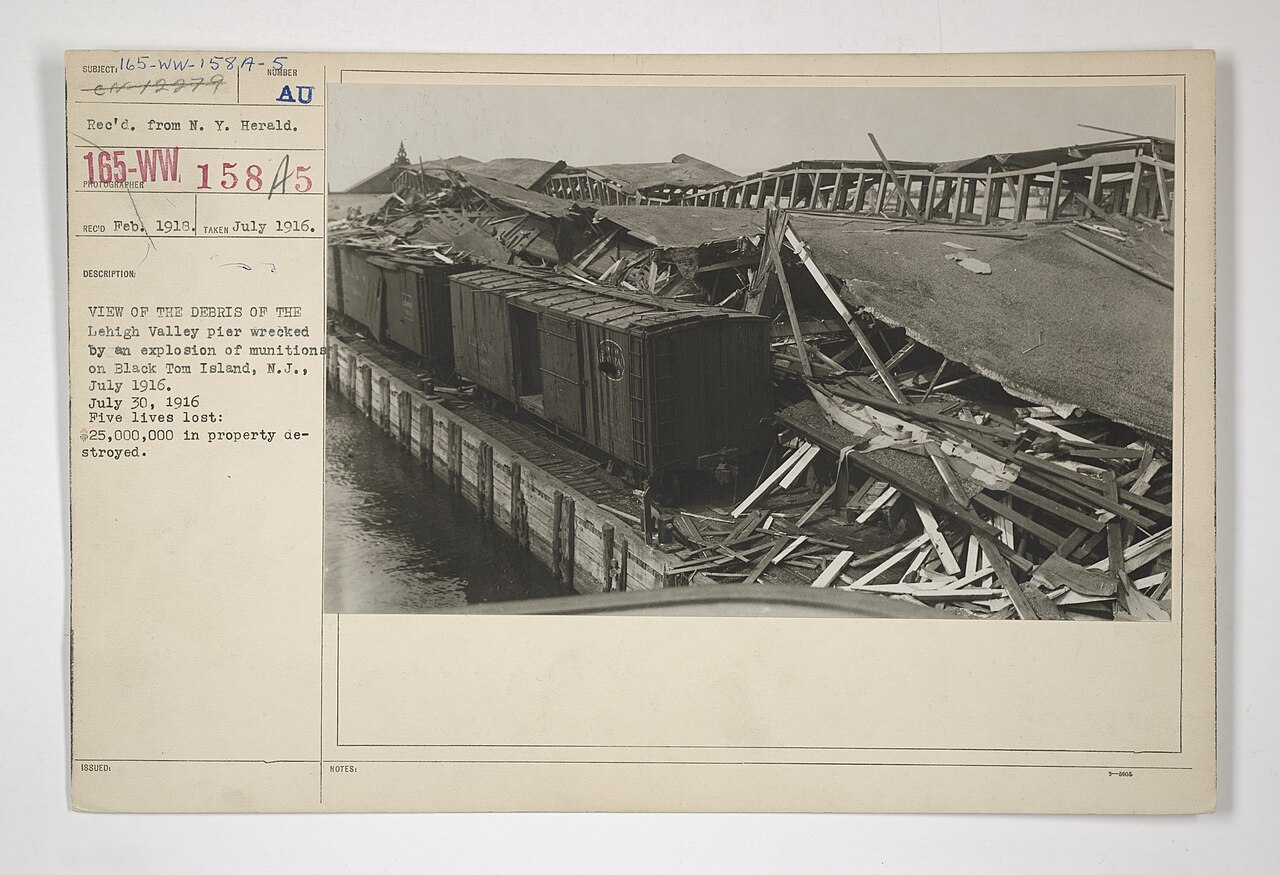
Black Tom is easy to remember as a spectacular explosion near the Statue of Liberty. That is true, but it is not enough. The deeper history is that a neutral country's commercial harbor had become a war machine before the country admitted it was in the war.
In the early morning of July 30, 1916, the munitions depot at Black Tom Island in Jersey City exploded. The National Park Service identifies the site as a Lehigh Valley Railroad depot where ammunition and explosives were stockpiled in warehouses, rail cars, and barges because cargo ships were scarce and Allied demand was heavy.[1] The FBI's account puts the amount in plain terms: roughly two million pounds of war materials packed into train cars blew up in what is now part of Liberty State Park.[2]
That physical arrangement is the key to the event. Black Tom was not simply a pile of dangerous goods. It was an interface: American factories, private railroad property, New York Harbor, Allied purchasing, German blockade pressure, immigrant processing at Ellis Island, military families on Bedloe's Island, and the Statue of Liberty all sat close enough for one sabotage chain to strike them together.[1][2][4]
The cover photograph shows why the event should be reconstructed through logistics rather than only through blast force.[3] The wreckage is not battlefield scenery. It is harbor infrastructure torn open: a pier, freight movement, rails, warehouses, and debris from a supply system that had been treated as commercial routine until it burned.
Before the blast, neutrality had a loading dock
The United States was officially neutral in the summer of 1916, but neutrality did not mean economic distance from the European war. American firms could sell munitions to buyers who could reach them, and Britain and France could reach them more easily than Germany because the British blockade constrained German access.[4] Black Tom therefore sat inside a contradiction. Legally, the United States was not a belligerent. Operationally, part of New York Harbor was feeding belligerent armies.
The National Park Service says the Black Tom depot was deliberately sabotaged to prevent supplies from being delivered to Britain and France.[1] The FBI is equally direct: German agents wanted to stop American munitions shippers from supplying Germany's enemy while the United States remained formally neutral.[2] Those two facts make the location intelligible. A harbor pier became a target because neutral commerce had strategic value.
The site also shows why private infrastructure mattered. Black Tom was not a federal arsenal guarded as a national war facility. It was a railroad and storage zone handling explosive cargo in a crowded metropolitan harbor.[1][3] That made the disaster both military and civilian at once. The munitions were war material; the workers, guards, nearby residents, immigrants, windows, ferries, rail cars, warehouses, and harbor buildings belonged to ordinary urban life.
The night turned small fires into a regional emergency
The sequence began quietly. NPS describes nearby Bedloe's Island, home of the Statue of Liberty, as calm and illuminated by the torch when saboteurs moved on Black Tom and placed explosives.[1] Shortly before 2 a.m., the first explosion woke Captain Alfred T. Clifton, commander of Company G of the U.S. Army Signal Corps, and his wife on Bedloe's Island.[1]
The response on Bedloe's Island was immediate but improvised. Clifton ordered a general alarm, directed the bugler to assemble the men, and had officers move women and children toward the parade ground.[1] By the time the second and largest explosion came at about 2:05 a.m., according to NPS, women and children were already walking in nightclothes toward the east side of Fort Wood for protection.[1] The timing matters. The island's first line of defense was not a prepared anti-sabotage protocol. It was a local commander trying to move families away from glass, debris, and structural danger.
The blast then converted distance into exposure. NPS records shrapnel, bullets, debris, glass, and wood falling on Bedloe's Island for two hours; seventeen buildings were damaged, shrapnel embedded in the Statue of Liberty, and the torch arm was pushed against the crown hard enough to damage internal framework.[1] The FBI adds the citywide dimension: thousands of windows shattered in lower Manhattan and Jersey City, and the Statue was pockmarked by shrapnel.[2]
Ellis Island also became part of the event. NPS notes that although its brick buildings survived comparatively well, windows blew out and the Main Building roof collapsed; the Guastavino tiles visible in the Registry Room today were installed after repairs made necessary by the attack.[1] Immigrant detainees and staff were ferried away to safety, as were civilians from Bedloe's Island.[1] The harbor's symbolic geography could hardly have been sharper. A sabotage attack meant to stop war supplies also struck the administrative threshold through which immigrants entered the United States.
The first explanation was not the final explanation
Black Tom's historical difficulty is that the event looked, at first, like the sort of catastrophe industrial ports already produced. CFR's retrospective notes that explosions in munitions work were common enough that local officials initially treated the disaster as lax safety rather than enemy action.[4] That first reading was plausible because the physical site really was dangerous. Dangerous cargo, private handling, rail cars, barges, warehouses, guards, and fire could explain a disaster without a spy story.
But plausibility can mislead. The FBI says German agents were not identified at the time, even though New York Police Department Bomb Squad detectives, the Secret Service, and the Bureau of Investigation tried to respond within a weak federal security framework.[2] The Bureau's limits mattered. According to the FBI, its predecessor had only 260 employees in a handful of offices and lacked the jurisdiction and intelligence infrastructure that later Americans would take for granted.[2]
That gap is the center of the reconstruction. Black Tom was not only a failure to guard a depot. It was a failure to see sabotage as an organized national-security problem before the legal and institutional machinery existed to see it clearly. CFR's account emphasizes that many facts emerged only later, especially through legal work before the Mixed Claims Commission, where evidence of German responsibility was developed after the war.[4] Michael Warner's CIA study makes the larger point: Black Tom left a deep institutional impression because it exposed how German sabotage tested American laws and security practices before the United States had modern domestic intelligence capacity.[5]
The aftermath stretched from harbor repairs to federal law
The immediate human toll was low relative to the scale of the blast, but the institutional effects were larger than the casualty count. The FBI says three men and a baby were killed, while other historical accounts use slightly different totals; the safest reading is that the event killed only a handful but injured and frightened many more.[2][4] That mismatch is part of why Black Tom can disappear from public memory. Disasters with low death counts often lose space to disasters with clearer casualty narratives, even when their political consequences are large.
The property and symbolic damage lasted. NPS describes structural harm to the Statue of Liberty's torch arm and shrapnel in the statue itself.[1] CFR connects that damage to the best-known public legacy: after damage assessment, public access to the torch was closed and never reopened.[4] Even readers who have never heard of Black Tom may know its residue as a visitor rule at the Statue of Liberty.
The federal afterlife was more important. The FBI links Black Tom to a larger chain of German provocations, followed by unrestricted submarine warfare and the Zimmermann Telegram, that pushed the United States toward war.[2] Once war came, Congress passed the Espionage Act and later the Sabotage Act, and the Bureau gained a clearer national-security role.[2] Black Tom did not single-handedly bring the United States into World War I. It did something subtler: it became evidence that the distinction between overseas war and domestic security could collapse inside an American port.
The event's final legal echo came decades later. The FBI says investigators eventually identified the saboteurs and reparations were paid for German attacks against the neutral United States.[2] CFR notes that the Black Tom claims process extended through later settlements and payments after World War II.[4] That long tail matters because it shows how slowly sabotage can become official truth. The blast took seconds. Historical accountability took generations.
Black Tom therefore belongs less to the history of freak explosions than to the history of interdependence under pressure. A railroad pier stored munitions because ships were scarce. Ships were scarce because the Atlantic war reordered commerce. German agents targeted the depot because neutral commerce had military consequences. The blast damaged the Statue of Liberty and Ellis Island because the harbor packed symbolic, civic, immigrant, military, and commercial functions into one shared space.
The lesson is not that neutrality was fake. It is that neutrality had infrastructure, and infrastructure can become a battlefield before policy catches up. Black Tom made that visible in the most literal way: a private loading dock exploded, and New York Harbor discovered that the war had already arrived.
Sources
- National Park Service, "Domestic Sabotage: The Explosion at Black Tom Island" - official account of the July 30, 1916 sabotage, Bedloe's Island response, damage to the Statue of Liberty and Ellis Island, and evacuation.
- Federal Bureau of Investigation, "Black Tom 1916 Bombing" - FBI history page on the explosion, German agents, casualties, investigative limits, Espionage Act, Sabotage Act, and later reparations.
- Wikimedia Commons, "File:View of the debris of the Lehigh Valley pier after Black Tom explosion.jpg" - source page for the New York Herald/National Archives archival photograph used as the article image.
- Council on Foreign Relations, "TWE Remembers: The Black Tom Explosion" - historical retrospective on neutrality, initial accident explanations, German sabotage evidence, Mixed Claims Commission context, and the Statue of Liberty torch legacy.
- Michael Warner, "The Kaiser Sows Destruction," Central Intelligence Agency, Studies in Intelligence 46:1 - essay on German sabotage in America and Black Tom's institutional security legacy.