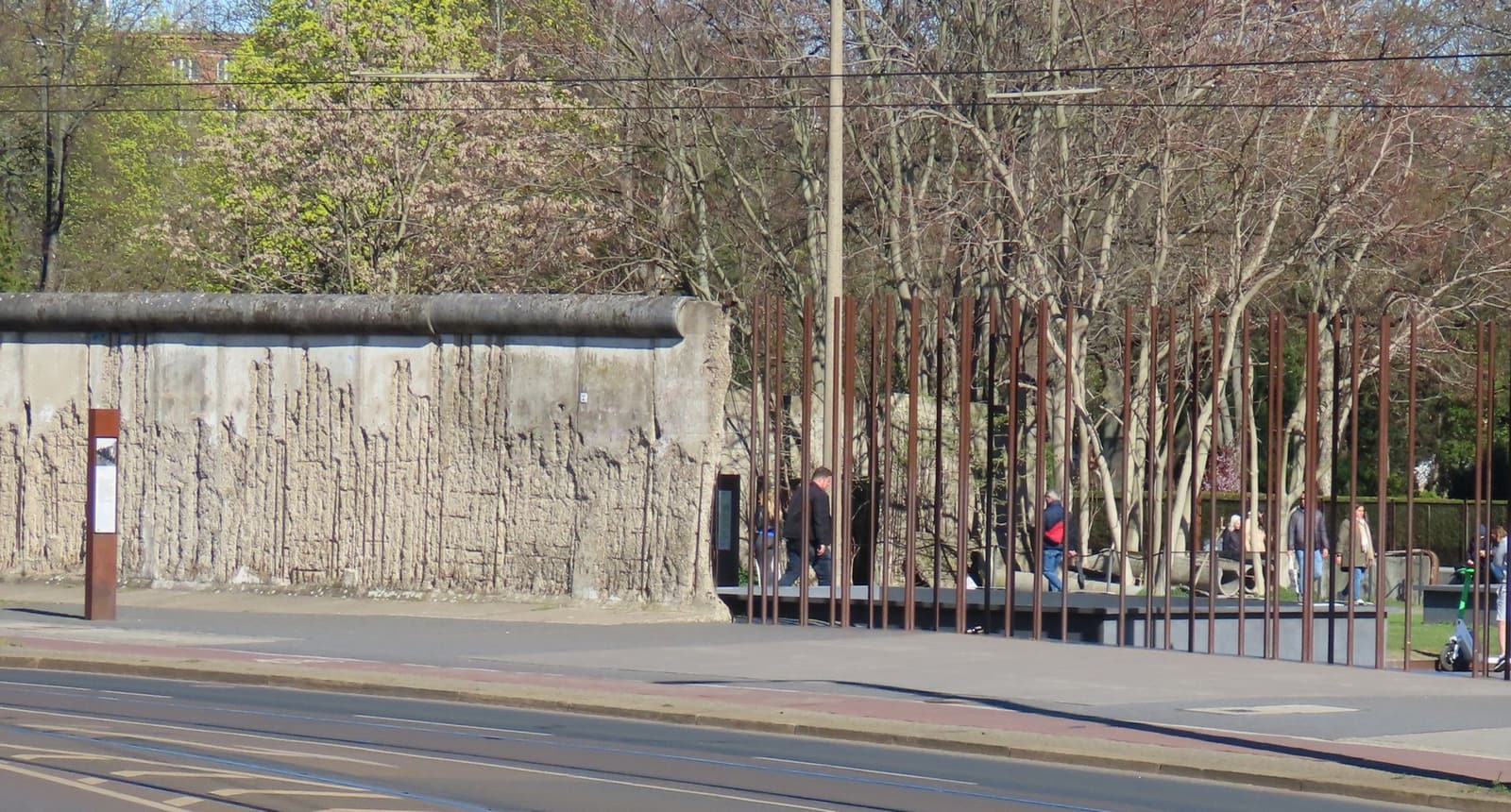
The most useful historical question about the Berlin Wall in 2026 is no longer how it was built or how it fell, but how a city remembers a border system after physically removing most of it.
Berlin’s answer is not one monument. It is a layered memory architecture: a central, documentation-heavy site at Bernauer Straße, plus dispersed traces, trails, and a heavily visited art-and-tourism zone at East Side Gallery.
Timeline anchors: from border regime to memory infrastructure
A clear timeline matters because Berlin’s remembrance model was assembled in stages, not designed in one act.
- 13 August 1961: the GDR seals the sector border and starts building the barrier system that becomes the Berlin Wall.[1]
- 9–10 November 1989: crossings open, and at Bernauer Straße the first wall segments are knocked out on the night of 10 November.[2]
- 2 October 1990: one day before reunification, East Berlin’s magistrate places a preserved Bernauer Straße border section under monument protection.[3]
- 13 August 1998: the Bernauer Straße memorial is inaugurated.[3]
- 9 November 1999: the Documentation Center opens (10th anniversary of the Wall’s fall).[3]
- 2006: Berlin Senate adopts the general concept that frames Bernauer Straße as the central remembrance site in a networked citywide memory landscape.[3][4]
- 2014: major expansion of the Bernauer Straße memorial is completed.[3]
- 2018: East Side Gallery parcels and wall elements are transferred to the Berlin Wall Foundation after years of preservation-vs-development conflict.[5]
This sequencing shows that Berlin’s memory work had three phases: emergency preservation (1989–1990), institution-building (1998–2006), then governance of conflict between memorial function and urban redevelopment (2006–present).
Why Bernauer Straße became the core site
Bernauer Straße carried unusually dense historical evidence: escape attempts from border houses, early deaths, tunnel activity, and later the destruction of the Reconciliation Church inside the border strip.[2][3]
That density made it suitable for a documentary memorial model rather than only symbolic commemoration. The current site combines:
- preserved border remains and exposed foundations,
- named-victim remembrance formats (including the Window of Remembrance),
- museum-style interpretation and civic education infrastructure.
This structure is historically important because it lets visitors move between three different evidentiary modes: place, biography, and institutional narrative.
Why East Side Gallery stayed contested
East Side Gallery represents almost the opposite memory logic. It is a surviving wall segment transformed into open-air art, with more than 1.3 km of preserved barrier length and work by 118+ artists from 21 countries after 1989/1990.[5]
Its strength is symbolic accessibility: people encounter the Wall through color, slogans, and photographic recognizability. Its weakness is governance pressure. The same source record documents repeated tension between monument preservation and waterfront development, including protests in 2013, relocations, and restoration debates over originality vs repainting.[5]
In other words, East Side Gallery keeps memory publicly visible, but in a form continuously exposed to tourism economics and urban land value.
What the sources state directly vs what this essay infers
What the sources state directly
- Chronology of Wall construction and opening in 1961 and 1989.[1][2]
- Legal/institutional milestones for preservation and memorial expansion at Bernauer Straße (1990, 1998, 1999, 2006, 2014).[3][4]
- East Side Gallery transformation facts: creation in 1990, monument status in 1991, major restorations, redevelopment conflicts, and 2018 governance transfer.[5]
- Victim research baseline and method (at least 140 deaths at the Wall under strict criteria).[6]
What this essay infers (with boundaries)
- Berlin operates a dual memory system: high-evidence institutional memory at Bernauer Straße plus high-visibility symbolic memory at East Side Gallery.
- The system is resilient because the two forms compensate for each other’s weaknesses, but it is also permanently unstable because one branch depends on contested urban-commercial space.
Boundary condition: this is not a claim that one site is “authentic” and the other is “inauthentic.” The stronger claim is functional: they preserve different kinds of historical attention.
Two competing interpretations
Interpretation A: Berlin’s distributed model is a strength
Under this reading, central curation plus dispersed public traces prevents memory from becoming museum-only. Visitors can enter through art, route markers, or victim biographies, then move into deeper documentation. The city thus preserves both accessibility and evidence depth.[3][4][5]
Interpretation B: distribution dilutes historical clarity
This view argues that tourism-heavy zones can convert political history into backdrop consumption. As commercialization pressure rises around iconic wall remnants, commemoration risks becoming visually persistent but analytically thin.[5][7]
Both interpretations are defensible. The deciding variable is institutional follow-through: whether preservation and interpretation budgets keep pace with footfall and redevelopment cycles.
Why this matters beyond Berlin
Berlin’s Wall legacy is a template problem for post-authoritarian and post-conflict cities: once the coercive infrastructure is gone, memory must live in planning law, educational design, and site governance—not only in anniversary speeches.
The strongest lesson is practical. If a city wants durable historical memory, it must preserve at least one high-evidence core and also maintain low-friction public encounters. Berlin built both. Its ongoing challenge is keeping them connected as urban incentives change.
Sources
- Chronicle of the Wall (Federal Centre for Civic Education / Deutschlandradio / Leibniz-ZZF), chronology overview and 1961 build-up
- Berlin Wall Foundation, Bernauer Straße historical site (division, deaths, and 9–10 Nov 1989 opening details)
- Berlin Wall Foundation, “The Berlin Wall Memorial” (preservation timeline: 1990, 1998, 1999, 2006, 2014)
- Berlin Senate, memorial policy page (2006 General Concept and citywide remembrance framework)
- Berlin Wall Foundation, East Side Gallery historical documentation (creation, restorations, protests, 2018 transfer)
- Chronicle of the Wall, “Victims at the Wall” methodology and baseline figures
- deutschland.de feature interview on East Side Gallery at 35 (urban change and preservation tension)
- Wikimedia Commons source image (Berlin Wall Memorial at Bernauer Straße)