The core historical question in Apollo 13 is not just what exploded but which decisions, in which order, turned a cascading spacecraft failure into a recoverable return path.
An event reconstruction helps because the mission’s popular memory (“Houston, we’ve had a problem”) compresses many separate technical and operational pivots into one line.
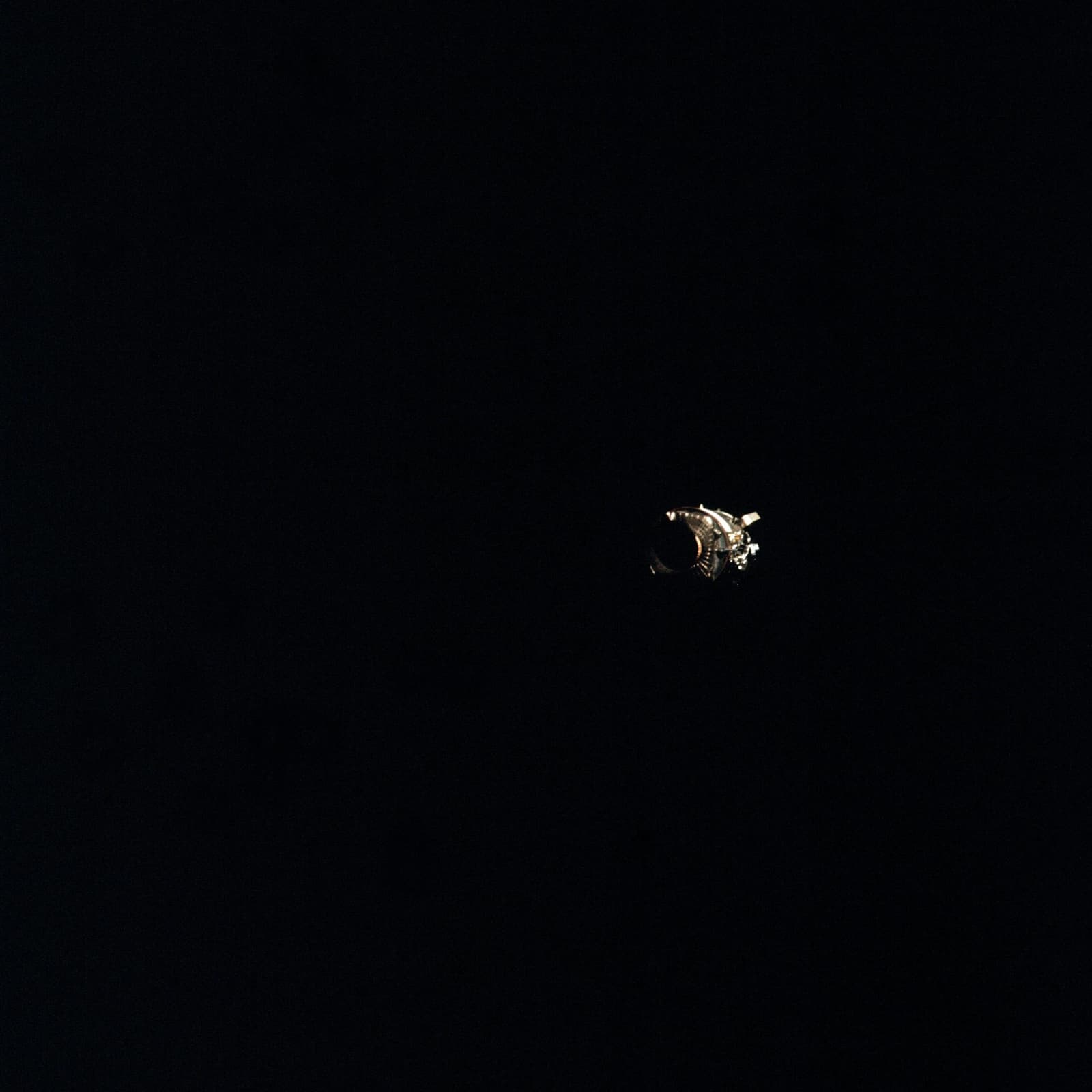
The hero image of the damaged Service Module is useful as orientation: it records physical destruction after the fact, but the decisive survival logic happened earlier in the invisible domain—power budgeting, sequencing choices, and return-geometry commitment while uncertainty was still high.
The source-grounded sequence (13–17 April 1970)
1) Launch and nominal mission phase
Apollo 13 launched at 19:13 UTC on 11 April 1970 as a planned lunar-landing mission.[1][2]
For roughly the first two days, the mission profile followed expected translunar operations. The later rescue path was not pre-scripted as a single contingency “button”; it was assembled from existing procedures under rapidly degrading power, oxygen, and guidance margins.[1][3]
2) The accident window: 13 April 1970
NASA’s detailed chronology pins the critical sequence to around 55:53–55:55 Ground Elapsed Time (about 22:06 EST, 13 April 1970).[3]
Two short quotes from the mission record mark the transition from anomaly to emergency:
- Jack Lousma (CapCom), requesting cryo-tank stirring just before the event.[3]
- John Swigert’s transmission at 55:55:20 GET: “Okay, Houston, we’ve had a problem here.”[3]
Telemetry then showed rapid oxygen-tank pressure/quantity anomalies, bus-voltage trouble, and fuel-cell degradation in quick succession.[3] In practical terms, that meant the Command/Service Module could no longer be treated as an energetically stable platform for a normal lunar mission.
3) Why the oxygen system failed (as reconstructed after splashdown)
The Review Board’s postflight investigation traced the initiating failure to oxygen tank no. 2 in the Service Module, with the chain involving damaged insulation, a combustion event, and panel loss in bay 4.[4][5]
NASA’s historical summary of the board findings is unusually clear that this was not a one-off random glitch. Cortright described it as “an unusual combination of mistakes coupled with a somewhat deficient and unforgiving design.”[5]
That phrasing matters historically: it assigns causality to both local errors and system-level design tolerance, not to a single operator mistake.
4) The decisive operational pivot: mission objective collapse, crew-survival objective rises
Once fuel-cell oxygen support was compromised, the mission’s objective hierarchy changed fast:
- abandon lunar landing,
- preserve life support and guidance capability,
- execute the lowest-risk Earth-return geometry available.
The selected path was a circumlunar free-return profile, with the Lunar Module used as a lifeboat for power/life support until late transfer back to Command Module systems before entry.[1][2][4]
This is the central decision-chain hinge: not one heroic maneuver, but an ordered reprioritization under hard resource constraints.
5) 17 April 1970: return and closure of the event arc
Apollo 13 splashed down safely on 17 April 1970.[1][5] The mission failed in its planned lunar objective but succeeded in crew recovery, which is why NASA and later institutional histories describe it as a “successful failure.”[6]
The high-risk bundle in the first post-accident hours
The most informative way to read Apollo 13 is to isolate the first post-blast decision bundle rather than jumping directly from anomaly to splashdown.
In that bundle, controllers and crew had to run three tasks in parallel:
- classify whether the anomaly was transient instrumentation noise or a persistent system failure,
- prevent cascading power loss while preserving enough guidance capability to keep return options open,
- commit to a return profile early enough that later correction burns remained feasible.
Each task had a different evidence quality and a different clock. Telemetry clarity improved over time, but power margins worsened over time. That mismatch forced action under partial information. Historically, this is why Apollo 13 is better modeled as a sequence-governance case than a pure engineering-fix case.
A useful reconstruction point is that “delay for certainty” was itself a decision with cost. Waiting for full causal certainty would have consumed exactly the resources needed to execute recovery. The mission therefore prioritized reversible decisions first, then locked irreversible ones when geometry and energy budgets required commitment.
That ordering principle appears repeatedly in high-reliability operations beyond spaceflight: preserve optionality early, collapse options only when data quality and constraint pressure cross a threshold.
What the sources state vs what this reconstruction infers
What primary/institutional records state directly
- The timing and telemetry progression around the explosion window.[3]
- The Review Board’s fault tree centered on oxygen tank 2 and design/test process issues.[4][5]
- The operational shift to LM-supported circumlunar return and eventual safe splashdown.[1][2]
What this reconstruction infers (with limits)
- The most important “decision” was not a single command but a sequence discipline: diagnosis triage -> mission-goal collapse -> energy-budget preservation -> return-geometry commitment.
- Apollo 13’s survivability came from coupling hardware redundancy with organizational procedure quality; either component alone would likely have been insufficient.
Inference boundary: this article does not claim a single counterfactual (“one action saved the crew”). The record supports a chain outcome, not a monocausal rescue myth.
Two competing interpretations of why Apollo 13 ended in survival
Interpretation A: operations excellence was the decisive factor
This view emphasizes Mission Control triage, configuration improvisation, and strict priority discipline under time pressure. Supporting evidence includes telemetry-guided fault progression analysis and life-support workaround execution documented in mission records and subsequent institutional reconstructions.[3][6]
Interpretation B: operations mattered, but design slack and mission geometry were co-decisive
This interpretation stresses that free-return geometry, subsystem redundancy, and remaining onboard margins made the operational playbook feasible at all. The Review Board framing—mistakes plus unforgiving design—supports this broader systems reading.[4][5]
The strongest synthesis is that Apollo 13 survival required both: human decision quality and enough residual system affordance to make those decisions executable.
Why this event still matters outside space history
Apollo 13 remains a high-value case for risk governance because it shows how disasters often emerge from stacked normalizations (small known irregularities, accepted constraints, local workarounds) rather than one extraordinary blunder. The post-incident redesign and recertification push also shows that crisis response and structural learning are separate tasks on separate clocks.[5]
If we flatten the story into one famous quote, we lose the more useful lesson: survival came from disciplined sequencing under uncertainty, then institutional redesign after the fact.
Sources
- NASA Technical Reports Server (NTRS), Apollo 13 Mission Report (Document ID 19710003598, Sept 1970)
- U.S. Congress, House Committee on Science and Astronautics, Apollo 13 Mission Review hearing record (1970)
- NASA History, Detailed Chronology of Events Surrounding the Apollo 13 Accident (GET timeline + transcript excerpts)
- NASA Technical Reports Server (NTRS), Report of Apollo 13 Review Board (Document ID 20170000913, 15 Jun 1970)
- NASA History, 50 Years Ago: Apollo 13 Review Board Report (context + findings summary)
- Smithsonian National Air and Space Museum, Apollo 13 mission overview and operations context
- NASA Image and Video Library, Apollo 13 damaged service module image metadata (
as13-58-8458)