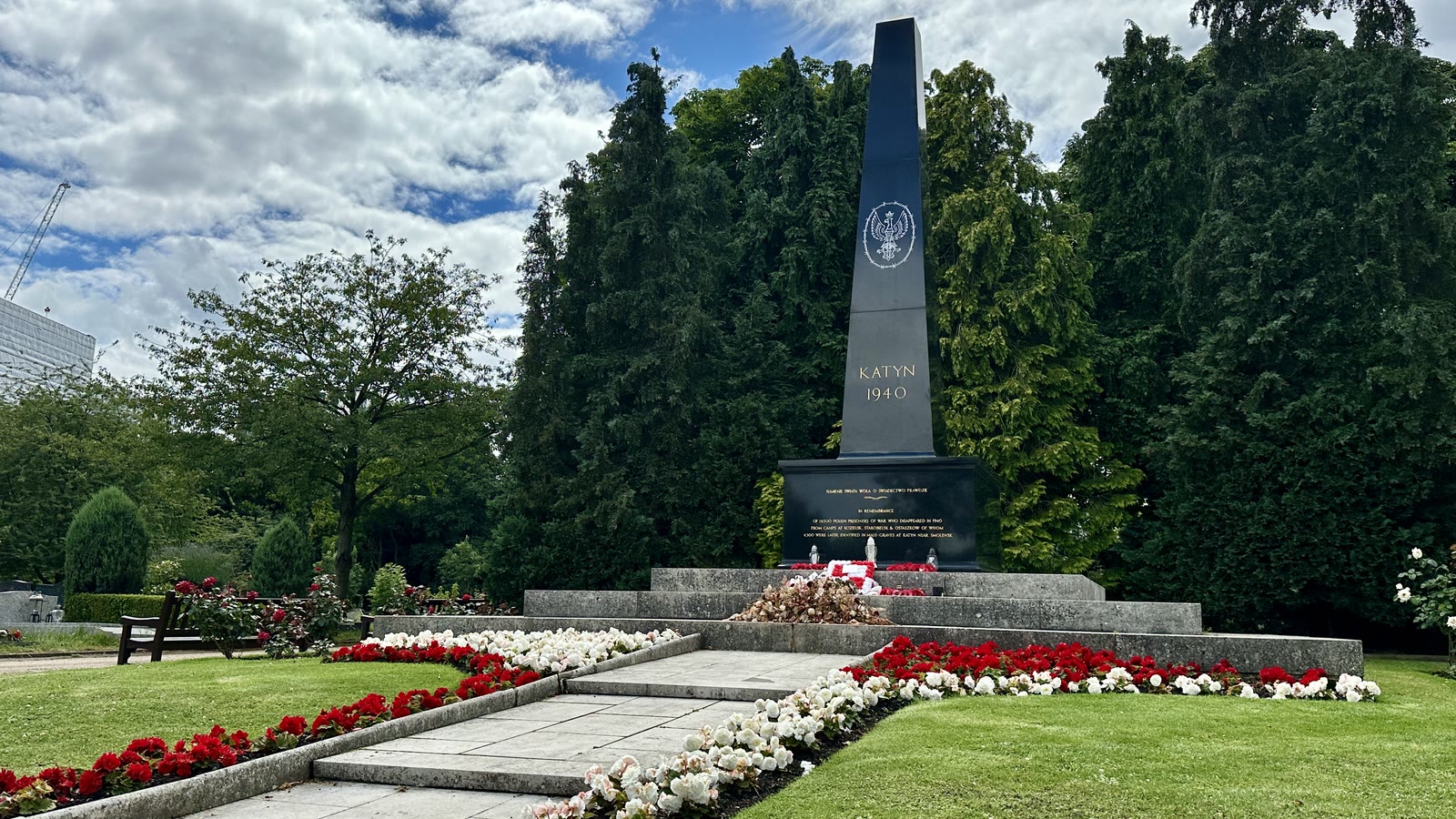
Near the top of the black granite obelisk at Gunnersbury Cemetery in London, a crowned Polish eagle is caught inside barbed wire. Beneath it appear two short lines: KATYN / 1940. A longer bilingual inscription remembers prisoners who disappeared from the Soviet camps at Kozelsk, Starobelsk, and Ostashkov, and those later identified in graves near Smolensk. It also appeals to the conscience of the world for the truth to be verified.[4][6][9]
The monument was unveiled on September 18, 1976. No representative of the British government attended, and no serving member of the armed forces appeared officially. In Parliament three weeks later, Foreign Secretary Anthony Crosland explained that the stone was not merely mourning the dead: its design and inscription assumed a historical judgment that successive governments had declined to endorse.[4][5][6]
The judgment was concentrated in the date. Dating the deaths to 1940 located the killings while the prisoners and the Smolensk region were under Soviet control; the official Soviet account put them in 1941, after German occupation. The obelisk did not have to carve “NKVD” to identify the accused.[2][5][6] The history that followed was one of progressive disclosure: an oblique place on family graves, an accusatory date in London, documents released by the perpetrating state, then individual names set beside the burial ground.[3][6][7][8] Each form preserved something the previous one could not. Each also revealed what commemoration still could not settle.
Two years became rival histories
The name Katyn is both a place and a historical shorthand. After Germany and the Soviet Union invaded Poland in September 1939, the NKVD confined Polish military officers, police, and others in camps and prisons. On March 5, 1940, the Soviet Politburo approved the execution of prisoners it treated as irreconcilable enemies. During that spring, the NKVD killed nearly 22,000 Polish citizens at several sites. About 4,400 prisoners sent from Kozelsk were murdered and buried in the Katyn forest; others were killed at Kalinin, Kharkiv, and additional locations. The first graves publicly exposed gave their name to the wider crime.[1]
German authorities announced the Katyn mass graves in April 1943, while occupying the Smolensk region. A German-organized international medical commission and a Polish Red Cross technical team examined the site and placed the deaths in spring 1940. Nazi Germany exploited the discovery for propaganda. That use did not make the bodies or their dates fictitious, but it gave Soviet authorities a ready language for dismissal: evidence announced by a criminal regime could be denounced as nothing but that regime's fabrication.[1][8]
After the Red Army retook the area, the Soviet Burdenko Commission supplied a counter-date. A January 1944 U.S. diplomatic telegram reported the version printed at length in Pravda and Izvestia: German forces had supposedly captured Polish prisoners left behind in the Soviet retreat and shot them in autumn 1941. The report called the 1943 disclosure a German provocation.[2] The rival dates therefore did more than order events. They assigned the forest to different occupiers and turned chronology into a verdict.
It would be false balance to present 1940 and 1941 as two equally viable explanations today. The Soviet government acknowledged NKVD responsibility in 1990, and in 1992 Russian authorities released copies of the Politburo decision of March 5, 1940.[7] But public memory does not begin only when a state opens its files. For decades, people who knew whom they were missing needed ways to keep their loss—and the suppressed attribution behind it—from being erased.
Families wrote around the censor
In communist Poland, a public inscription could be dangerous before it could be monumental. The Institute of National Remembrance traces how censorship removed references to the massacre from official publication after the Soviet-backed authorities took power. Remembrance survived in trusted circles, at Masses, in obituaries, churches, and family graves. A tombstone might name a missing relative as someone who “died in the East.” As Stalinist terror receded, some formulas became more explicit: killed at Katyn.[3]
These inscriptions did work a national monument was not allowed to do. Families lacked bodies to bury, access to the execution sites, and in many cases reliable knowledge of which site held a relative. Because the Katyn forest was the best-known grave, its name often absorbed people murdered elsewhere. A family stone could restore a person to a cemetery at home, but only by using language oblique enough to survive.[3]
The euphemism carried two messages to two audiences. To a censor, “the East” named no perpetrator and made no explicit accusation. To relatives and neighbors, it could identify the entire suppressed story. The wording preserved memory by withholding part of it. That was a practical achievement, not an ideal condition: a truth that depends on shared private decoding is easily lost when witnesses die or communities scatter.
Polish political exiles faced a different limit. In Britain they could say Katyn and 1940 together, but they could not compel the British state to say the same. Their struggle shifted from keeping a truth inside the family to obtaining land, visibility, and official presence for it in public.
London gave the date a body
The Katyn Memorial Fund Committee formed in London on October 18, 1971, charged with raising money and finding a site. Earlier monument proposals had already failed. The 1970s effort moved through central locations, church land, local planning, and diplomatic objection before a borough council offered space at Gunnersbury Cemetery in December 1975. It was the committee's seventh proposed London site and far from the prominent center its organizers had first sought.[6]
The location story matters because the British government did not simply ban the monument. Its method was more indirect. Tomasz Korban's study of British and Polish diplomatic files shows the Foreign and Commonwealth Office discouraging local authorities from approving sites while officials of both the Soviet Union and communist Poland pressed against the project. When Gunnersbury emerged, the FCO explored whether a legal route existed to stop it. The borough held its course, and construction began in 1976.[6]
Officials understood exactly what the date would do. In the diplomatic records Korban cites, British officials observed that 1940 indicated Soviet responsibility, whereas 1941 indicated German responsibility. The proposed date was therefore an accusation made without a verb. The emblem deepened the challenge. Korban explains that the crowned eagle ringed by thorns symbolized Poland's subjugation under communist rule, while Crosland said its use was regarded as derogatory toward the communist Polish government.[5][6]
The dedication also preserves the campaign's period figures: 14,500 prisoners missing from three camps and 4,500 identified at Katyn.[9] Those numbers should be read as part of a 1976 artifact, not as today's full accounting of a crime committed across several execution sites.[1]
When the monument was unveiled, Britain withheld official representation. The Foreign Office had advised against government attendance; the Ministry of Defence barred serving personnel from attending in uniform. Retired officers, British politicians, Polish exile leaders, families, and members of the public came anyway. Korban records one widow's understanding of the ceremony: with the monument unveiled, she felt she had at last buried her murdered husband there.[6] Gunnersbury was not his grave. It was the accessible place where public naming could finally perform a burial denied at the actual one.
Was Britain uncertain, or managing the truth?
The clearest official explanation of Britain's absence appears in Crosland's written answer of October 11, 1976. He expressed revulsion at the massacre and respect for the Polish dead, but said the evidence was not firm enough for a governmental assignment of responsibility. Because the memorial assumed that judgment—and used the crowned eagle in a way the government considered derogatory to communist Poland—official attendance would amount to endorsement. Had it been “simply a memorial” to the dead, he said, attendance would have been possible.[5]
That distinction contains a defensible principle: governments should not convert uncertain evidence into official history merely because a community wants recognition. The 1943 investigation unfolded under Nazi occupation and propaganda; the 1944 Soviet commission answered it with another state propaganda campaign.[1][2][8] Yet Britain had declassified Owen O'Malley's wartime reports in 1972, and the former ambassador argued that the Soviet Union was responsible. The Politburo decision ordering the executions was not made public until 1992.[1][6][7] Caution over wartime evidence was understandable; by 1976, caution alone cannot explain the policy.
The archival reading is harder on the government. Korban finds that British politicians and officials often privately judged Soviet responsibility much more likely than their public neutrality suggested. He also documents officials worrying about relations with Moscow and Warsaw, advising against sites, reacting to repeated diplomatic pressure, and trying to keep government and military representatives away from the unveiling. Hansard itself records that Soviet representatives raised the monument in four meetings with Foreign Office officials after February 1974.[5][6]
The evidence supports a mixed conclusion. Some evidentiary caution was reasonable in a record deliberately contaminated by two dictatorships. Yet Britain's practical behavior cannot be explained by method alone. Diplomatic cost shaped how high the public threshold of proof was set and where the memorial could stand. That judgment is now testable because the government files used by Korban expose a gap between private assessment and public posture. The Gunnersbury stone mattered precisely because a privately funded monument on borough land could cross a line the state had chosen not to cross.
The line began to move before the Soviet admission. At the memorial's third-anniversary ceremony in 1979, a British military band took part and a Defence undersecretary attended. The undersecretary's presence was Margaret Thatcher's personal decision despite Foreign Office advice against ministerial-level representation. It was a gesture, not yet a full official attribution. But it showed that “neutrality” was a policy capable of changing with a government, not merely an automatic consequence of missing evidence.[6]
Admission changed what 1940 could mean
On April 13, 1990, the Soviet news agency TASS acknowledged direct responsibility by Lavrentiy Beria, Vsevolod Merkulov, and their NKVD subordinates, calling Katyn one of Stalinism's gravest crimes. The same day, Mikhail Gorbachev handed the Polish delegation initial copies of Soviet documentation. In October 1992, Boris Yeltsin's representative transferred copies of crucial records including the Politburo decision of March 5, 1940.[7]
The admission did not discover 1940 for the families or vindicate them by retroactive permission. It changed the status of the date in interstate public life. What had functioned on a London monument as an exile community's officially unendorsed charge could now be read alongside records from the perpetrating state. The date no longer had to carry the whole accusation by itself.
Post-1990 records clarified the geography and scale of a shorthand that was already expansive in family and exile usage. They confirmed the linked killings of prisoners from Starobelsk and Ostashkov and of people held in prisons; Katyn became the conventional name for a crime of nearly 22,000 victims across multiple places.[1][3][7] The 1976 London inscription itself had named all three special camps.[9] It preserved a central truth while freezing the limits of what its builders could document. Vindication did not make the old stone complete.
The cemetery turned a verdict into a landscape of names
Acknowledgment still had to be translated into a burial place. Polish and Russian agreements in 1994–95 established the legal and practical basis for a Polish war cemetery in the Katyn forest. Field teams located five original death-and-burial pits, recovered fragments of remains and personal objects, and mapped the ground. Construction began in May 1999. The Polish War Cemetery at Katyn opened on July 28, 2000, sixty years after the killings.[8]
Its design changes the unit of remembrance. The Gunnersbury obelisk rises as one collective claim: place, year, missing prisoners, truth. At Katyn, six collective graves preserve the reburials made after the 1943 exhumation, while cast-iron slabs mark the original death pits remapped in 1994–95. The differing counts record two layers of the site's history, not a contradiction. Two generals have individual graves; four tablets bear Catholic, Jewish, Orthodox, and Muslim symbols. Along the enclosing walls, individual epitaph plaques restore names one after another. A cemetery book published in 2000 joined thousands of those names to short biographies.[8]
This did not make the London monument obsolete. The two sites perform different historical work. Gunnersbury records the years when putting 1940 on a permanent London monument was an act of opposition by the exile campaign. The cemetery begins after that battle over attribution and asks a different question: once the perpetrator and date are acknowledged, can a mass execution site return individuality to the people placed in its pits?
No architecture can fully do that. An epitaph condenses a life; a wall orders names that violence first reduced to categories and transport lists. The Polish cemetery was created under Polish–Russian agreements and is maintained day to day by the directorate of the Russian State Memorial Complex “Katyn.”[8] That institutional arrangement does not turn commemoration into prosecution, or recognition into a complete archive.
By 2000, the burden placed on commemoration had changed. The cemetery did not have to make one date carry the accusation; it could give its surfaces to names, faiths, and grave boundaries. That later abundance was possible because earlier commemorators had insisted that chronology was part of mourning, not a detail outside it.
Look again at the first two lines in Gunnersbury. KATYN / 1940 now reads like a settled label. In 1976 it was the part that made official attendance at this particular memorial politically unacceptable under government policy: Britain offered mourning without attribution, and the builders refused.[5][6] The stone did not end the argument. It made the government explain why it would not stand beside an accurate year.
Sources
- European Court of Human Rights, Grand Chamber, Janowiec and Others v. Russia (2013), “The facts” §§15–24 and 38 — invasion and camps, March 5 decision, execution timeline and sites, competing wartime accounts, victim totals, and the 1990 Soviet admission.
- U.S. Department of State, Foreign Relations of the United States, telegram from Ambassador W. Averell Harriman, January 26, 1944 — primary diplomatic record of the Soviet commission's German-1941 account.
- Institute of National Remembrance, “The Katyn Massacre — Commemorations” (2020) — censorship, family tombstone formulas, church memorials, and exile commemoration.
- Institute of National Remembrance, “In the West” (Katyń 1940 portal) — Gunnersbury unveiling, Soviet protests, British non-attendance, the 1979 change, and the monument's form.
- UK Parliament, Historic Hansard, “Katyn Memorial,” October 11, 1976 — primary record of Soviet representations, official non-attendance, and the Foreign Secretary's stated rationale.
- Tomasz Korban, “The Construction of Katyn Memorial in London between 1971 and 1979 in the Light of British and Polish Diplomatic Sources,” Dzieje Najnowsze 51, no. 4 (2019) — peer-reviewed reconstruction from British and Polish diplomatic files.
- Institute of National Remembrance, “1990–2005: Katyn Chronology” — TASS admission, document transfers, exhumations, and cemetery openings.
- Institute of National Remembrance, “Polish War Cemetery at Katyn” — excavation history, agreements, construction, memorial design, name plaques, and July 28, 2000 opening.
- Matt Brown, “Katyn Memorial, Gunnersbury Cemetery 2024-07-10,” Wikimedia Commons — source page for the real site photograph used as the article image.