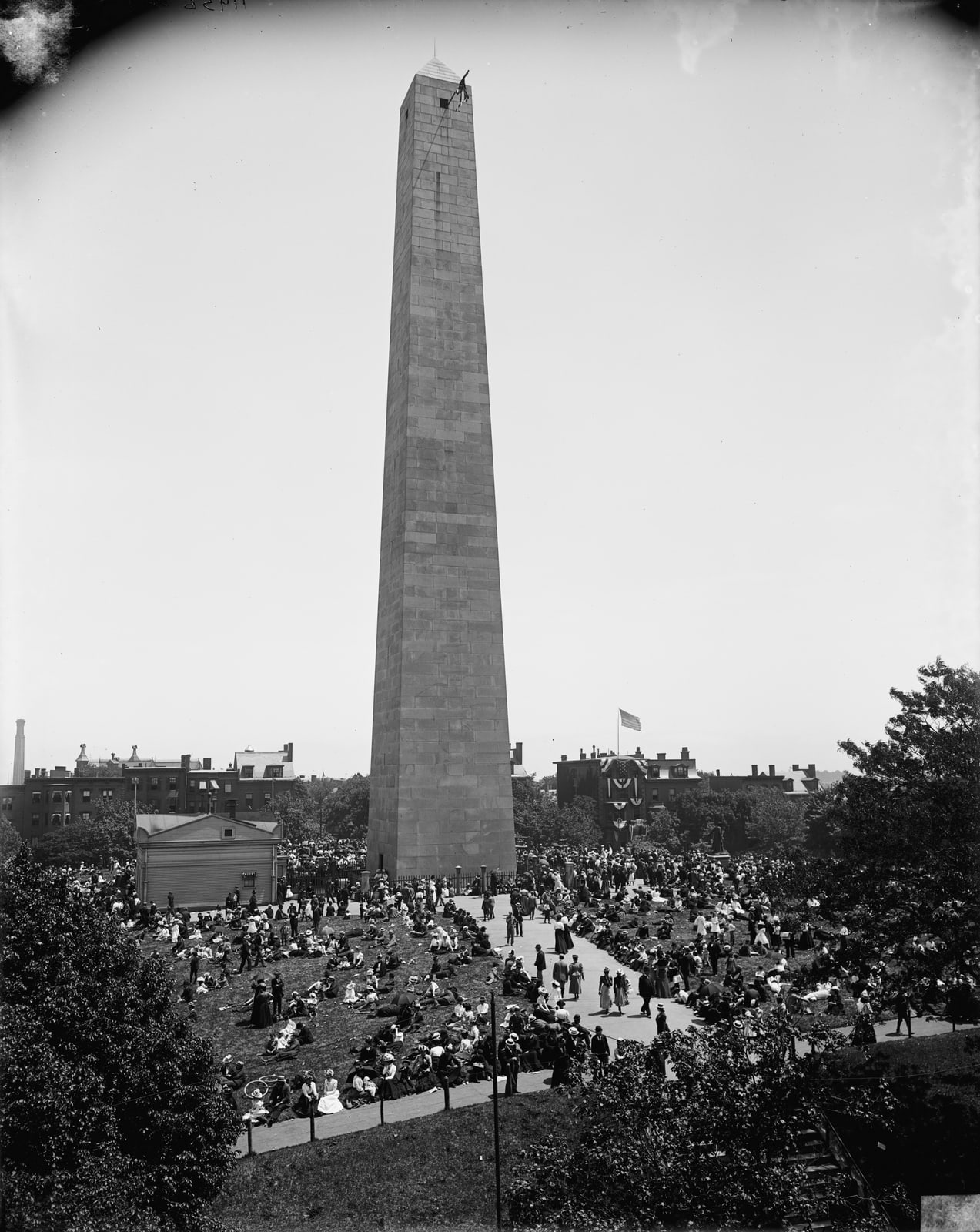
By 1835, Boston's grand memorial to the Battle of Bunker Hill had reached 85 feet and stopped. Money had run out again. The unfinished shaft stood on Breed's Hill, where provincial militia had fought British troops on 17 June 1775. It was supposed to make gratitude permanent; for years, its most conspicuous feature was how much remained to be built.[2]
The decisive change came partly from a different kind of public gathering. In September 1840, women organized a fair in Boston's Quincy Market to help finish the monument.[2][4] Their success raises a question that the completed obelisk cannot answer by itself: when a nation builds a memorial, whose work becomes part of the story it tells?
A promise larger than its subscriptions
The Bunker Hill Monument Association formed in 1823, as surviving Revolutionary veterans grew older and the battlefield faced development. Its founders sought both to preserve ground and to erect an imposing tribute. Membership began with a five-dollar contribution, and appeals travelled to prominent potential donors far beyond Massachusetts.[1]
The scheme did not command universal admiration. Caleb Stark, himself a battle veteran and the son of Colonel John Stark, objected that veterans' unpaid claims were being answered with stone. His complaint exposes a choice beneath the patriotic language: money spent representing gratitude could compete with money spent meeting obligations to the living.[1]
Nor did an impressive ceremony guarantee completion. Lafayette attended the cornerstone laying on 17 June 1825. Construction subsequently stalled, revived with help from the Massachusetts Charitable Mechanic Association, and stalled again. In 1839, the monument association sold ten acres of battlefield land to reduce its debt.[1][2]
The tradeoff was painfully concrete. Preserving the site and building the memorial had begun as connected ambitions; financial pressure pulled them apart. The rising monument would occupy a landscape diminished by the effort to pay for it.
The skills already existed
Sarah Josepha Hale brought an editor's reach and an organizer's experience to the campaign. Her magazine work connected women through writing, advice and correspondence. In 1833, she had helped establish Boston's Seaman's Aid Society, which supported sailors' impoverished wives and children through work opportunities and practical assistance.[4]
Members of that society's sewing circle developed the fair proposal. Appeals through newspapers and letters drew on women's networks across New England and farther down the Atlantic coast.[4] The monument campaign could therefore call upon relationships built for other purposes. Its organizers did not have to invent cooperation when construction money ran short.
This helps explain why the familiar image of Hale rescuing the project single-handedly is inadequate. An influential editor could circulate an appeal; producing goods, receiving contributions and running a public sale required many people's time. Domestic skills acquired a visible civic result when their products could be sold for the monument.
Patriotism at the counter
George Washington Warren's 1877 history preserves the fair's regulations and accounts. As a former president of the monument association, he wrote an admiring institutional history; the documents he reproduced nevertheless let us inspect the work behind the praise.[3]
The rules required fair prices and readily returned change. They prohibited raffles, pressure on buyers and partisan emblems. A miniature completed monument stood in the rotunda, while Hale edited a daily paper printed inside the hall. Visitors could see the intended result while shopping toward it.[3]
The accounting is equally revealing. Treasurer Mary Otis paid $30,035.53 to the association after expenses. The women's committee explained that its report had taken time because unsold goods were still being sold and bills had to be settled. This was a managed enterprise with responsibilities extending beyond the crowd's departure.[3]
Those details give the women something more substantial than a supporting role in a patriotic tableau. They established terms of exchange, controlled costs and accounted for public money. The memorial depended on their ability to make trust practical.
Credit in the language of decoration
Work restarted in 1841, and the obelisk reached its completed height of 221 feet in July 1842. The fair's proceeds and two further donations totalling $20,000 helped make that final phase possible. The public dedication followed on 17 June 1843.[2]
Daniel Webster's address acknowledged the women. But listen to the terms of the acknowledgment: “Garlands of grace and elegance” crowned an undertaking begun in “manly patriotism.” He went on to credit the country's mothers and daughters with supplying what was needed to finish it.[5]
The compliment was sincere enough to name their importance, yet its imagery softened the character of their work. Bookkeeping, management and fundraising became a graceful finishing touch. Read beside the fair's accounts, the speech shows how recognition could preserve a hierarchy even while admitting dependence.
That tension should not turn Hale into a campaigner she was not. She supported women's education and opportunities, but did not advocate their participation in formal political processes.[4] Her civic ambition operated within boundaries that later reformers would challenge.
A monument available to new claims
The finished memorial offered later visitors more meanings than its builders could control. The National Park Service records suffragist Lucy Stone's claim upon it, reported in 1893: “It is our monument.” Stone understood the revolutionary promise commemorated there as something women were still seeking to secure.[6]
Her claim did not make Hale's politics identical to hers. It demonstrates how a public monument can become useful to people arguing beyond the terms of its dedication. The same stone could express gratitude for an inherited freedom and dissatisfaction with the limits of that inheritance.
The fair belongs in this history because it makes participation tangible. Before the obelisk could appear complete and inevitable, people had to organize a sale and settle its accounts. Remembering that work changes the view from below: the monument honours a battle, but its own existence also records who was capable of building public life.
Sources
- National Park Service, “The Bunker Hill Monument Association: Expressing Gratitude and Patriotism” — formation, subscriptions, Caleb Stark's objection and the fundraising coalition.
- National Park Service, “Building the Bunker Hill Monument” — construction stoppages, sale of battlefield land, final financing, completion in 1842 and dedication in 1843.
- George Washington Warren, The History of the Bunker Hill Monument Association During the First Century of the United States of America (1877), pp. 296–309 — the fair, regulations, Mary Otis's accounts and the women's committee report; digitized full text.
- National Park Service, “Sarah Josepha Hale” — editorial networks, the Seaman's Aid Society, fair organization and the limits of Hale's political position.
- Daniel Webster, “The Completion of the Bunker Hill Monument,” address delivered on 17 June 1843, in The Great Speeches and Orations of Daniel Webster — opening acknowledgments of the contributors, including women.
- National Park Service, “Bunker Hill Monument” — Lucy Stone's claim to the monument, citing The Woman's Journal, 28 October 1893.
- Detroit Publishing Company, Bunker Hill Monument on Bunker Hill Day, photograph dated 1890–1901; Library of Congress collection, digital ID det.4a07543, via Wikimedia Commons.