The Balfour Declaration is often remembered as a short British promise made during World War I in support of Zionism.[1][3] That memory is accurate as far as it goes, but the document matters because of how it distributes recognition inside one sentence. In Arthur James Balfour's letter of 2 November 1917 to Lord Rothschild, the Cabinet backs the establishment of a national home for the Jewish people in Palestine, then adds a limiting clause about the civil and religious rights of the existing non-Jewish communities there.[1] Read closely, the sentence does two different things at once. It gives one collective a national horizon and gives the local majority a rights-protection formula without naming it as a people.
That asymmetry is the real historical hinge.[1][2] The declaration did not merely express sympathy. It set up a hierarchy of political language that later governing documents would preserve. By the time the Palestine Mandate was confirmed on 24 July 1922, the same imbalance had moved from a wartime letter into an international legal framework.[2]
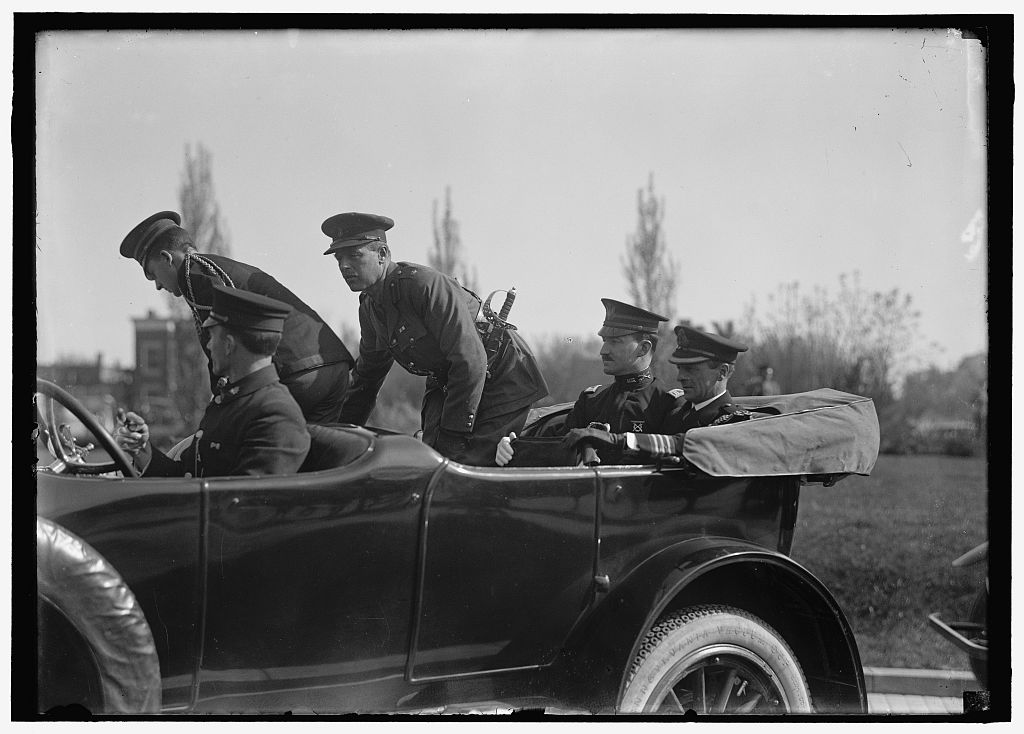
Image context: the cover uses a real 1917 Library of Congress photograph of Balfour arriving in Washington.[4] It belongs here because this article is about administrative language becoming durable policy. The image restores the declaration to the world of officials, files, and wartime diplomacy from which the sentence emerged.
First layer: the letter is short, but it is not casual
The declaration is framed as a formal transmission of Cabinet policy, not a private note.[1] Balfour tells Rothschild he is conveying, on behalf of His Majesty's Government, a declaration of sympathy with Zionist aspirations that had been submitted to and approved by the Cabinet.[1] That matters because the text arrives already authorized. The reader is not looking at an exploratory memorandum. The reader is looking at a chosen formula.
Even the verbs show that the government wanted commitment without over-specification.[1] The Cabinet says it views the establishment of a national home with favor and will use its best endeavours to facilitate that object.[1] The wording falls short of a treaty-like sovereignty guarantee, and the letter never uses the word state. From that phrasing, I infer that the government wanted a politically consequential commitment while preserving room over constitutional form, timing, and implementation.[1][3]
That is why the phrase "national home" became so durable.[1][3] It is stronger than cultural protection and softer than an explicit declaration of statehood. The document places the project in Palestine, yet it does not say the whole territory is to become a Jewish state, nor does it explain what institutions would mediate between the project and the population already there.[1] The ambiguity was not a later accident added by bad readers. It was present in the chosen wording from the start.
Second layer: the sentence names one people directly and the other only negatively
The strongest evidence sits in the letter's nouns.[1] The document speaks directly of "the Jewish people," a phrase that treats Jews as a collective subject of national policy.[1] The other side of the sentence is structured differently. The majority population of Palestine appears only as "existing non-Jewish communities."[1]
This is not a stylistic quirk. It is the declaration's central political choice.[1][2] One side is named positively as a people linked to a national home. The other side is described by what it is not, then attached to a rights clause defined in narrower terms. The text protects civil and religious rights, but it does not mention political rights for those same communities in Palestine.[1] That omission matters precisely because this is a close reading. The sentence names a national future for one collective and a non-prejudice floor for the other.
The last clause confirms how carefully the Cabinet was managing categories.[1] The declaration separately protects the rights and political status enjoyed by Jews in any other country.[1] In other words, the text is not indifferent to political status as a concept. It explicitly invokes political status when discussing Jews outside Palestine. What it does not do is grant an equivalent political vocabulary to the Arab majority within Palestine.[1] The asymmetry is therefore internal to the sentence, not something projected onto it afterward.
Third layer: the rights clause limits the project, but it does not balance it
It would be a mistake to read the second half of the declaration as empty decoration.[1] The civil-and-religious-rights clause is real, and later arguments over British responsibility often turned on it.[1][2][3] The point is narrower and sharper: the clause limits what may be done, but it does not create parity between the two sides named in the sentence.
Why not? Because the two halves of the sentence are written at different political levels.[1] The first half advances a collective national objective. The second half protects communities against prejudice in specified domains. Those are not interchangeable forms of recognition. One concerns historical destination and institutional development. The other concerns restraint.
This is where later conflict becomes easier to understand without importing hindsight the document itself does not contain.[1][2][3] The declaration does not openly say that the population already in Palestine should lose rights. It does something subtler. It creates a framework in which one collective's national project is affirmatively to be facilitated, while the other collective's protection is framed as a boundary on how far that facilitation may go.[1][2] That is a structurally unstable arrangement even before anyone argues about borders, immigration, or sovereignty.
Fourth layer: the 1922 Mandate carried the same hierarchy forward
The best test of this reading is the Palestine Mandate itself.[2] The Mandate's preamble explicitly says the Principal Allied Powers agreed that the Mandatory would be responsible for putting into effect the declaration originally made on 2 November 1917 in favor of the establishment in Palestine of a national home for the Jewish people, while preserving the civil and religious rights of existing non-Jewish communities there.[2] In other words, the declaration's sentence was not left behind in wartime rhetoric. It was copied into the architecture of rule.
Article 2 makes the carryover even clearer.[2] Britain is charged with placing Palestine under conditions that will secure the establishment of the Jewish national home and the development of self-governing institutions, while also safeguarding the civil and religious rights of all the inhabitants of Palestine.[2] The governing text therefore widens administration, economy, and institutions around the national-home objective. The Arab majority, however, still appears through a rights-protection vocabulary rather than through parallel national language.[2]
Article 6 shows how operational the difference became.[2] The Administration is told to facilitate Jewish immigration under suitable conditions and encourage close settlement by Jews on the land, while ensuring that the rights and position of other sections of the population are not prejudiced.[2] That is not a neutral balancing formula. It is a developmental instruction for one project, constrained by a protective clause for others.[2]
From the text alone, one can see the governing logic. The Mandate does not solve the declaration's asymmetry. It institutionalizes it.[2] The document adds administrative machinery, but it preserves the basic hierarchy between a positively stated national aim and a narrower safeguard for those living in the country.
Why the document still reads as consequential in 2026
The Balfour Declaration lasts because it compressed empire, war, diplomacy, and national aspiration into a sentence short enough to look simpler than it is.[1][3] Its most enduring feature is neither mystery nor mere brevity. It is asymmetry. The letter names one people, one project, and one official duty to facilitate. The people already living in Palestine enter the sentence through a limiting clause that is genuine yet narrower, protective yet not coequal.[1][2]
That is why the declaration still has to be read with the 1922 Mandate beside it.[2] The later document reveals what the original formula could do once it became governing text. It could preserve a rights floor, create administrative obligations, develop institutions, and still carry forward an imbalance in political recognition. The instability of the later Palestine question was not produced only by bad implementation after a clear blueprint. A large part of the trouble was already present in the blueprint's wording.[1][2][3]
Sources
- The Avalon Project, "Balfour Declaration November 2, 1917" - full text of Arthur James Balfour's letter to Lord Rothschild.
- The Avalon Project, "The Palestine Mandate" - full text of the League of Nations Mandate confirmed on 24 July 1922.
- Encyclopaedia Britannica, "Balfour Declaration" - concise historical overview of the letter, its wartime context, and its later inclusion in the mandate over Palestine.
- Library of Congress, "BALFOUR, ARTHUR JAMES. M.P., O.M., HEAD OF BRITISH COMMISSION TO U.S. ARRIVAL AT UNION STATION..." - 1917 Harris & Ewing photograph used for the cover image.
- The National Archives Discovery catalog, "Balfour Declaration: proposed publication of correspondence" - archival record context for the Foreign Office file around the declaration.