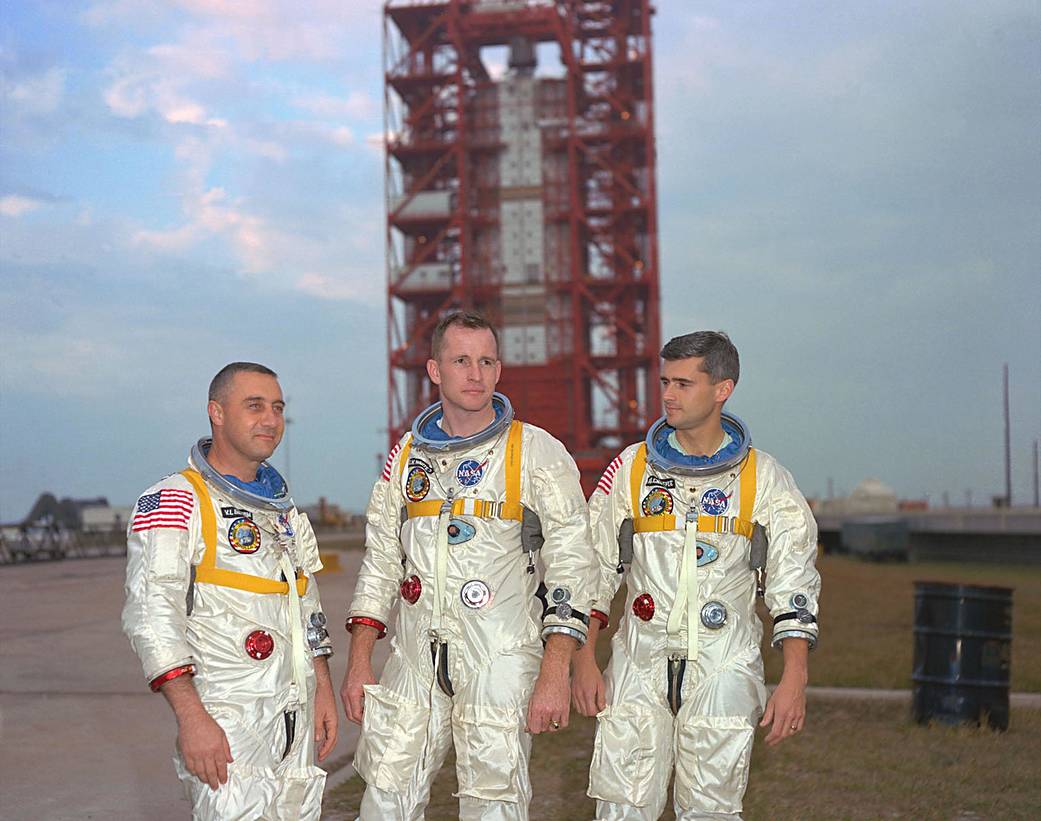
The Apollo 1 fire is often compressed into one sentence: a flash fire during a ground test killed Virgil I. "Gus" Grissom, Edward H. White II, and Roger B. Chaffee on Jan. 27, 1967, delaying the first crewed Apollo flight and forcing NASA to redesign the spacecraft.[2][4] That sentence is true, but it makes the event sound as if one unlucky spark suddenly overturned a sound system. Read as an event reconstruction, the harder historical point is different. Apollo 1 became fatal before liftoff because the rehearsal itself had already turned the command module into a dangerous enclosure: pure oxygen above ambient pressure, an inward-opening hatch, too much combustible material, confused communications, and a ground test treated as routine enough that rescue planning lagged behind the actual risk.[1][2][3]
That is why the phrase "plugs-out test" matters so much.[1][2] The spacecraft sat atop the Saturn IB at Launch Complex 34, but the rocket was unfueled.[1][2] The test was supposed to rehearse the moment when the command module would shift from external pad power to its own internal systems at simulated liftoff.[1] In administrative terms, it looked like a countdown exercise. In physical terms, it placed three astronauts inside a sealed cabin whose fire conditions were already harsher than ordinary air and whose exit hardware was slow even under ideal circumstances.[2][3] The catastrophe therefore belongs less to the category of sudden accident than to the history of a hazard chain that kept thickening while the day still looked controllable.
Timeline anchors
- 21 February 1967: Apollo 1 had been scheduled to launch on this date as the first crewed Apollo flight, then still officially designated AS-204.[4]
- 25 January 1967: the backup crew conducts the earlier plugs-in test with the hatch open; glitches with spacecraft and ground equipment already consume extra time.[1]
- 27 January 1967, 1:20 p.m.: after entering the capsule, Grissom reports a sour odor, and the test pauses while engineers inspect the air.[1]
- 27 January 1967, 2:42 p.m.: the test resumes after the odor dissipates and no anomaly is found.[1]
- 27 January 1967, 5:40 p.m.: controllers halt the count so the crew can reconfigure communications equipment amid persistent static and poor audio quality.[1]
- 27 January 1967, 6:30 p.m.: the countdown is held at T minus 10 minutes while communications problems continue.[1]
- 27 January 1967, 6:30:55 p.m.: engineers observe a voltage spike and other anomalous electrical signals in the spacecraft telemetry.[1]
- 27 January 1967, 6:31 p.m.: the crew reports fire; radio transmissions cease about eighteen seconds after the first warning.[1]
- 27 January 1967, about five minutes later: pad workers finally remove the hatches, but the crew has already died of asphyxia from carbon monoxide and other toxic gases generated by the fire.[1][2]
- Spring 1967 to October 1968: NASA redesigns the spacecraft, changes safety and management structures, and does not fly a crewed Apollo mission again until the program is cleared for Apollo 7.[2][4]
These markers matter because Apollo 1 was not one instantaneous failure floating free of context. It was a sequence in which each delay and design choice made the next stage harder to survive.[1][2][3]
1. The test looked procedural on paper, but it had already crossed into high hazard
NASA's Apollo 1 mission page states the simple frame: the mission was to be the first crewed Apollo flight and was scheduled for Feb. 21, 1967.[4] The Jan. 27 exercise therefore sat at the border between checkout and launch readiness. The Tragedy on the Launch Pad chronology shows that the main difference between the earlier plugs-in rehearsal and the Jan. 27 Space Vehicle Plugs-Out Integrated Test was the planned switch from pad power to simulated onboard power at the moment of mock liftoff.[1] That description can sound narrow and technical. Yet it placed the astronauts inside a fully sealed spacecraft for hours while systems, wiring, communications circuits, and cabin atmosphere all had to behave together.
This is the first place where hindsight can mislead. Because the Saturn IB was unfueled, the test was treated as less hazardous than a real launch countdown.[2][3] The aftermath history makes plain that this classification mattered: the test was not reviewed as a fully hazardous operation by the relevant safety bodies, and therefore the provisions for emergency rescue and treatment did not match the danger actually present inside the capsule.[2] The disaster was not only a materials problem or an electrical problem. It was also an organizational reading problem. NASA had placed a launch-like cabin environment inside a category that did not force launch-level rescue assumptions.[2][3]
The cabin atmosphere sharpened that mismatch. According to the aftermath article and NASA's lessons-learned page, the spacecraft was pressurized with pure oxygen at 16.7 psi, slightly above atmospheric pressure.[2][3] Over hours, oxygen permeated cabin materials that were far more vulnerable in that environment than in ordinary air.[3] The result was a setting in which ignition, if it came, would not behave like a small localized fire. It would move through the cabin with extraordinary speed.[2][3]
2. The day kept generating warnings, but none of them yet forced a stop
The Jan. 27 reconstruction grows sharper when the day's interruptions are set in order.[1] After breakfast with Joseph Shea and Deke Slayton, the crew suited up, began breathing pure oxygen from portable packs at 10 a.m., and arrived at the pad before entering the command module around 1 p.m.[1] Almost immediately, Grissom reported a sour smell. Engineers paused the test, sampled the air, found no anomalous reading, and resumed at 2:42 p.m. when the odor had dissipated.[1]
That pause did not cause the fire, but it reveals a pattern that would define the afternoon. Apollo 1 did not move through a clean checklist. It moved through a clutter of irritations, glitches, and small anomalies that did not by themselves justify abandonment.[1] The earlier plugs-in test on Jan. 25 had also run long because of trouble with ground equipment and spacecraft systems.[1] Walter Schirra, after seeing that rehearsal, warned Grissom the night before the plugs-out test that if things did not feel right, he should stop the exercise.[1] The warning matters because it shows that dissatisfaction with the process existed before the fire. The problem was not total ignorance. It was that dissatisfaction never crystallized into an irrevocable halt.[1]
Communications trouble then consumed the second half of the day. NASA's reconstruction notes static severe enough that the crew, the blockhouse, and the Acceptance Checkout Equipment room often could not understand one another clearly.[1] An open microphone contributed noise. At one point, air-traffic chatter from Miami broke into the line.[1] Controllers halted the test at 5:40 p.m. so the astronauts could reconfigure communications equipment, then held at T minus 10 minutes around 6:30 p.m. because the audio problems still were not resolved.[1]
The most quoted line from the afternoon came out of that frustration. Grissom complained, "How are we gonna get to the Moon if we can't talk between three buildings?"[1] The line lasts in memory because it sounds prophetic. Historically, its force lies in something more specific. The count had not collapsed under one grand technical failure. It had sunk into a swamp of communication defects serious enough to anger the crew and delay the rehearsal, yet still normal enough that everyone remained in the capsule while engineers kept trying to patch around them.[1]
3. Once the fire started, the hatch and pressure made time disappear
At 6:30:55 p.m., engineers saw a voltage spike and other anomalous electrical signals on the telemetry.[1] Ten seconds later, the first fire call came from inside the spacecraft.[1] The sequence that followed is brutally short. One of the astronauts, likely Grissom, shouted "Fire!"; seconds later Chaffee reported a fire in the cockpit; within roughly eighteen seconds of the first warning, radio transmissions ceased.[1]
From this point on, the design of the hatch and the pressure inside the cabin became the central fact. NASA's aftermath history says the three-piece hatch used on Apollo 1 required about 90 seconds to open under ideal conditions, with the innermost section opening inward.[2] Under rapidly rising internal pressure, that design became effectively impossible for the crew to operate.[2] White tried to open the hatch; outside, pad workers fought smoke, heat, and flame as they removed the outer cover, then the middle section, then the inner section.[1][2] Their effort took about five minutes.[1]
In ordinary storytelling, five minutes can sound brief. In a pressurized oxygen-fed cabin fire, it was far too long.[1][2][3] NASA's later examination concluded that the astronauts died of asphyxia from carbon monoxide and other toxic gases generated by the fire and that their burns were likely survivable had the atmosphere not become lethal first.[2] That finding matters because it shifts the event away from a crude image of instantaneous incineration. The fatal mechanism was enclosure. Heat, smoke, toxic gases, and an exit sequence that could not beat the pressure rise together turned the command module into a trap.[1][2][3]
4. The review did not see a single-cause accident. It saw a stacked system failure
The strongest historical reading of Apollo 1 comes from resisting the urge to blame one thing only. NASA's lessons-learned summary identifies the most probable initiator as an electrical arc from an unprotected wire routed below Grissom's left-hand seat, near the environmental control system and oxygen plumbing.[3] Yet the same summary immediately expands the picture: failure to identify the test as hazardous, the inward-opening hatch, inadequate ground-safety procedures and emergency equipment, last-minute procedural changes, unsatisfactory communications, poor control of combustible materials, and broader deficiencies in engineering, workmanship, and quality control all contributed.[3]
That list changes the meaning of the event. The electrical arc mattered, but Apollo 1 was not historically important because NASA found a bad wire. It was historically important because the wire had been laid into an environment already optimized for fire growth and then enclosed within procedures that were too tolerant of lingering problems.[2][3] Even the review board, as summarized in NASA's aftermath history, could not isolate one definitive ignition point beyond areas showing evidence of arcing beneath Grissom's couch.[2] The better conclusion is structural. Apollo 1 failed because design, materials, atmosphere, procedures, and organizational judgment had stopped providing backup for one another.
This is also why the event belongs to the history of systems engineering and safety culture, not only to the history of heroic sacrifice.[2][3] The crew did not die because space exploration is inherently tragic in some abstract way. They died in a specific terrestrial configuration built on the pad, in a spacecraft on the ground, during a test that administrators did not fully respect as the hazard it had become.[2][3]
5. The redesign mattered because NASA changed both the hardware and the reading of risk
The aftermath was therefore more than memorial. NASA's historical summary describes a cascade of changes. All subsequent crews would fly the more advanced Block II spacecraft, not the Block I version assigned to Apollo 1.[2] The three-piece hatch was replaced by a unified hatch that could open from inside or outside in about three seconds.[2] Combustible materials were severely restricted, wiring protection improved, and new fire-resistant spacesuits introduced.[2] Management changed as well: George M. Low replaced Joseph Shea as Apollo Spacecraft Program Office manager, and NASA created stronger independent safety structures, including the Aerospace Safety Advisory Panel and a separate safety, reliability, and quality-assurance office at the center level.[2]
The Apollo 1 mission page adds a final chronological point that often gets skipped. The exhaustive investigation and reworking postponed crewed Apollo launches until the program was cleared again, while the mission designation AS-204 was reassigned in a different form and the dead crew's mission itself came to be officially known as Apollo 1.[4] The numbering change matters because it preserved the lost flight inside the visible sequence of Apollo history instead of treating it as a technical embarrassment to be hidden between successful missions.[4]
Seen in full, Apollo 1 was not a prelude that simply had to happen before the Moon landings. It was a forced re-education in what counted as danger. The Jan. 27 test assembled a fatal environment before any launch took place; the redesign that followed succeeded because NASA finally treated that fact as real in hardware, procedure, and management at once.[2][3][4]
Sources
- NASA, "55 Years Ago: Tragedy on the Launch Pad" - detailed chronology of the Jan. 27, 1967 plugs-out test, including the sour-odor pause, communications delays, the 6:30:55 p.m. telemetry anomaly, the crew's fire calls, and the five-minute hatch-opening effort.
- NASA, "55 Years Ago: The Apollo 1 Fire and its Aftermath" - on the 16.7 psi pure-oxygen cabin, the 90-second inward-opening hatch, the astronauts' cause of death, the review findings, and the post-fire spacecraft and management redesign.
- NASA Safety and Mission Assurance, "Significant Incidents: Apollo 1" - probable electrical-arc initiator near the left-hand couch and the stacked contributing factors identified in NASA's lessons-learned record.
- NASA, "Apollo 1" mission page - mission designation AS-204, the planned Feb. 21, 1967 launch date, and the way the program renumbered missions and resumed after the redesign.
- NASA, "Remembering the Apollo 1 Astronauts" - source page for the archival photograph of Grissom, White, and Chaffee posing in front of Launch Complex 34 on Jan. 2, 1967.
Editor’s Pick Review
This piece earns the pick because it turns a familiar tragedy into a precise systems-history reconstruction. The argument does not lean on memorial shorthand or a single-cause spark story; it patiently stacks the physical, procedural, and organizational conditions that made the plugs-out test lethal before launch ever began. The timeline anchors are unusually strong, the NASA source base stays primary and traceable, and the image choice is fully compliant with the updated visual policy: an immersive archival photograph grounded in the actual people, place, and event, not an analytical diagram.
The article also clears the bilingual quality bar. The Chinese version keeps the same evidence chain while giving the prose a natural historical cadence, with technical terms such as plugs-out, 16.7 psi, Block I / Block II, and Launch Complex 34 preserved or contextualized without translation drag. Among the last 24 hours of eligible posts, it offers the best combination of source discipline, narrative control, topic significance, image relevance, and translation finish.