The 1906 San Francisco earthquake is often remembered as one overwhelming shock event.[1][3] That memory is understandable. At 5:12 a.m. on April 18, 1906, the ground shook violently for less than a minute, and the disaster left nearly 3,000 people dead and about 225,000 residents homeless.[1][3] Yet that familiar framing still puts too much weight on the tremor alone. The sharper historical question is why one earthquake became a city-destroying urban fire catastrophe. The answer is mechanistic: the quake did not merely damage buildings. It disabled the system that should have limited the damage once fire began.[1][2]
That system failure had three linked parts. First, the quake generated many ignition points. Second, it ruptured the water and gas mains, so the same shock that created fires also stripped away the pressure and flow needed to suppress them.[2] Third, once ordinary firefighting ceased to be realistic, city officials and Army officers had to switch from extinguishing flames to sacrificing parts of the city in order to stop the burn somewhere else.[1][2] San Francisco therefore was not destroyed by shaking plus fire as two separate items on a list. It was destroyed by a coupled failure in which the first event dismantled the city's defensive capacity at the exact moment the second event began.
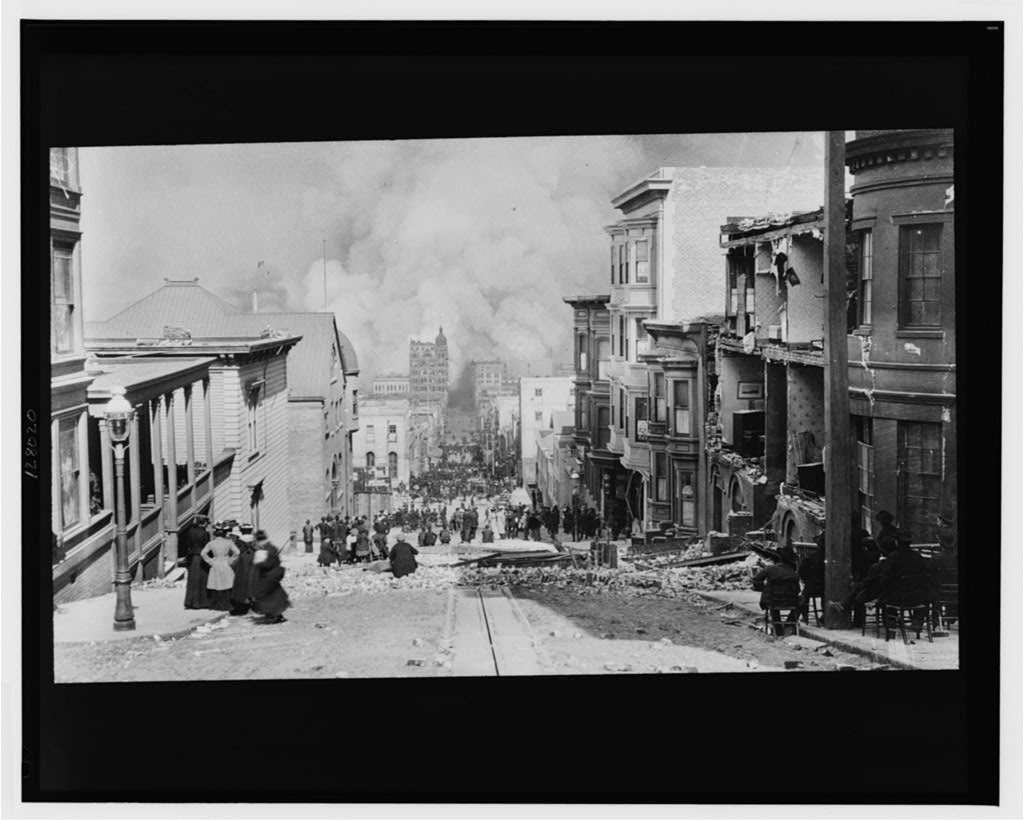
Image context: the cover uses a Library of Congress street photograph of San Francisco after the 1906 earthquake, with cable-car tracks, damaged buildings, people in the roadway, and smoke rising beyond the hill. It fits this essay better than a caption-card stereograph because the main historical hinge is not simply collapse. It is the moment when ordinary urban systems still visibly existed, yet fire had already outrun normal city response.[4]
Timeline anchors
- April 18, 1906, 5:12 a.m.: the earthquake strikes San Francisco; severe shaking lasts less than a minute.[1]
- Immediately after the quake: about thirty fires break out across the city while broken water pipes cripple firefighting capacity.[1][2]
- About one hour later: the San Francisco Fire Department asks the Presidio for Army assistance in containing the fires.[2]
- Evening of April 19: officials begin preparing a major firebreak along Van Ness Avenue as the financial district and city center are already burning.[2]
- April 21: after three days of destruction consuming more than five square miles and over five hundred blocks, the fire stops.[1][2]
- Three days after the earthquake: the Earthquake Investigation Commission begins work, helping turn the disaster into a foundational case for modern American earthquake science.[3]
1. The decisive first move was that the earthquake damaged the fire response network at the same time it created fires
The National Park Service's Presidio overview states the sequence in one hard sentence: the earthquake struck at 5:12 a.m., about thirty fires broke out almost immediately, and because San Francisco's water pipes had been shattered, little could be done to stop the inferno.[1] That is the core mechanism. Urban fire control depends on rapid concentration of water, crews, and local containment. In San Francisco, the quake attacked that capacity before firefighters could even decide where to commit their force.
The Fire Fighting page from the Presidio sharpens the same point by naming the broken utilities directly. Many of the city's water and gas mains were ruptured; leaking gas fed the new fires, while the lack of water made firefighting radically harder.[2] That pairing matters more than either fact in isolation. Broken gas lines alone would have been dangerous. Broken water lines alone would have left the city vulnerable. Together they created the worst possible arrangement: multiple new fires and a crippled suppression system.
This is why the standard phrase "earthquake and fire" is accurate but incomplete.[1][2][3] It makes the disaster sound additive, as though one event ended and the next began. The historical reality was tighter. The first event mechanically prepared the second. The city did not move from an earthquake emergency to a separate fire emergency. It moved into a single compound emergency in which the same shock wave both widened the ignition problem and narrowed the response options.
2. Once water pressure collapsed, officials stopped solving individual fires and started triaging the map
When a city can still move enough water, officials can think locally: protect this block, save that district, hold this corner. San Francisco lost that kind of firefighting almost at once.[1][2] The Fire Fighting account says the San Francisco Fire Department sent a messenger to the Presidio roughly one hour after the earthquake to request artillery assistance with containment.[2] That detail shows how quickly the problem outgrew civilian routines. The question was no longer how to put out a specific blaze. The question was how to keep a city of simultaneous fires from joining into one urban firestorm.
At that point the response had to change categories. Presidio troops and city officials turned to dynamiting buildings in an attempt to create gaps the fire could not cross.[2] This was not normal firefighting. It was controlled destruction used as a substitute for missing water pressure. The page also notes a revealing delay: during the first day, and until the evening of the second, city authorities limited permission to blow up buildings except those immediately touching existing flames.[2] In practical terms, that caution meant officials were still thinking too narrowly while the fire was already operating at city scale.
The mechanism here is brutal but clear. Once a fire has many points of origin and too little resistance, it spreads faster than local authority can make ordinary case-by-case decisions. Caution that would be sensible in a smaller fire becomes costly in a compound one. By the time San Francisco fully embraced demolition as a firebreak strategy, much of the central city had already been yielded.[1][2]
3. Van Ness Avenue mattered because the battle became one of corridors, widths, and sacrificial edges
The most useful way to understand the disaster's middle phase is to stop picturing a city being "consumed" in the abstract and start picturing a map of corridors. By the evening of April 19, Army officers and civic leaders prepared a major firebreak along Van Ness Avenue.[2] That choice was not symbolic. A broad street could function as a usable edge only if authorities were willing to destroy adjoining structures aggressively enough to widen the break and deny the flames fresh fuel.[2]
The Presidio account preserves the severity of that decision. Funston, his officers, the mayor, and members of the Citizen's Committee watched as three blocks of expensive houses fell every twenty minutes while the line was being prepared.[2] That is the physical meaning of a firebreak campaign. Officials were no longer defending each building in turn. They were selecting which urban fabric to lose so that a different section might survive.
The street photograph used as this article's cover image belongs to this phase of the story.[4] It shows San Francisco as a lived city of tracks, slopes, buildings, crowds, and smoke, already captured inside a larger fire logic. The city's problem was no longer collapsed masonry alone. Its problem was that street space, utility failure, fuel load, and wind had together converted blocks into transmission surfaces. In that setting, a wide avenue like Van Ness became historically important not because it was inherently safe, but because it could be turned into a place where the spread might finally be interrupted.[2]
4. The larger lesson is that the disaster should be remembered as a coupled infrastructure failure
The U.S. Geological Survey's retrospective on the centennial makes the scale plain: the earthquake killed nearly 3,000 people, left 225,000 homeless, and within days generated the Lawson-led investigation that helped define modern American earthquake science.[3] That scientific afterlife matters, but it can also subtly tilt memory back toward the fault rupture alone. The harder historical lesson is urban and administrative. San Francisco in 1906 shows what happens when a city depends on tightly linked systems and one shock disables them in the wrong order.
The sequence is stark.[1][2][3] Shaking damages buildings, but also tears up the water grid. Gas leaks supply new ignition. Fire crews confront a citywide problem with weakened tools. Authorities hesitate before shifting to firebreak logic. Then demolition, Army support, and the geometry of streets become more decisive than ordinary hose work. Once that chain is visible, the disaster stops looking like an unavoidable natural blow followed by bad luck. It looks like a systems failure in which the loss of firefighting capacity was the hinge between severe earthquake damage and metropolitan devastation.
That is the most useful way to remember 1906. The earthquake began the catastrophe, but the city was lost in the hours when suppression failed and containment became a battle over how much of San Francisco had to be deliberately given up so that any of it could remain.[1][2][4]
Sources
- National Park Service, "1906 Earthquake and the Army" - overview of the 5:12 a.m. shock, the roughly thirty immediate fires, the three-day burn, and the destruction of more than five hundred blocks.
- National Park Service, "1906 Earthquake: Fire Fighting" - on ruptured water and gas mains, the request for Presidio assistance, the delayed shift to demolition, and the Van Ness Avenue firebreak.
- U.S. Geological Survey, "The 1906 earthquake and a century of progress in understanding earthquakes and their hazards" - on the disaster's death toll, homelessness, and the Lawson Commission's role in modern earthquake science.
- Library of Congress, "San Francisco earthquake and fire of 1906" - Genthe Collection street photograph showing damaged urban space and smoke after the earthquake and fire, used as this article's cover image.