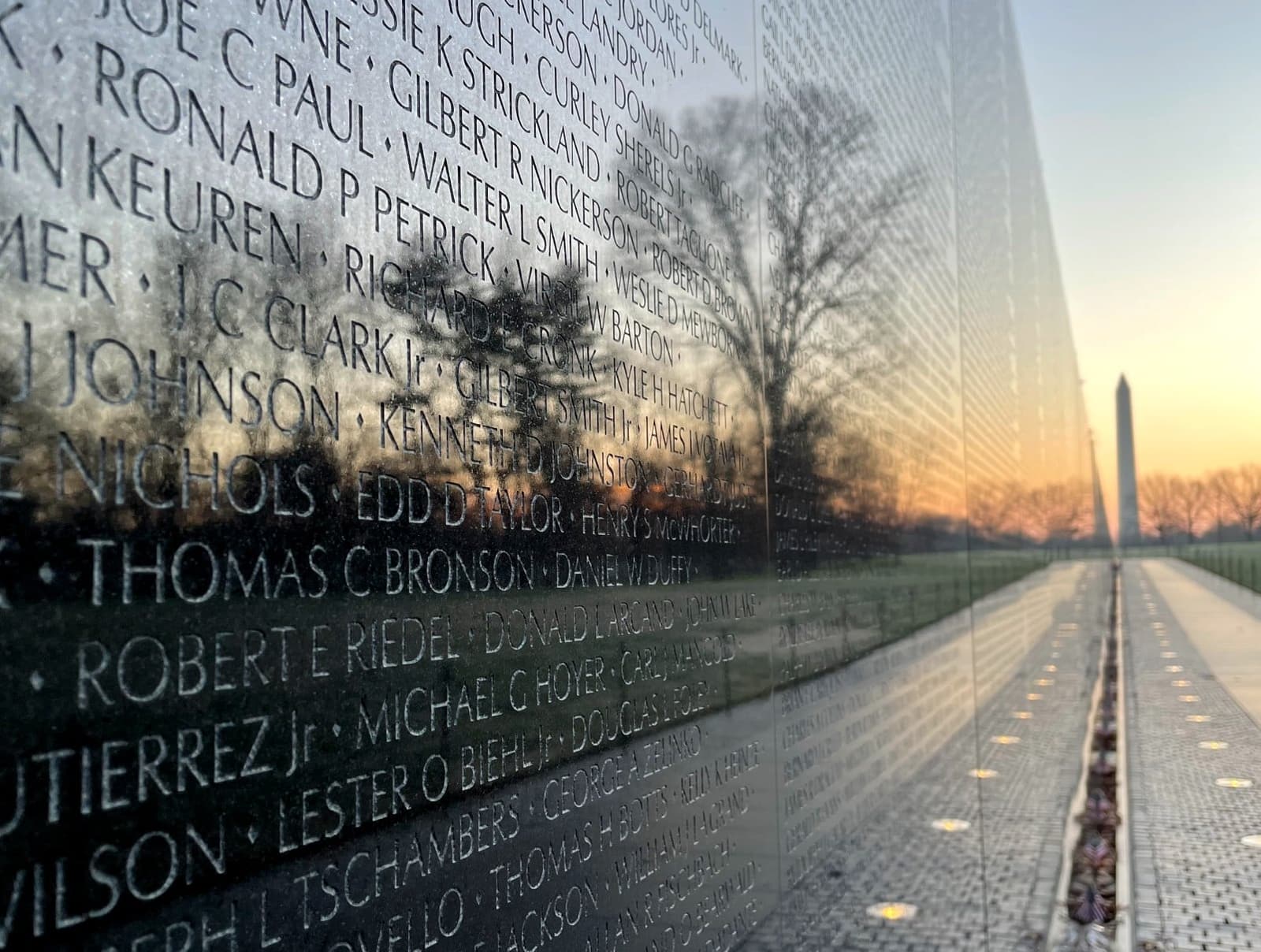
The Vietnam Veterans Memorial is often described as a successful monument. That is true, but incomplete. The stronger historical reading is that it became a memory system: a place where national mourning is repeatedly produced through design, naming rules, and visitor ritual.
This essay asks one focused question: between 1980 and 1993, what institutional and design choices turned one controversial memorial into a durable commemoration practice?
Timeline anchors: memory was built in layers, not in one gesture
- July 1, 1980: Public Law 96-297 authorized a Vietnam memorial on federal land and specified an approximately two-acre site in Constitution Gardens, with private financing rather than federal construction spending.[1]
- 1981: A national design competition selected Maya Lin’s proposal from more than 1,400 submissions.[2][6]
- November 13, 1982: The Wall was dedicated.[3][6]
- November 11, 1984: The Three Servicemen statue and flag were formally added after controversy over the abstract design language.[3]
- 1993: The Vietnam Women’s Memorial was unveiled near the Wall, widening representational scope within the same memorial field.[3][7]
This sequence matters because each step solved a different problem: legal authority, form selection, public legitimacy, symbolic compromise, and representational expansion.
The core design mechanism: names before narrative
The memorial’s architecture is not neutral backdrop; it actively structures how memory is experienced. VVMF’s published wall facts emphasize that each arm is 246 feet, 8 inches long, the two walls meet at 125°12', and the name order is chronological by casualty date.[4]
That geometry does two things at once:
- It refuses a single heroic focal statue as the whole story.
- It forces visitors into a time-sequenced encounter where individual names accumulate into scale.
Maya Lin’s own proposal language—“a rift in the earth”—helps explain why this became a memory technology rather than a commemorative plaque.[5] The polished surface reflects the visitor while presenting the dead as ordered text. The effect is neither pure abstraction nor pure figuration; it is participatory reading.
Why controversy did not end the project
The Wall’s first public reception was polarized. Britannica’s synthesis captures the core conflict: a minimalist design in a political culture still divided over the war, followed by compromise through figurative addition.[3]
A common interpretation is that the figurative additions “fixed” a design failure. The stronger evidence suggests something more specific: the additions created a dual-register site.
- The Wall remained names-first, procedural, chronological.
- The Three Servicemen and later Women’s Memorial supplied recognizable representational entry points for visitors who needed embodied figures.
In practice, that combination increased site resilience. Visitors could enter through symbol, then move into names; or enter through names, then move toward symbol.
Commemoration became a public ritual, not just a viewing act
The most important institutional shift was not aesthetic. It was curatorial. According to National Park Service documentation, visitors began leaving personal items immediately after dedication, and in 1984 NPS formalized collection and preservation procedures for those mementos.[8]
That decision changed the site’s function:
- It turned one-way remembrance (looking at a monument) into two-way exchange (leaving testimony).
- It created a growing archive of grief practices rather than a fixed memorial meaning.
- It linked federal stewardship to everyday citizen ritual.
Seen this way, the memorial is not only a statement about Vietnam-era loss. It is an operating process for how the U.S. publicly stores contested military memory.
What the sources state directly vs what this essay infers
Directly stated in sources
- The legal authorization structure, site constraints, and private-funding rule in Public Law 96-297.[1]
- Competition scale (more than 1,400 entries), dedication date, and key chronology.[2][3][6]
- Wall dimensions, panel arrangement, and chronological naming logic.[4]
- Emergence of memento-leaving practice and NPS institutional collection from 1984.[8]
Inference in this essay (bounded)
- The memorial’s long-run success is best explained as interaction among legal framework, spatial form, and ritual practice—not by design form alone.
- The compromise additions did not replace the Wall’s logic; they expanded the memorial’s interpretive access points.
Boundary condition: this is not a claim that all visitor groups experience the site similarly. It is a claim about why the site remained institutionally stable across disagreement.
Two competing interpretations
Interpretation A: the memorial healed by depoliticizing
Under this reading, the names-first design and reflective surface shifted attention away from policy dispute and toward shared sacrifice, making public reconciliation possible.[3][4]
Interpretation B: the memorial preserved conflict in a workable form
Under this reading, the site never resolved Vietnam’s historical argument. Instead, it organized disagreement into a ritual space where incompatible memories could coexist: abstraction and figure, soldier and civilian witness, grief and critique.[3][8]
The stronger account is Interpretation B. The site’s durability comes less from consensus than from structured plurality.
Bottom line
From 1980 to 1993, the Vietnam Veterans Memorial evolved from statutory authorization to layered memory infrastructure. Its historical significance is not only that it honors the dead. It is that it built a repeatable civic practice: names in sequence, bodies in space, offerings over time.
That is why the memorial still functions under changing political climates—it is a commemoration machine designed for ongoing use, not a one-time verdict on the war.
Sources
- U.S. Congress, Public Law 96-297 (July 1, 1980), authorization text and site/funding provisions
- Library of Congress (Timeless blog), competition context and submission scale (“over 1,400 proposals”)
- Encyclopaedia Britannica, memorial chronology and controversy/compromise timeline
- Vietnam Veterans Memorial Fund, wall design/layout facts and name-order mechanics
- Vietnam Veterans Memorial Fund, Maya Lin original proposal text (“rift in the earth” and design intent)
- Vietnam Veterans Memorial Fund, institutional history timeline (formation, authorization period, and dedication sequence)
- U.S. National Park Service, Vietnam Women’s Memorial dedication context (1993)
- U.S. National Park Service, “Caring for Mementos left at the Vietnam Veterans Memorial” (collection practice and 1984 formalization)