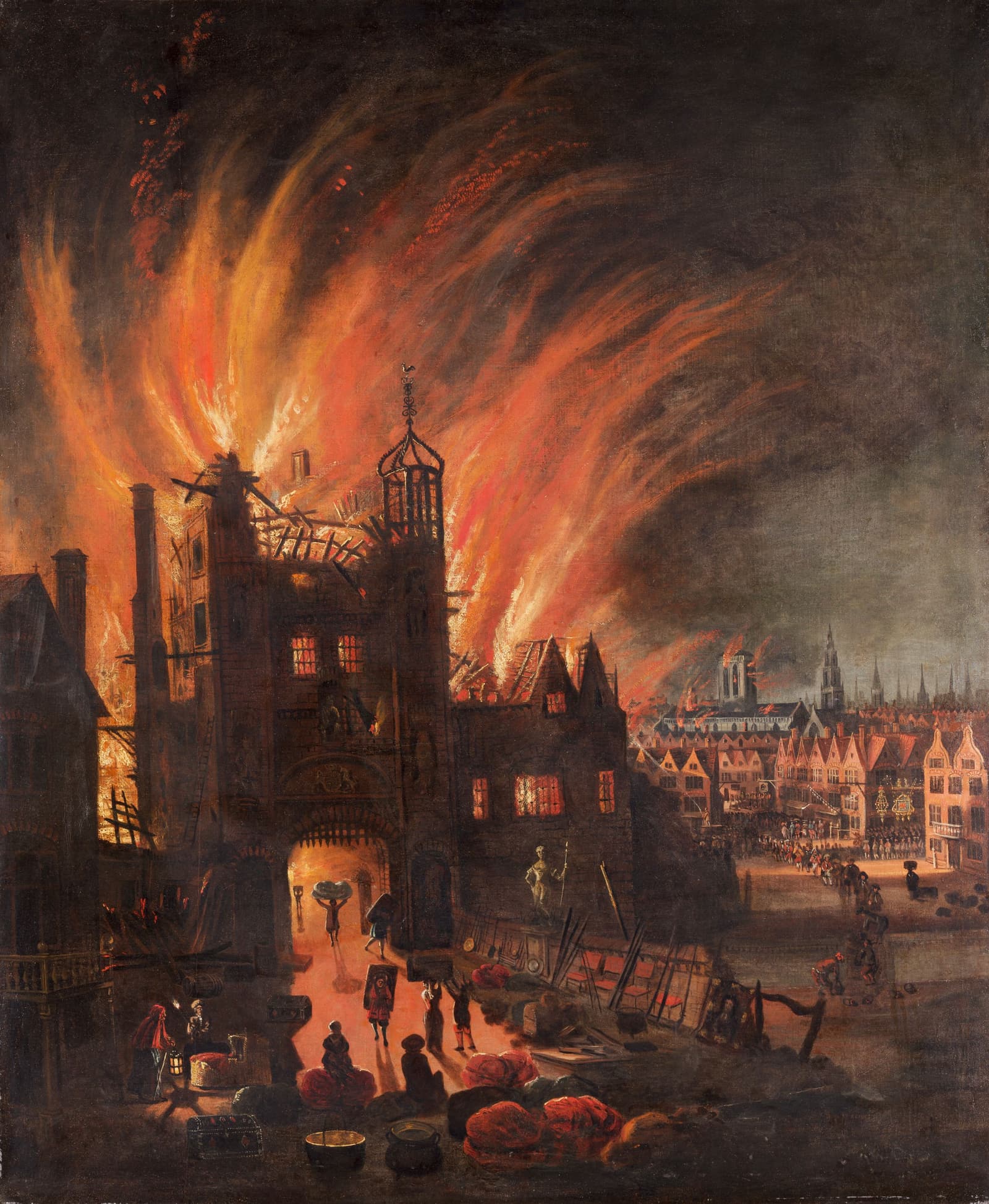
The Great Fire of London is usually told as spectacle: one bakery, four days, one city in flames. The more useful historical question is harder and more practical: how did a city that had just lost most of its core housing and civic buildings rebuild fast enough to stay economically alive, without getting trapped in endless property litigation?
This chronicle follows that question from 2 September 1666 through the first rebuilding years.
1) 2 September 1666, pre-dawn: ignition in Pudding Lane
Primary accounts place the start in the early hours near London Bridge and Thames Street. Samuel Pepys’s diary entry for Sunday 2 September records reports that the fire began in the king’s baker’s house in Pudding Lane and spread rapidly along dense riverfront streets storing combustible goods.[1]
The same day, the London Gazette’s notice described a "sudden and lamentable fire" beginning near London Bridge around two o’clock and already consuming many houses.[2]
At this point, what sources state is narrow: location, timing, and rapid spread. What later historians infer is the mechanism: timber-heavy buildings, narrow street fabric, drought conditions, and wind created a high-propagation urban fuel system.[3][4]
2) 2–3 September: response lag, then coercive firefighting
Pepys records a crucial tactical pivot. He reports telling Charles II and the Duke of York that stopping the fire required pulling down houses ahead of the flame front.[1] The Gazette report confirms direct royal involvement and deployment of guards to assist civic authorities.[2]
By Wednesday 5 September, Pepys describes large-scale demolition and use of gunpowder as the measure that finally created effective firebreaks, alongside weaker winds.[5]
This sequence matters because it marks a classic disaster-governance transition:
- Phase A: local officials and ad hoc bucket/hook response;
- Phase B: crown-backed coercive action (demolition, military labor, powder);
- Phase C: containment once fire spread outruns the built fabric.
3) 5 September and aftermath: urban loss at city scale
Damage estimates are consistent across major institutional summaries: roughly 13,200 houses and 87 parish churches lost, including old St Paul’s and major civic infrastructure.[3][4][6]
Oxford’s reconstruction estimates the burn footprint at about 373 acres within the walls plus 63 acres beyond, with 70,000–80,000 people left homeless; other public-history institutions cite around 100,000 displaced, which is best read as a broader upper estimate rather than a contradiction.[3][4]
Either way, the constraint was obvious by early September: London needed to restore legal certainty and building capacity faster than social disorder and capital flight could compound the shock.
4) The contested cause: plot narrative vs accident narrative
The fire’s cause was politically disputed almost immediately.
Interpretation A (contemporary rumor): hostile plot
Multiple contemporary witnesses recorded suspicion of French/Dutch or Catholic sabotage during wartime anxiety; Pepys’s entries also capture panic about foreign conspiracy.[5] This interpretation spread fast because it fit wartime fear and offered moral clarity in chaos.
Interpretation B (institutional inquiry): accidental origin + structural vulnerability
Later inquiry concluded accidental origin, and the famous Robert Hubert confession became unreliable once chronology and location evidence failed to support his claim.[3] In this reading, the decisive cause is not a hidden arson network but a known urban-risk stack: combustible materials, compressed streets, and delayed decisive intervention.[3][4]
What would change the assessment? A contemporaneous, independently corroborated forensic record proving intentional ignition by identifiable agents would materially shift the balance. No such evidence has displaced the accident consensus.
5) Winter 1666 to 1667: from emergency to legal architecture
The key post-fire achievement was not a perfect urban redesign. It was a governance package that made rebuilding executable.
First, Parliament created a special disputes judicature (the Fire Court pathway) to arbitrate landlord-tenant rebuilding conflicts quickly, limiting legal paralysis.[3]
Second, the Rebuilding of London Act (royal assent February 1667) imposed enforceable construction standards. The statute text explicitly requires new exterior building in brick or stone, defines street/lane categories, and sets structural rules and surveyor oversight.[7]
This is the crucial mechanism: dispute resolution + enforceable building code + administrative survey capacity.
6) 1668–1674: rapid reconstruction, partial redesign
Grand geometric plans by Wren, Evelyn, and Hooke were largely not implemented at full scale.[6] Property rights complexity and compensation limits constrained full replanning.[3][6]
Yet rebuilding throughput accelerated once legal and supply constraints loosened:
- about 1,450 houses rebuilt in 1668,
- around 6,000 houses completed by end 1670,
- most public buildings (except specific holdouts) rebuilt by 1674.[3]
So the city’s long-run form became a hybrid: stronger materials and somewhat adjusted street widths, but substantial continuity of pre-fire parcel logic and street alignments.[3][6]
Why this chronicle still matters
The Great Fire was not only a combustion event. It was a stress test of state capacity under urban-system collapse. The durable historical lesson is that recovery speed depended less on visionary urban drawings than on three boring but decisive levers:
- clear emergency authority,
- fast dispute adjudication,
- enforceable, inspectable construction standards.
That is why London could rebuild without fully reinventing itself.
Sources
- Samuel Pepys, diary entry (2 September 1666), transcription archive
- The National Archives, London Gazette report transcript (2 September 1666)
- Mark Goldie (University of Oxford), "Facing up to catastrophe: The Great Fire of London"
- London Museum, "The Great Fire of London"
- Samuel Pepys, diary entry (5 September 1666), transcription archive
- Encyclopaedia Britannica, "Great Fire of London"
- Statutes of the Realm (British History Online), Rebuilding of London Act text (1666/67)
- Wikimedia Commons file metadata (image source, c.1670 painting at Yale Center for British Art)