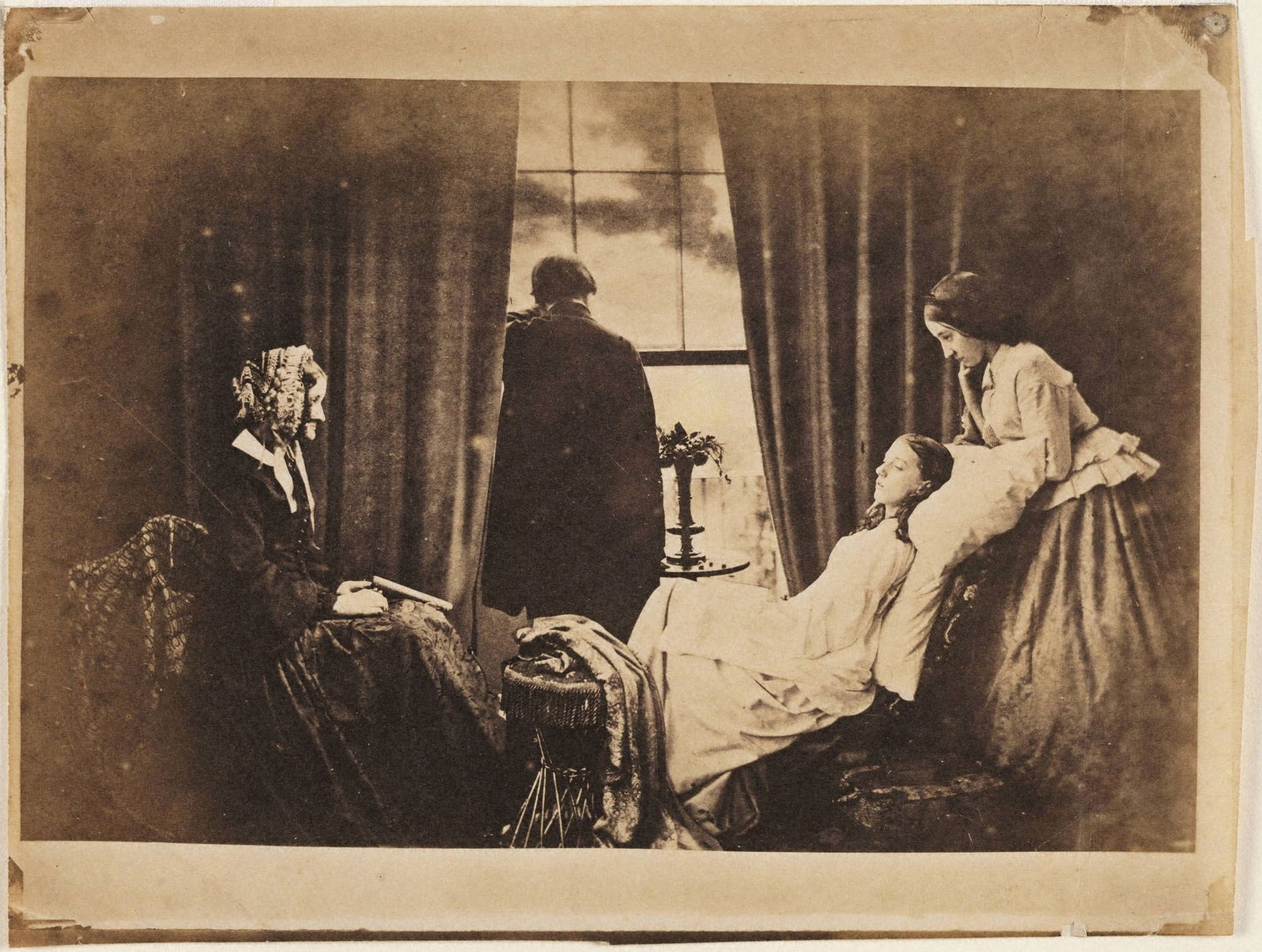
The man at the window has found somewhere else to look. For everyone else in Henry Peach Robinson’s Fading Away, including the person holding the photograph, there is the young woman in white. A companion bends over her. Across a little stretch of carpet, another woman sits watching. The man’s turned back makes it easy to imagine how long they have been here together. The time they seem to have spent in this room is among the things Robinson made in the printing. [1][2]
In 1858 Robinson put five glass negatives to work on a single picture. In combination printing, different negatives supply different parts of the image on one sheet of sensitive paper. The printer has to control where each exposure falls. A clean edge is only the beginning. A head that prints too large for the chair beneath it, or a patch of daylight too weak for the shadow beside it, can give the game away even when the boundary itself is invisible. Robinson’s finished photograph lets a viewer cross such boundaries without ever having to locate one. [1][2]
Consider what holds the left and right sides together. The woman on the left has enough room in front of her knees to stand up. Across that interval lies the girl, too weak, in the story the picture tells, even to sit upright unaided. The seated woman’s gaze carries across the gap. Cover her with a thumb and the pair on the right make a picture of physical care. Let her back in and a second kind of attendance appears. She can see perfectly well from where she sits. There is very little she can do. [1]
Robinson had already found a different use for the reclining figure. In his 1857 photograph She Never Told Her Love, a young woman rests against a field of deep black. The title comes from Viola’s speech about concealed love in Shakespeare’s Twelfth Night. Robinson exhibited the picture on its own, and it served as a study for Fading Away. Seen alone, the face gives a reader of the play somewhere to imagine a secret. Furnish the room and give the girl three companions, and the same pose raises a much more domestic question. Who can bear to watch? [2][3]
The distinction mattered to the people who saw the finished print. Some objected to the very presence of a photographer at what they took for an actual deathbed. Others understood that Robinson had staged and assembled the scene and took offense at the liberties he had taken with photography. Imagine trying to satisfy both viewers by disclosing how the print was made. The explanation that might reassure the first would give the second every reason to complain. [3]
In October 1858 the Illustrated Times carried the scene as a wood engraving. Its readers could follow the same glances across the same room, this time in lines cut by an engraver. That version offers a small experiment anyone looking at the photograph can repeat. Which part of the story requires a camera? A figure can turn his back just as eloquently in ink. What the photographic print adds is the unsettling sense that someone stood behind him while he did it. Five negatives went into making that one place for a witness to stand. [1][4]
Sources
- Princeton University Art Museum, Fading Away, object x1984-1, with the reproduced print and an account of combination printing.
- The Metropolitan Museum of Art, Henry Peach Robinson’s Fading Away, 1858, albumen silver print from glass negatives.
- The Metropolitan Museum of Art, She Never Told Her Love, 1857, on the Shakespearean study and the reception of the later photograph.
- The Metropolitan Museum of Art, Fading Away, wood engraving after Robinson in the Illustrated Times, October 30, 1858.