In 2003, two men in an exhibition of photographs from Art News caught curator Frank Goodyear’s eye. He knew who they were. Everett Shinn was a painter, Daniel Chester French a sculptor. What held him was the quality of the prints, and when he looked for the photographer’s name he found one he could scarcely place. Zaida Ben-Yusuf had photographed both men. The National Portrait Gallery, where Goodyear worked, already owned two of her portraits. Even there, it took a show about a magazine to bring her to his attention. [1]
Ben-Yusuf understood what a famous face could do for a photograph. Born in London to an Algerian father and a German mother, she moved to New York in 1895 and worked as a milliner. In 1896 she exhibited at a salon sponsored by the Linked Ring photographic society. By the following year she had a portrait studio at 124 Fifth Avenue. Edith Wharton and the actress Julia Marlowe were among her subjects. A reader who recognized one of her sitters in a magazine had a reason to pause on the page. Ben-Yusuf had her own ideas about what might keep the reader there. [1][2]
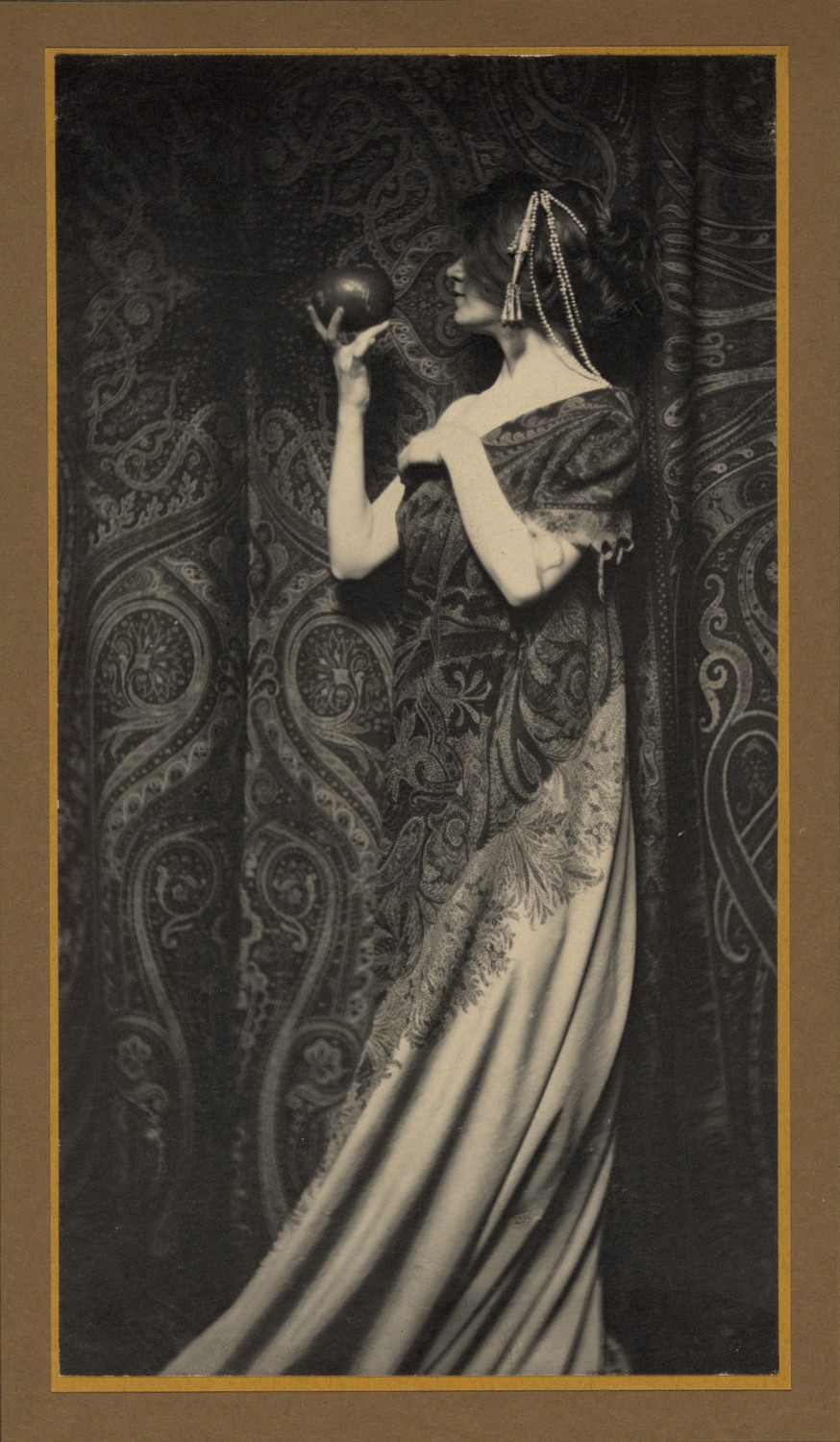
Consider the woman with a pomegranate. Ben-Yusuf gave this picture a title that leaves the sitter unnamed and directs us to a sense a camera can do very little with. You can see the weight of the fruit in the hand. To imagine its smell you have to measure the little interval between the fruit and the woman’s face. Follow her eyes and you find yourself attending to what interests her. For a photographer who earned her living giving strangers a good look at other people, that shift in the direction of attention feels particularly deft. [2][3]
The dress helps. Its long folds continue the rhythm of the hanging fabric behind the figure, so that the small movement of a hand lifting a fruit registers against a whole expanse of still cloth. By 1899 Ben-Yusuf had moved her business up Fifth Avenue to number 578, where tall windows admitted light from two sides. A former milliner working in a room like that would have known how much difference turning a head, a hat brim or a length of fabric could make. Years later she converted a studio into a dressmaking salon. Cloth kept its place in her working life on either side of the years she spent making pictures. [2][4]
The afterlife of a commissioned portrait depended partly on who wanted to keep it. In 1899 Ben-Yusuf photographed wildlife artist Ernest Thompson Seton for a magazine. More than a century later, Goodyear had a reproduction and wanted to find the print. He put the question to Seton enthusiasts. A tip about the artist’s papers led him to the New York Public Library, where he spent four hours going through picture files. The Seton portrait turned up in a manila envelope. By the time he finished looking, he had found eight Ben-Yusuf prints, including a photograph of Grover Cleveland out fishing. [1]
That envelope makes an oddly apt companion to the woman with the fruit. In one case Ben-Yusuf could withhold the sitter’s name and still give the viewer a reason to look. In the other, the sitter’s name became the best surviving lead to hers. To see Seton as one of Ben-Yusuf’s people again took someone willing to start where his admirers had left him and then keep looking through the file. [1][3]
Sources
- Michael Lipske, “Research brings the life of a little-known portrait photographer into focus,” Inside Smithsonian Research, Spring 2007, pp. 3–5
- Hundred Heroines Museum, “Zaida Ben-Yúsuf,” biography and photographs
- Kristi Finefield, “Finding Pictures,” Library of Congress, with the archival reproduction of The Odor of Pomegranates
- New York Almanack, “Anna Ben-Yùsuf,” on the family’s millinery work and Zaida’s Fifth Avenue studios