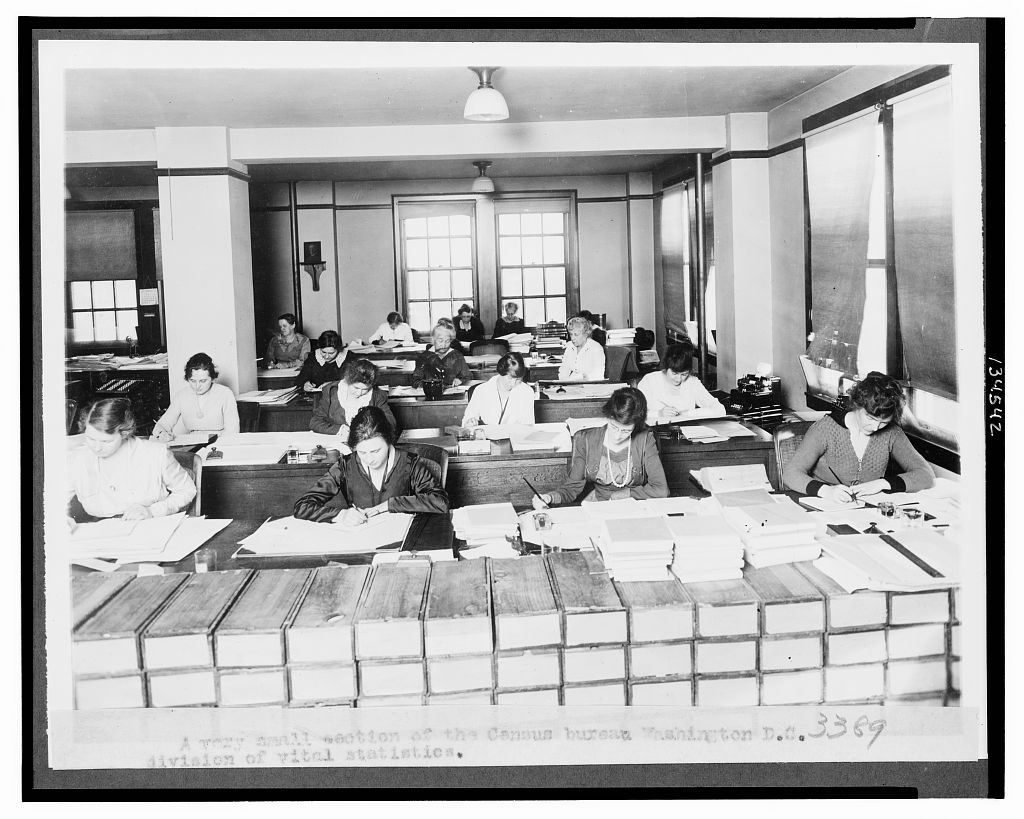
The photograph is almost all desks. Between 1910 and 1930, women in the U.S. Census Bureau's Division of Vital Statistics sat in long ranks beneath high windows, reading, sorting, and transforming records of individual deaths. The Library of Congress catalogue calls the room only “a very small section” of the division. Its scale still pushes beyond the frame.[7]
Every national mortality table passed through work like this. A physician might write cardiac failure, tuberculosis of the lung, puerperal fever, or two conditions linked by an uncertain sequence. A clerk then had to place those words into a limited statistical category, following rules precise enough that another office could reach the same result. The certificate described one death. Classification made that death countable beside thousands of others.
That distinction is the story. Public health did not gain comparable mortality evidence simply because doctors became better at naming disease. It gained it by constructing a common language—and by building revision conferences, manuals, certificates, indexes, coding rules, and clerical offices around that language. The sharp question is not who invented the first disease list. It is how a cause written in one city became comparable with a cause written somewhere else without pretending that either record was complete.
1891–1893: one list, in three levels of detail
Nineteenth-century statisticians already understood the problem. Cities and countries published mortality tables, but their local lists grouped diagnoses differently. One office might separate forms of tuberculosis by organ; another might gather them under a single infectious-disease heading. A total could look precise while resisting comparison.
At the International Statistical Institute's 1891 meeting in Vienna, Jacques Bertillon—physician, demographer, and chief of statistics for Paris—was asked to lead a committee on causes of death. When the institute met in Chicago in 1893, his committee presented three linked classifications containing 44, 99, and 161 conditions. The short list summarized the longer ones, allowing an administration with modest capacity to publish fewer categories without breaking its relationship to the detailed system.[1]
That nested design was a quiet administrative insight. International agreement did not require every town to operate the same size office. It required the categories to roll up in the same direction. A tuberculosis death could retain more detail in one table and less in another, yet both could still belong to a shared statistical family.
Bertillon also treated coding as a rule-bound act rather than an invitation to improve the doctor's prose. His guidance told clerks how to handle an omitted anatomical site, an operation entered as a cause, or more than one condition on the certificate. Most important, the clerk was to classify what had been written, not silently replace it with what the physician might have meant.[1] That boundary limited imaginative correction. It also preserved a visible distinction between evidence and inference.
The International Statistical Institute adopted the committee's report in 1893. The event later became the origin point of the International List of Causes of Death, but the list's real innovation was not a set of numbers attached to diseases. It was an agreement that the same reported condition should meet the same category wherever possible.[1][2]
1897–1901: comparability acquired a revision clock
A fixed list would soon become obsolete. A constantly changing list would destroy the trend lines it was meant to support. The next step was therefore a bargain between scientific change and statistical continuity.
The American Public Health Association recommended adoption of the Bertillon classification by registrars in the United States, Canada, and Mexico in 1897. In 1898, it added the proposal that the list be revised every ten years. By the International Statistical Institute's 1899 meeting, the classification had appeared in French, English, Spanish, and German and had spread through North America, parts of South America, and some European cities.[1]
France convened the first international revision conference in Paris in August 1900. Delegates from 26 countries adopted a detailed classification of 179 groups and an abridged one of 35 groups, recommended their use from the beginning of 1901, and accepted recurring revision as part of the system.[2] A cause-of-death list had become an international process.
The ten-year rhythm mattered for two opposing reasons. Revision let new diagnoses enter and old boundaries move with medical knowledge. Restraint kept a count from changing merely because a category had been casually renamed. Later statisticians would develop bridge coding and comparability ratios to measure how many deaths moved between categories when one revision replaced another.[1] The list could evolve, but the break had to be studied.
1900–1933: the United States could standardize only the deaths it registered
The United States put the international classification to work at scale in 1900, but “national” mortality statistics were not yet national in coverage. Only ten states and the District of Columbia initially met the Census Bureau's requirements for the Death Registration Area. The area held 30,765,618 people, or 40.5 percent of the continental U.S. population, and recorded 539,939 deaths that year.[1][3]
Those numbers establish both achievement and limit. More than half a million certificates could now be compiled with one classification. Most of the country still sat outside the accepted registration area. Nationwide coverage did not arrive until 1933.[1]
The Census Bureau's Mortality Statistics 1908 made the labor behind the tables unusually explicit. Uniform titles were not enough; trained coders had to apply definite rules under medical supervision, and registrars had to query physicians when a certificate was indefinite or ambiguous.[3] The vital-statistics office was therefore not a warehouse for finished facts. It was a place where reported language was tested against a public rulebook.
That is what the cover photograph records. The women at those desks were not decorative background to Bertillon's classification. They were the system's operating layer. Each certificate had to be read, assigned, checked, and added before a category could become a rate. Standardization lived in repeated judgment.
It also exposed the difference between consistency and truth. Two clerks could code the same vague statement consistently and still preserve the vagueness. A shared list could not supply a missing death, improve a physician's diagnostic access, or repair a jurisdiction that failed to register deaths at all. It could only make the treatment of the available record more reproducible.
1909–1938: every revision threatened the history it extended
The second revision conference met in Paris in 1909, one year early because the U.S. Census Office wanted the new list ready for statistics based on the 1910 census. Its expanded alphabetical index ran to 1,044 typewritten pages, a reminder that categories work only if the many phrases physicians actually use can be routed into them.[1]
For the 1920 revision, Bertillon circulated proposals to more than 500 people working in classification, medicine, and statistics. After his death in 1922, international committees continued the decennial structure through revisions in 1929 and 1938.[1][2] The durable invention was now bigger than its principal organizer: a procedure for soliciting, testing, narrowing, and adopting changes.
Yet revision created its own hazard. If a death moved from one category to another under a new manual, a graph could jump even when the population's health had not. The 1938 conference therefore recommended classifying the same 1940 deaths under both the fourth and fifth revisions to create a bridge between them.[1] Comparison required more than using the newest list. It required measuring what the new list did to the past.
This is why historical mortality series are constructed evidence, not a transparent window. They contain actual deaths and actual certificates, but also diagnostic habits, registration coverage, coding choices, and category revisions. The classification makes those layers more governable; it does not erase them.
1945–1948: the list crossed from death into illness
By the end of the Second World War, a classification built primarily for mortality could no longer satisfy governments that also wanted statistics on hospital diagnoses and nonfatal disease. Canada, Britain, and the United States had developed separate morbidity codes because the existing international list did not serve that work well.[1]
In 1945, the U.S. Committee on Joint Causes of Death began addressing two linked problems: how to select one main cause when a certificate reported several, and how to build a classification useful for illness as well as death. A draft combined list was tested on mortality and morbidity records in Canada, England and Wales, and the United States. The tests exposed practical problems before the scheme moved to international adoption.[1][5]
The Sixth Revision Conference met in Paris from 26 to 30 April 1948. The proposal had roughly 800 categories when injuries were grouped by their bodily nature and 765 when they were grouped by external cause. It expanded the system explicitly to nonfatal diseases and injuries, supplied a broader index, and introduced a recommended certificate designed to show the sequence leading to death.[1][5]
That sequence resolved a persistent statistical problem. A final mechanism such as heart failure might appear beside the disease that initiated the fatal chain. For primary tabulation, the sixth revision centered the underlying cause: the disease or injury that started the sequence of events leading directly to death, or the circumstances that produced a fatal injury.[6] This was not a claim that only one condition mattered medically. It was a rule for choosing one comparable starting point while the certificate retained the rest of the chain.
The First World Health Assembly endorsed the sixth revision in 1948, and the list became the International Statistical Classification of Diseases, Injuries and Causes of Death—the decisive transition from an international death list to the modern ICD family.[1][5]
A common language is a tool, not a guarantee
The chronology can sound like a march from disorder to perfect information. The evidence supports a narrower conclusion. Between 1893 and 1948, international health statistics acquired a common vocabulary, a revision schedule, rules for selecting an underlying cause, and an institutional home. Those changes made comparisons possible in a way that local lists could not.[1][2][5]
They did not make every comparison sound. WHO's mortality system still treats registration coverage as a threshold question: country-years displayed in its portal must have at least 65 percent of deaths registered, and some countries do not report causes using ICD codes.[4] Even complete registration cannot remove differences in diagnostic resources or certifier practice. And every major revision can introduce a break that must be measured rather than wished away.[1]
The best way to read a mortality table is therefore neither as bureaucratic fiction nor as raw nature. It is a disciplined translation. A person dies; someone records a causal sequence; a clerk or system assigns codes; rules select an underlying cause; a statistical office aggregates the result. Each step can add comparability, and each step can lose information.
The Census Bureau photograph makes that chain visible. Its desks show that a cause of death did not travel by itself. It traveled because people agreed on names, documented exceptions, revised those names cautiously, and repeated the classification work certificate by certificate. The same death needed the same name in every city. It also needed an honest record of how that name was made.
Sources
- Harry M. Rosenberg, Donna L. Hoyert, and colleagues, History of the Statistical Classification of Diseases and Causes of Death, National Center for Health Statistics (2011) — detailed institutional history of the Bertillon lists, U.S. registration coverage, decennial revisions, coding practice, bridge studies, and ICD-6.
- World Health Organization, ICD-10, Volume 2: Instruction Manual, “History of the Development of the ICD” (2010 edition) — official chronology of international adoption, the 1900 conference, and successive revisions.
- U.S. Bureau of the Census, Mortality Statistics 1908 — primary administrative account of the international classification's U.S. use, the 1900 registration-area scale, and the need for trained coding and physician queries.
- World Health Organization, “About the WHO Mortality Database” — official timeline beginning with the 1893 International List and the portal's current registration-coverage boundary.
- World Health Organization, Report of the International Conference for the Sixth Decennial Revision of the International Lists of Diseases and Causes of Death (Paris, April 1948) — primary resolutions on a shared mortality-and-morbidity classification and international coding.
- World Health Organization, “Cause of death” — current definition of the underlying cause and explanation of the certificate-to-code-to-selection chain used for mortality statistics.
- Library of Congress, “A very small section of the Census Bureau, Washington, D.C.—Division of Vital Statistics” (between 1910 and 1930), National Photo Company Collection — machine-readable catalogue record and source for the archival cover photograph.