Yellow fever in Cuba is often retold as a clean eureka moment: Walter Reed arrives, sees what others missed, and solves one of tropical medicine's great mysteries. The archival record supports a narrower and more useful reconstruction. Carlos Finlay had already spent years arguing that a specific mosquito carried the disease. Jesse Lazear made that hypothesis operational by breeding and infecting mosquitoes. Reed's board then built a controlled test at Camp Lazear that separated mosquito bites from contaminated bedding, clothing, and room air.[1][2][3][4][5][6]
That sequence matters because the board did more than identify a vector. It changed the method of public-health proof. Instead of treating yellow fever as one atmospheric curse with many plausible causes, the investigators staged rival pathways under quarantine and asked which one still produced disease. Camp Lazear became important because it converted an argument about plausibility into an argument about sequence, incubation, and controlled exposure.[2][3][4]
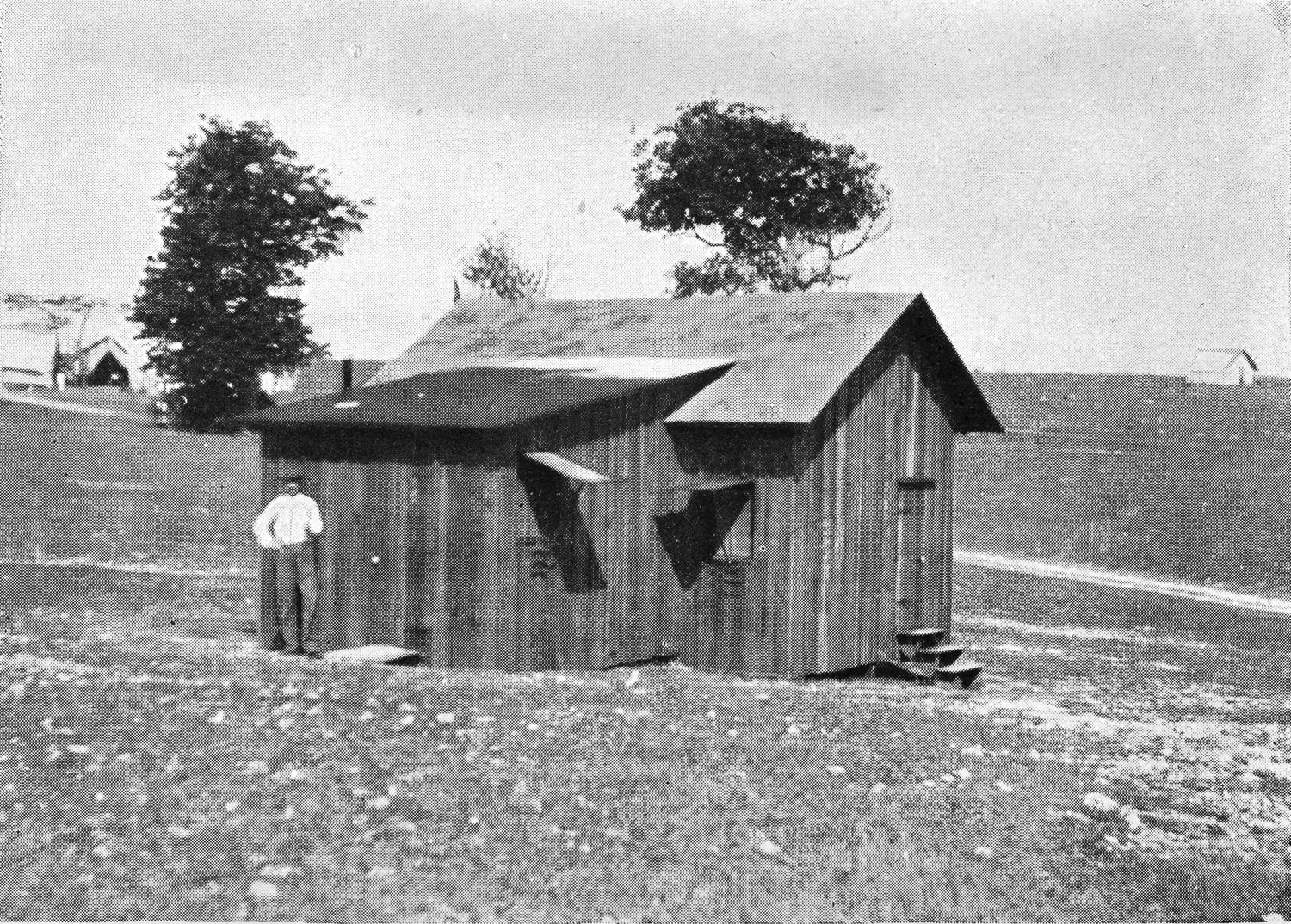
Image context: the cover image is a real archival photograph of Camp Lazear. It belongs here because this article is about experimental layout as much as medical theory; the physical separation of tents, buildings, screens, and volunteers was part of the proof itself.[7]
Timeline anchors before interpretation
- 1881: Carlos Finlay formally presents the mosquito-transmission hypothesis in Havana, identifying what is now known as Aedes aegypti, but he cannot persuade the wider medical world with proof strong enough to displace competing theories.[2][3][5][6]
- 1898: During the Spanish-American War, yellow fever kills far more U.S. troops than combat, turning an old coastal scourge into an urgent military and public-health problem.[2][5]
- June 1900: the U.S. Army Yellow Fever Board reaches Cuba under Walter Reed and consults Finlay, who shares his publications and mosquito material with the commission.[2][6]
- August-September 1900: Lazear's mosquito-feeding experiments begin; James Carroll becomes ill after a late-August bite, and Lazear dies in September after contracting yellow fever.[2][3][4]
- November-December 1900: Camp Lazear runs the controlled bedding-versus-mosquito experiments that finally isolate the transmission pathway.[1][3][4]
- February 1901 and after: Reed presents the findings publicly, and mosquito-control work in Havana rapidly changes the city's disease environment.[1][2][5][6]
1. Before Camp Lazear, Finlay had the right direction but not decisive authority
The first thing the event reconstruction changes is the cast of the story. Yellow fever did not become a mosquito disease only when the U.S. Army noticed it. PBS's scientific-method chronology and the Finlay retrospective both make clear that Finlay had proposed mosquito transmission in 1881, long before Reed's board arrived in Cuba.[2][6] The problem was not absence of theory. The problem was authority strong enough to beat older explanations.
Those older explanations were durable because they matched ordinary observation well enough. Outbreaks clustered in heat, filth, crowding, ports, and military encampments. If one looked only at pattern without controlled testing, contaminated bedding, soiled clothing, direct contact, and "bad air" all retained explanatory power.[2][3][5] Finlay's problem was therefore methodological as much as biological. A correct theory still had to survive a field in which several wrong theories also looked superficially plausible.
The war context sharpened the stakes. Yellow fever had already terrorized Atlantic and Gulf cities for centuries, but the 1898 U.S. military experience in Cuba made the cost newly intolerable.[2][5] When Reed's board arrived in 1900, it entered a scene in which the disease was not just a scientific puzzle. It was a strategic obstacle. That urgency helps explain why the commission was willing to move beyond descriptive observation into human experimentation.
2. August-September 1900: the board learns that timing is the missing variable
The summer experiments are important because they show that Finlay's theory was incomplete in the eyes of skeptics, not absurd. According to PBS, Lazear bred Finlay's mosquitoes, exposed them to yellow fever patients at Las Animas Hospital, and used them in a series of bites during August 1900.[2] Early trials produced no illness. Then a mosquito placed on James Carroll in late August was followed by Carroll's disease a few days later, and a soldier volunteer also became sick.[2] Shortly afterward, Lazear himself contracted yellow fever and died in September 1900.[2][4]
That sequence could have remained tragic but inconclusive. What changed it was the incubation clue. The Camp Lazear account notes that the decisive mosquitoes had fed on yellow fever patients at least 12 days earlier, leading Reed to infer that the infectious agent required time inside the mosquito before transmission became possible.[3] This detail matters because it explains why Finlay's earlier attempts had not fully convinced the field. The right insect was not enough by itself; the timing of that insect's infectiousness also mattered.
In other words, the board did not simply "discover the mosquito." It discovered the experimental conditions under which the mosquito theory became reproducible. That is a different and stronger claim.[2][3][4] The evidence no longer rested on one dramatic illness or one unfortunate death. It was moving toward a design in which the rival explanations could be staged side by side.
3. November-December 1900: Camp Lazear turns a crowded controversy into a clean test
Camp Lazear was the hinge because it forced the competing theories into different rooms. PBS's reconstruction of the site is unusually concrete. Reed's team set up an "infected clothing building" filled with bedding, clothes, and towels soiled by yellow fever patients, and a separate "mosquito building" with a screened partition that let some men remain near the environment while shielding them from bites.[3] Seven tents for volunteers surrounded the site, and the camp was guarded. The point was not theatrical drama. The point was physical separation.
The volunteer protocol also deserves to remain visible. PBS reports that the subjects included Army personnel and Spanish immigrants, and that they were paid $100 to participate plus an additional $100 if they became infected.[3] English's 2018 review reads Camp Lazear as a model for focused clinical research because the board asked a sharply bounded question and constructed a design that could return a definitive answer.[4] That assessment is methodologically useful, but the payment structure reminds you that this clarity was purchased through risk borne by real human subjects.
The results were devastating to fomite theory. Beginning on November 30, 1900, volunteers in the infected-clothing building slept among foul linens and garments for twenty nights and handled the materials repeatedly; none developed yellow fever.[3] In the mosquito building, by contrast, John Moran was bitten by infected mosquitoes and became ill on December 25. PBS reports that five of seven additional volunteers exposed in the large mosquito compartment also developed the disease, while the men in the screened compartment did not.[3]
That layout is why Camp Lazear still reads as exemplary event reconstruction rather than as legend. One building loaded the old explanation as heavily as the investigators could manage and produced no cases. The other building created a sterile environment except for infected mosquitoes with the proper incubation period and produced disease.[3][4][5] The board was no longer arguing that mosquitoes were one plausible route among several. It was showing that mosquitoes could transmit yellow fever even when bedding and clothing were neutralized, while bedding and clothing failed even when made maximally disgusting.
4. The proof mattered because it could be turned into city-scale control
Evidence alone does not always change practice quickly. In Havana, this time it largely did. The scientific-method summary and the Finlay retrospective both connect the board's proof to William Gorgas's later mosquito-control program, which brought yellow fever in Havana to a near-immediate halt.[2][6] That operational shift is the real endpoint of the event.
Before the mosquito proof, public-health effort could be squandered on disinfecting goods, policing contact, or fearing contaminated objects without clarity about causal priority.[2][3][5] After Camp Lazear, the control target became specific: breeding sites, mosquito exposure, screening, and urban sanitation directed toward Aedes aegypti.[2][6] The event therefore changed not only laboratory opinion but municipal labor. It told cities what kind of work actually interrupted transmission.
This is also the place where the Reed myth becomes least useful. If one reads the story only as heroic discovery, the afterlife looks automatic. Read as reconstruction, the chain is more precise. Finlay proposed the vector. Lazear handled the entomological work that made exposure experiments possible. Reed organized the proof structure and public presentation. Havana's disease environment changed when that proof was translated into systematic anti-mosquito operations.[2][3][6] The public-health win belongs to the whole chain.
The strongest two interpretations
Interpretation A: Walter Reed was the singular discoverer who solved yellow fever
This interpretation survives because Reed became the public face of the commission and because his name attached neatly to the triumph narrative. It captures part of the record: he did lead the board, shape the final proof sequence, and present the findings publicly.[1][2] It explains commemoration. It does not fully explain discovery.
Interpretation B: the decisive breakthrough was a collaborative proof chain that began with Finlay and ended with Camp Lazear
This interpretation fits the sources better. Finlay's mosquito theory predated the commission by nearly two decades, and the board relied on his publications and mosquito material.[2][6] Lazear's late-summer experiments supplied the incubation clue, and Camp Lazear's design settled the transmission dispute by discrediting fomites and isolating the mosquito pathway.[2][3][4] Reed's importance stays intact inside this reading, but it becomes the importance of orchestration and proof, not solitary origination.
What the reconstruction changes
The cleanest conclusion is narrower than the schoolbook version and stronger as history. Camp Lazear settled the yellow fever argument because it converted a city of competing impressions into a controlled sequence of exposures.[1][2][3][4] Once the disease could be made to appear with incubated mosquitoes and fail to appear with infected bedding, the center of gravity moved from theory to operations.
That is why the episode still matters in present-tense health thinking. Public health advances when a mechanism becomes controllable enough to reorganize labor, infrastructure, and policy. Camp Lazear did exactly that. It showed that proof is strongest when it does two things at once: it identifies what causes disease, and it strips wasted effort away from everything that does not.[2][3][4][6]
Sources
- U.S. Army Yellow Fever Commission, Papers and Reports Relating to the Etiology and Prevention of Yellow Fever (National Library of Medicine PDF of the original report collection, 1901).
- PBS American Experience, "Yellow Fever and the Scientific Method" (Finlay hypothesis, 1900 board chronology, and Havana mosquito-control aftermath).
- PBS American Experience, "Camp Lazear" (controlled design, volunteer protocol, and bedding-versus-mosquito results).
- Peter C. English, "Walter Reed at Camp Lazear: A Paradigm for Contemporary Clinical Research" (The Linacre Quarterly, 2018; PubMed abstract).
- Francis Delaporte, "(Centenary of the discovery of yellow fever virus and its transmission by a mosquito (Cuba 1900-1901))" (Med Trop (Mars)., 2003; PubMed record).
- Charles S. Bryan, "Carlos Finlay and yellow fever: triumph over adversity" (Military Medicine, 2006; PubMed record).
- Wikimedia Commons, "File:Camp Lazear Wellcome L0000010.jpg" (archival source page for the article image).