Florence Nightingale is still trapped inside one of medicine's most durable pictures: the woman with the lamp walking night rounds in Scutari. The picture is not false. It is incomplete. If you keep only the lamp, you lose the larger historical achievement. Nightingale's real force came from turning a military hospital disaster into something the British state could no longer call unfortunate chaos. She made it countable, sanitary, and redesignable.[1][2][3]
That is why the Crimean episode still matters. Many medical heroes are remembered for one treatment or one theory. Nightingale's more durable contribution lay in the space between care and administration. She arrived at Scutari in 1854 as a superintendent of nurses; she emerged from the war as a builder of reports, hospital principles, training systems, and a new kind of public-health argument about how institutions kill when dirt, drainage, crowding, and supply failure are allowed to masquerade as fate.[1][2][4][5]
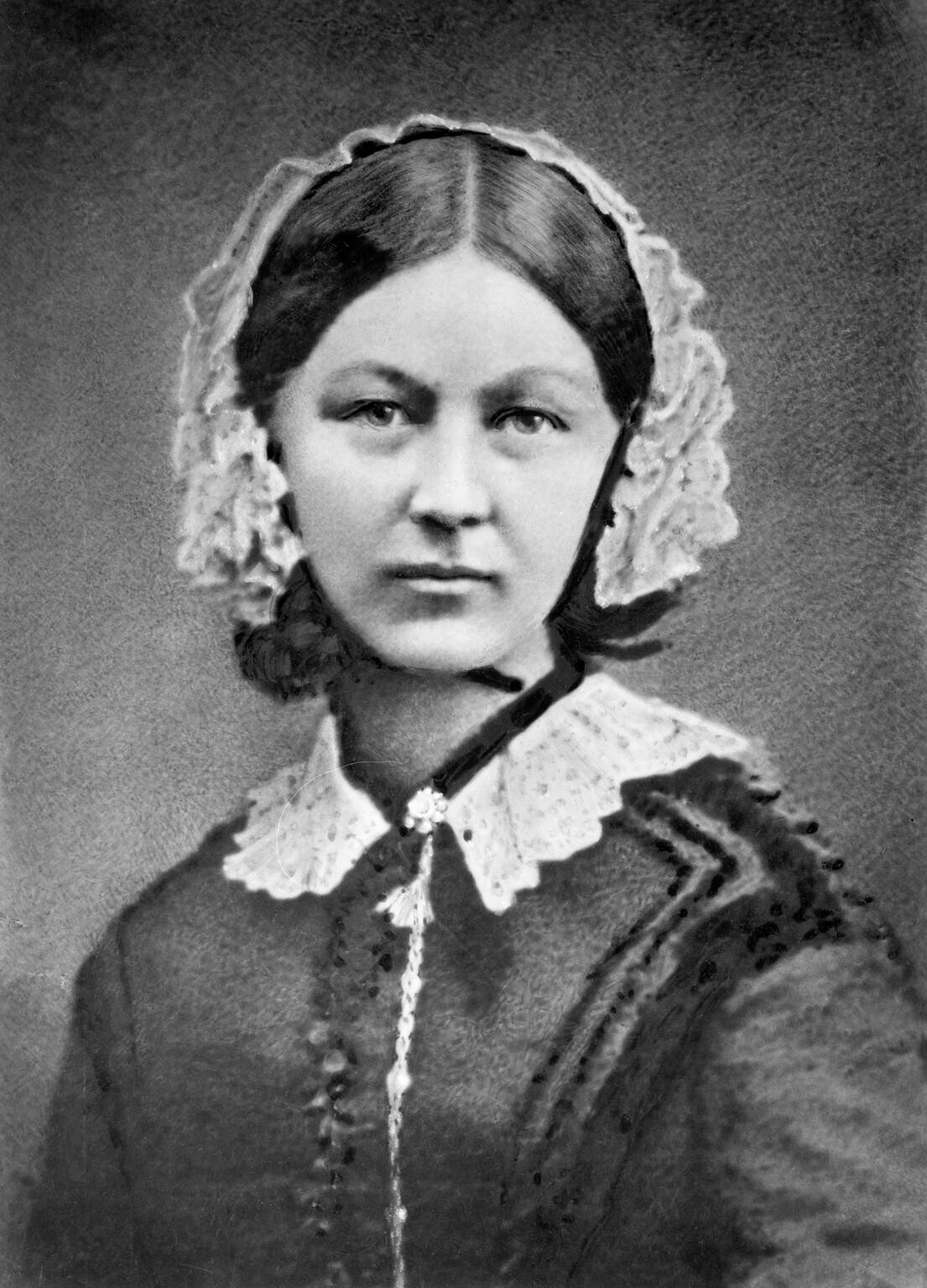
Image context: the cover uses a real photographic portrait of Nightingale. That is deliberate. This article is about the movement from mythic bedside presence to administrative power, and a formal portrait captures the public authority she later carried into hospital reform and state health policy.[6]
Timeline anchors before interpretation
- October-November 1854: under Sidney Herbert's authority, Nightingale took 38 volunteer nurses to the British military hospital at Scutari, where they arrived to find catastrophic sanitary conditions.[2]
- Winter 1854 to February 1855: disease mortality in Scutari rose sharply, with Nightingale's later tables placing the peak before the major sanitary turnaround.[1][3]
- March 1855: a government Sanitary Commission reached Scutari to flush sewers, improve drainage, and repair ventilation, after which mortality fell rapidly.[2][3]
- 1858: Nightingale completed her vast report, Notes on matters affecting the health, efficiency and hospital administration of the British Army, turning wartime experience into a state reform document.[1]
- 1859: Notes on Hospitals extended the argument from army barracks to hospital architecture and management.[4]
- 1860: the first nurses began training at Florence Nightingale's school at St Thomas' Hospital in London, giving her Crimean lessons an institutional afterlife.[5]
Those dates matter because they show a change in scale. Nightingale moved from one hospital's emergency to a program for redesigning hospitals and training the people who would run them.
Before Scutari, the useful part of Nightingale was already administrative
The later myth often makes Nightingale look like a sudden wartime apparition, as if the Crimea transformed a private gentlewoman into a nurse by moral force alone. The historical record points somewhere more disciplined. She already cared about organization, religious vocation, and the practical management of institutions before the war. The Crimea did not invent her seriousness. It gave it an arena in which institutional failure was so obvious that observation could become leverage.[2]
That leverage started with an unusually ugly reality. The Scutari barrack hospital was overcrowded, undersupplied, and filthy. PMC's historical summary is concrete enough to keep the scene from drifting into legend: there were no towels, basins, or soap, and only 14 baths for approximately 2,000 soldiers.[2] Medicine was in short supply, the linen was dirty, vermin were everywhere, and infections spread through a system that barely functioned as a hospital at all.[2] Nightingale's first work therefore belonged to logistics as much as compassion. She bought towels, secured shirts, improved food, cleaned kitchens, and turned her nurses toward the physical environment instead of only bedside consolation.[2]
That is the first correction worth making. Nightingale did not walk into a coherent ward system and simply add kindness. She entered an institution whose environment was itself pathogenic. The practical work began with supply, laundering, cooking, and cleaning because the hospital's basic operating conditions had already collapsed.[2][3]
The mortality story is stronger once the legend is made less simple
This is where Nightingale's history is often flattened. Popular memory likes a direct line: Nightingale arrives, sanitation improves, deaths fall. Later statistical reading made the sequence harder and more interesting. As later work on Nightingale's Crimean statistics argues, the death rate peaked in February 1855, and the sharp decline followed the arrival of the Sanitary Commission in March 1855, when drainage, sewage, and ventilation defects were finally attacked at infrastructure level.[3]
That revision does not diminish Nightingale. It changes what sort of historical actor she was. If one insists on a lone-savior model, then the Sanitary Commission becomes an embarrassment. If one reads her as a systems reformer, the sequence becomes clearer. Nightingale's importance lay in recognizing that ward care could not be separated from sewers, kitchens, laundry, ventilation, and record-keeping. The Commission handled some of the heavy engineering work; Nightingale helped make the institutional horror visible and later made it governable on paper.[1][2][3]
The difference matters because it rescues her from sentimentality. A sentimental heroine soothes suffering. A systems reformer changes the denominator of suffering. Nightingale belongs in the second category. Even where others carried out parts of the sanitary rescue, she was central to the larger reframing: deaths from typhus, typhoid, cholera, and dysentery should be read as failures of administration, not as unavoidable background to war.[1][2]
After the Crimea, Nightingale turned one war hospital into a state argument
The most durable part of the Nightingale story happened after the famous rounds. In 1858, she produced Notes on matters affecting the health, efficiency and hospital administration of the British Army, a document so large and so systematic that it moved beyond memoir altogether.[1] This was not a moral diary from Scutari. It was a reform machine: tables, comparisons, and administrative reasoning designed to force army health into the language of preventable loss.
That transition from witness to analyst is what made her historically dangerous in the best sense. Once the army's mortality could be arranged into comparative tables, the state could no longer pretend that disease deaths were simply the weather of war. Statistical display became a form of accusation. Nightingale's later reputation as a pioneer of hospital statistics exists for good reason: she used numbers to convert scattered misery into a claim about how institutions should be rebuilt.[1][2][3]
She then widened that claim. Notes on Hospitals pushed the same logic into civilian design: wards, pavilions, spacing, ventilation, and circulation were all part of medical outcome, not neutral architecture.[4] The war had taught her that bad hospital form could manufacture infection. Postwar writing turned that lesson into design doctrine.
The final hinge is training. King's official history notes that in 1860 the first nurses began training at Nightingale's school at St Thomas' Hospital.[5] That date matters because it shows how Crimea became infrastructure. If Scutari had remained only a story of one remarkable woman under pressure, the effect would have faded with memory. Training school, hospital design principles, and official reporting gave the episode institutional persistence.
The strongest two interpretations
Interpretation A: Nightingale's main contribution was personal bedside heroism
This interpretation survives because it is visually irresistible. The lamp rounds, the exhausted soldiers, the lone competent woman inside a bureaucratic disaster: the imagery carries moral force, and it captures a real part of her public authority.[2][6] It also explains why her memory traveled so easily.
Interpretation B: Nightingale's decisive contribution was converting ward suffering into a systems problem of sanitation, measurement, and design
This interpretation fits the evidence better. The Scutari crisis was environmental and administrative from the start.[2] The mortality turn is more accurately placed alongside the March 1855 sanitary intervention than in a pure bedside miracle story.[3] Her postwar reports and hospital-design work show where the deepest impact landed: on the state's ability to measure preventable loss and on institutions' obligation to redesign the conditions producing it.[1][4][5]
Interpretation A keeps the emotional truth. Interpretation B explains the historical durability.
Why this microhistory still matters
The Nightingale story remains contemporary because health systems still fail in the same layered way. Public praise often attaches to the visible rescuer at the edge of crisis, while mortality frequently turns on less photogenic things: ventilation, staffing, waste removal, records, procurement, bed spacing, and whether institutions notice the pattern soon enough to admit responsibility.
Nightingale's afterlife therefore belongs in public health as much as in nursing memory. She showed that care can widen into governance when someone forces a hospital's hidden mechanics into view. The lamp mattered because it made her legible to the public. The tables mattered because they made the institution legible to the state. That second achievement is why her work outlived the ward.
Sources
- Florence Nightingale, Notes on matters affecting the health, efficiency and hospital administration of the British Army (1858, Wellcome Collection scan).
- Lynn McDonald, "Florence Nightingale and the Crimean War" - conditions at Scutari, the 38 nurses, and the sanitary crisis (PMC).
- Colin Begg, "Nightingale Statistics and the Crimean War" - mortality timing, statistical interpretation, and the March 1855 sanitary-turn argument (Campaign for the Welfare of Florence Nightingale).
- Florence Nightingale, Notes on Hospitals (Wellcome Collection record).
- King's College London, Florence Nightingale Faculty history - 1860 training-school timeline at St Thomas' Hospital.
- Wikimedia Commons, direct file delivery URL for "Florence Nightingale (H Hering NPG x82368).jpg" - source image used in the article.