The 1950 Doll and Hill paper is often remembered as the moment medicine finally learned that cigarettes cause lung cancer. That memory gets the direction right and the document wrong. Read closely, the paper does something more specific and more durable. It takes smoking out of the realm of anecdote, morality, and urban suspicion, and turns it into something epidemiology can count: a graded exposure that can be compared across matched patients, tested against alternative explanations, and linked to a sharply specific disease pattern.[1]
That is why the paper still matters. The argument is forceful, but it is not reckless. Doll and Hill do not write as if one hospital study can close the whole causal case forever. They show a real association, show that the association strengthens with heavier smoking, show that it is specific to lung cancer rather than to all hospital illness, and then mark the remaining inferential gap in full view.[1] Later work, especially the British doctors follow-up and the 1964 Surgeon General report, would harden that gap into institutional causation.[2][3][4] The breakthrough in 1950 was earlier in the chain. It was a change in method and language: smoking became measurable.
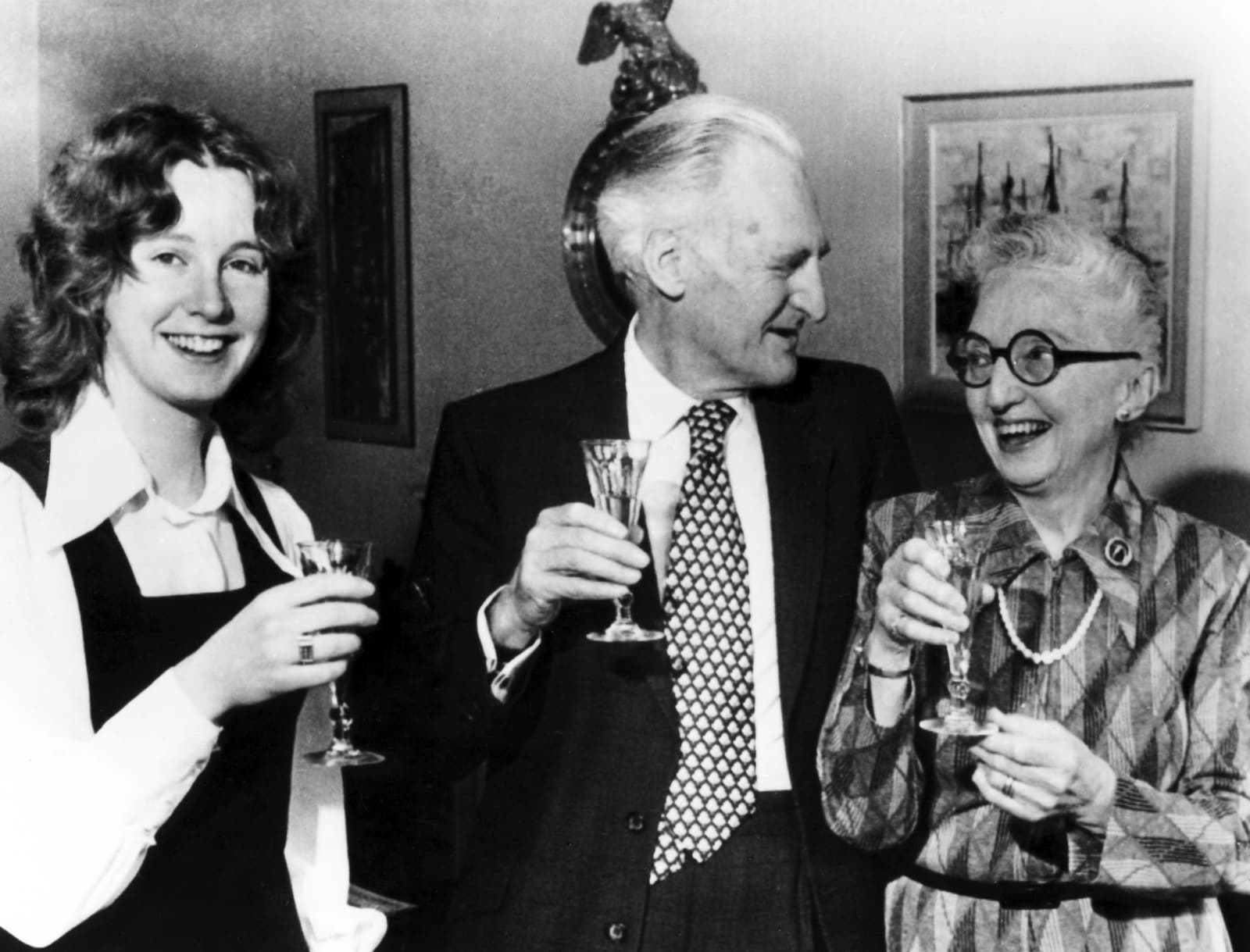
Image context: the cover uses a real 1979 National Cancer Institute portrait of Richard Doll. It works here because this article is about epidemiologic seeing, not about generic cigarette imagery or later anti-smoking iconography.[5]
Timeline anchors before interpretation
- 1922 to 1947: Doll and Hill open by noting that annual deaths attributed to lung cancer in England and Wales rose from 612 to 9,287, a change too large to dismiss as population growth alone.[1]
- April 1948 to October 1949: the investigators interviewed hospital patients in London, eventually comparing 649 male lung-cancer patients with 649 non-cancer controls matched by sex, age group, hospital, and interview period.[1]
- September 30, 1950: the BMJ paper appears and frames smoking against the rival explanation of general atmospheric pollution.[1]
- June 26, 1954: Doll and Hill publish the preliminary British doctors mortality report, moving from hospital case-control logic toward prospective follow-up.[2]
- January 11, 1964: the first Surgeon General smoking report gives the evidence an official U.S. public-health settlement and changes the policy clock.[4]
1. What the paper actually built was a denominator
The strongest feature of the 1950 paper is not its rhetoric. It is the study design. Doll and Hill did not rely on one famous clinic, one memorable surgeon, or one pile of death certificates. They organized notifications from 20 London hospitals, then sent trained interviewers to question both cancer patients and non-cancer controls using the same questionnaire.[1] For each lung-cancer patient, the control was chosen from the same hospital, of the same sex, in the same five-year age band, and at about the same time.[1] That matching decision is the real engine of the paper.
Why does it matter so much? Because the public argument about lung cancer in the late 1940s was still crowded with loose suspects. City air, tarred roads, gas works, domestic coal smoke, and motor exhaust all sat in the causal atmosphere.[1] If the paper had merely said that many lung-cancer patients smoked, it would have added one more impression to a noisy field. By using matched hospital controls, the authors changed the operative question from "Do lung-cancer patients smoke?" to "Do they smoke differently from comparable patients who do not have lung cancer?" That is the question that makes a habit look like an exposure.
The paper is also unusually transparent about its own weak points. Notification systems differed by hospital. Some eligible patients were discharged, too ill, or dead before interview. Place of residence was not perfectly matched. The authors walk through those problems instead of hiding them, then test whether they could plausibly explain the result.[1] This matters because one of the paper's lasting achievements is methodological tone. It treats bias as something to be handled in the open, not brushed aside in the name of urgency.
2. The tables turn smoking into a dose-pattern, not a lifestyle label
The most famous statistic in the paper deserves to stay famous. Among the male lung-cancer patients, only 0.3% were non-smokers, compared with 4.2% of the male control group.[1] That is already striking, but it is not the end of the argument. The paper's deeper move is dose. Among men, 26.0% of the lung-cancer patients fell into the two highest-consumption groups, defined as 25 cigarettes a day or more, versus 13.5% of the controls.[1]
That shift is what makes the article feel modern. Smoking is not treated as a yes-or-no moral trait. It becomes a gradient. The authors even push that logic further in their tentative Greater London risk estimates. Taking non-smokers as the reference group, they derive relative risks that climb steeply with amount smoked, reaching ratios of 6, 19, 26, 49, and 65 at progressively higher daily consumption levels, while carefully noting that these are speculative approximations rather than final population risks.[1] The caution matters, but so does the shape of the result. By 1950, the paper is already showing readers what dose-response feels like on the page.
This is where the article separates itself from looser anti-tobacco argument. It does not ask the reader to be shocked that smoking is common among patients. It asks the reader to notice how distribution changes as disease status changes. That is an epidemiologic habit of mind. Once smoking is arranged into dose bands and compared against controls, the debate no longer lives only in the register of vice, fashion, or city life. It lives in tables.
3. The discussion is careful in exactly the place people misremember
The closing discussion is worth reading slowly because it contains both the paper's boldness and its restraint. Doll and Hill say the association is real. They say it appears specific to carcinoma of the lung rather than to the other cancer sites and respiratory diseases in their comparison groups.[1] Then they pause. "This is not necessarily to say that smoking causes carcinoma of the lung," they write before walking through the alternatives and rejecting the idea that the disease itself caused the habit.[1]
That paragraph is not hedging for weakness. It is showing its work. The paper is strong enough to exclude several easy escape routes, but it still keeps the difference between association and causation visible. Only after that do the authors reach the sentence that gives the article its historical force: "We therefore conclude that smoking is a factor, and an important factor, in the production of carcinoma of the lung."[1]
This sequencing is the part later retellings usually flatten. Public memory wants either a thunderbolt or a mistake. The paper is neither. It is a controlled escalation of claim. First: the association is real. Second: it is specific. Third: reverse causation makes no sense. Fourth: a common-cause story is hard to imagine across a 20- to 50-year lag. Only then do they say smoking is an important factor.[1] That is why the paper aged so well. Its caution was part of its strength.
4. Why 1950 was not the whole verdict
If the 1950 paper had remained alone, it would still matter, but it would matter differently. Hospital case-control evidence can reveal a powerful pattern, yet it cannot by itself settle every challenge about representativeness, population baselines, or future risk. That is why the next steps are essential to the close reading.
The 1954 preliminary report on British doctors changed the evidentiary direction by following physicians prospectively and relating subsequent mortality to smoking habits already recorded.[2] The later 50-year observations paper showed how durable that design became: a short argument about one disease in one paper turned into a long mortality record across decades.[3] By the time the Surgeon General's committee reported in 1964, the question facing institutions was no longer whether there was a suspicious association worth notice. It was whether the accumulated epidemiologic evidence had crossed the line into public-health causation. The report answered yes and moved the issue into the language of official warning, regulation, and prevention.[4]
That sequence suggests the strongest interpretation of the 1950 paper. Its greatest achievement was not solitary proof. Its greatest achievement was building a measurement grammar strong enough that later cohort evidence and institutional review could extend it rather than replace it. The paper taught public health how to talk about smoking quantitatively.
Why this close reading still matters
The Doll-Hill paper remains useful because it shows that major health causality often becomes visible before mechanism is completely settled, but only after exposure has been made countable.[1][3][4] The document does not sound like a crusade. It sounds like a statistical unit being built under pressure: match the controls, test the bias objections, sort the habit by dose, and keep the inferential boundary visible while still saying what the evidence can already bear.
That is the real historical turn. Smoking did not become important in 1950 because a paper suddenly made cigarettes immoral. It became newly actionable because the paper made smoking legible as exposure. Later decades would supply the longer follow-up, the policy apparatus, and the social fight. The 1950 article supplied the grammar.
Sources
- Richard Doll and A. Bradford Hill, "Smoking and Carcinoma of the Lung: Preliminary Report," British Medical Journal (September 30, 1950), scan/PDF.
- Richard Doll and A. Bradford Hill, "The mortality of doctors in relation to their smoking habits: a preliminary report," PubMed record (1954).
- Richard Doll, Richard Peto, Jillian Boreham, and Isabelle Sutherland, "Mortality in relation to smoking: 50 years' observations on male British doctors," Journal of Epidemiology & Community Health / PubMed Central (2004).
- National Library of Medicine Profiles in Science, "The 1964 Report on Smoking and Health."
- Wikimedia Commons, "File:Doll, richard.jpg" - National Cancer Institute portrait photograph used for the article image.