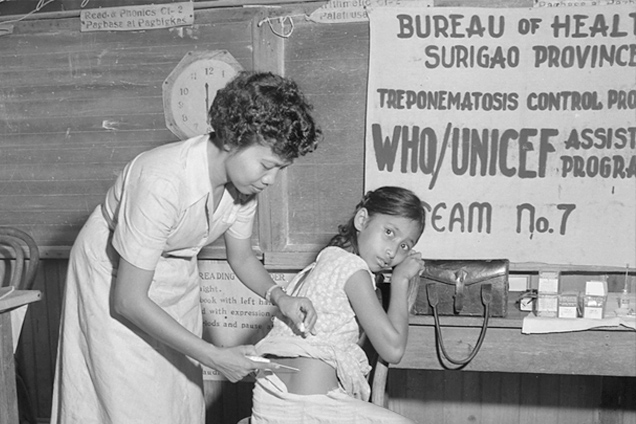
Between 1952 and 1964, the World Health Organization and UNICEF supported yaws campaigns in 46 countries. Teams screened an estimated 300 million people, treated more than 50 million, and reduced the burden of endemic treponemal disease by about 95 percent.[1][2] Few public-health programs have ever made illness retreat at that scale.
Yaws nevertheless survived.
That outcome invites two interpretations. In the first, an extraordinarily effective vertical campaign was dismantled too soon; the final cases were handed to primary-care services that had neither the reach nor the resources to find them. In the second, the campaign had achieved control and called it eradication: its treatment could clear infection, but its thresholds, selective policies, and incomplete surveillance left too many latent and remote infections outside the count.[2][4]
The evidence supports both, but in sequence rather than as rival absolutes. Penicillin did not fail. The campaign failed to build a detection and certification system as durable as its treatment system. It could make disease scarce faster than it could learn how to prove disease absent.
A cure built for a visible disease
Yaws is caused by Treponema pallidum subspecies pertenue, a close relative of the bacterium that causes syphilis. It spreads mainly through direct skin contact and has historically affected children in warm, humid rural communities far from health services. Early lesions can be conspicuous; infection can also become latent, leaving no lesion for a field worker to see while remaining detectable by serology.[2][6]
That combination made yaws unusually inviting to postwar campaign medicine. The disease was common, disabling, and geographically concentrated. A single injection of long-acting benzathine penicillin could produce rapid clinical healing. WHO's visual history records that communities and health workers described the injection as a “magic bullet,” with visible cure in roughly two to three weeks.[1]
The institutional clock moved quickly. WHO was founded in 1948. The second World Health Assembly adopted a resolution on endemic treponematoses in 1949. In March 1952, WHO convened an international yaws conference in Bangkok with 70 participants from 23 countries; a second conference met in Enugu, Nigeria, in November 1955, when Africa held roughly half of the estimated global burden.[2]
The conferences did not treat drug delivery as a minor detail. By Enugu, program leaders understood that interruption of transmission required treating active disease, incubating infection, and latent infection together. They regarded coverage below 90 percent as inadequate and 100 percent as the operational ideal.[2] A 1956 Bulletin of the World Health Organization report on Haiti already described mass treatment as only the beginning and “mopping-up” as a distinct administrative phase.[3] The last mile was visible in the plan before it became the program's undoing.
Interpretation one: the victory was abandoned
The most direct reading is political and organizational. Mass treatment worked, prevalence collapsed, attention moved elsewhere, and the remaining surveillance task was transferred before local systems were ready.
The handoff can be dated. In 1960, program guidance allowed mass treatment and routine population resurveys to stop when at least 80 percent of a population had been seen in the latest resurvey, active yaws prevalence was no more than 2 percent, and infectious yaws prevalence was no more than 0.5 percent. Surveillance would then run through rural health centers and health posts, supplemented by school surveys.[2]
Those are sensible control thresholds. They are not proof of zero transmission. A village could satisfy them while still containing untreated latent infection, missed contacts, people absent during the survey, or a neighboring settlement that the team had not reached. Once prevalence fell, every remaining case also became more expensive to find: teams had to travel farther, inspect more people, and maintain suspicion in places where yaws no longer looked urgent.
The historical review by Kingsley Asiedu and colleagues makes the institutional failure explicit. The vertical programs were progressively integrated into primary care, but many of the services receiving the work were weak. Active surveillance declined, yaws resurged in several countries during the 1970s, and the distinction between “no cases” and “no reports” blurred.[2] A later analysis of reporting history sharpened the problem: the 1950s campaign had no formal certification system for local elimination, so when a country stopped reporting, the record often could not show whether transmission had stopped or reporting had.[4]
On this interpretation, the lost five percent was not evidence that the drug or the biological premise was wrong. It was evidence that success had weakened the political case for the very activities success still required. The program created its own invisibility and then lost the machinery needed to investigate it.
Interpretation two: control was wearing eradication's name
The stronger challenge begins inside the campaign design. Even before the handoff, treatment policy did not always match the biology that planners themselves described.
The 1955 framework initially varied treatment by the prevalence of clinically active yaws. Where prevalence exceeded 10 percent, the whole population would be treated. Between 5 and 10 percent, treatment focused on children under 15 and close contacts. Below 5 percent, it narrowed to household and other close contacts.[2] The trouble was definitional. A contact network extends beyond the household, latent infection has no visible lesion, and a clinical survey cannot reveal everyone incubating disease. Asiedu and colleagues note that the selective policies were unlikely to reach all latent infections without frequent, difficult, and costly resurveys; the Enugu meeting ultimately favored total mass treatment even below the 10 percent threshold.[2]
The campaign's headline number also hides a denominator problem. Screening 300 million people and treating 50 million is an immense achievement, but eradication is not the average reduction across everyone screened. It is the interruption of every remaining transmission chain, including chains in communities that are hardest to reach and least likely to report. A 95 percent fall can coexist with a geographically concentrated reservoir capable of rebuilding incidence after the campaign leaves.
Later surveillance research shows how large that uncertainty became. A study reconstructing reports from 1945 to 2015 found that yaws had been reported in 103 of 237 countries and areas considered. Among 86 places classified as previously endemic but of unknown status, the model estimated that 66 had less than a 50 percent chance of reporting cases through passive surveillance even if transmission were continuing.[4] The model does not prove that yaws persisted in all or even most of those places. It proves that silence was weak evidence.
Modern diagnostics make the historical limitation even easier to see. WHO's January 2023 fact sheet noted that about 40 percent of ulcers clinically mistaken for yaws were caused by Haemophilus ducreyi. Ordinary treponemal tests cannot distinguish yaws from syphilis or reliably separate past from current infection, while PCR is needed to confirm the organism in a lesion and monitor resistance.[6] Those are present-day diagnostic facts, not an explanation retroactively available to a 1950s field team. They do show why eradication cannot rest on a visual search plus an empty ledger.
India changes the vertical-versus-integrated argument
If the first campaign's history proved that only a permanent vertical service could finish eradication, India's later experience would be difficult to explain. India succeeded without creating an entirely separate workforce. What it did preserve was campaign intensity inside the existing system.
In 1996, India piloted active, house-to-house case finding in Koraput district, Odisha, then expanded the program by 1999 to all 51 historically affected districts across ten states. Health workers searched before and after monsoon seasons, treated cases and contacts, used community recognition materials, and continued routine reporting. Reported cases fell from 3,571 in 1996 to 664 in 2000 and 46 in 2003; the last case was found in Mayurbhanj district in 2003.[5]
Crucially, the search did not stop with the last case. India added rumor investigation, an award for reporting a suspected case, independent appraisal missions, and serological surveys in young children. During 2009–2011, the published program account reported no serological evidence of transmission among 18,217 children sampled in formerly affected villages. WHO verified the achievement and declared India free of yaws in 2016.[1][5]
India therefore weakens a simple “vertical good, integration bad” verdict. Its program used state health directorates and existing workers, but paired them with a defined eradication target, central funding, repeated active search, supervision, verification, and surveillance after zero. Integration did not mean dissolving the task into ordinary clinic traffic. It meant giving ordinary services an extraordinary, measurable obligation.
The more defensible historical distinction is not vertical versus integrated. It is bounded campaign versus accountable continuity. A specialist team can fail if it leaves after the prevalence crash. A general health system can succeed if money, field search, reporting, and verification remain attached to the final case.
A simpler drug does not close the surveillance gap
Treatment improved again in 2012. In an open-label randomized non-inferiority trial in Papua New Guinea, 250 children were assigned to single-dose oral azithromycin or injected benzathine penicillin. At six months, the per-protocol cure results were 96 percent (106 of 110) for azithromycin and 93 percent (105 of 113) for penicillin; the treatment difference was −3.4 percentage points, with a 95 percent confidence interval from −9.3 to 2.4.[7] Oral dosing removed needles, injection equipment, and some of the trained-personnel burden.
WHO built the renewed Morges Strategy around total community treatment followed by active surveillance and further treatment. Its current neglected-tropical-disease road map targets global yaws eradication by 2030.[6][8] The change from injection to tablet matters enormously for access. It does not repeal the historical lesson. A medicine can be easy to swallow while the last infection remains hard to locate.
The uncertainty boundary is also wider now. WHO's 2023 fact sheet said humans were currently believed to be the only reservoir.[6] A 2025 Emerging Infectious Diseases study found T. pallidum pertenue infection in nonhuman primates in Uganda and Rwanda, including 33 percent seropositivity across nine tested species and a newly described genomic lineage. The authors did not demonstrate transmission from those primates to people; they identified a potential reservoir question that requires host-specific and epidemiological work.[9] This evidence should not be projected backward as the cause of the 1960s rebound. It does mean that present eradication claims must remain open to a biological complication the first campaign could not test.
Where the balance of evidence lands
The abandonment interpretation explains the timing best: prevalence plunged under active treatment, surveillance weakened after the handoff, and disease returned to reporting systems that were often least capable where yaws had always been most remote. The design interpretation explains why the handoff was so dangerous: thresholds for control were treated as if they could support an eradication claim, selective policies struggled with latent infection, and formal certification did not yet exist.
The two accounts meet at the same causal hinge. The campaign had a treatment endpoint but no equally strong information endpoint. It knew how many injections it had delivered and how far prevalence had fallen. It did not have a durable, standardized way to establish that every formerly endemic place could still detect the disease once teams, budgets, and attention moved on.
Evidence could still shift that assessment. Detailed country archives showing sustained high-coverage resurveys followed by resurgence would strengthen biological explanations such as missed latent infection or reintroduction. Records showing that surveillance and funding collapsed before the rebound would strengthen the abandonment account. Genomic evidence linking human cases to nonhuman primates would materially revise the modern eradication model, while evidence of long-term separation between primate and human transmission would narrow that concern.[4][9]
What the 95 percent figure cannot do is settle the argument by itself. It measures the force of the campaign at its center, not the quality of knowledge at its edges. Yaws survived in the gap between curing a person and certifying a world.
Sources
- World Health Organization, “Yaws eradication,” facts-in-pictures feature, February 28, 2018 — campaign scale, archival photography, treatment history, resurgence, and India's certification.
- Kingsley Asiedu et al., “Eradication of Yaws: Historical Efforts and Achieving WHO's 2020 Target,” PLOS Neglected Tropical Diseases 8, no. 9 (2014) — conferences, treatment policies, stopping thresholds, coverage, integration, and renewed strategy.
- G. E. Samame, “Treponematosis Eradication, with Special Reference to Yaws Eradication in Haiti,” Bulletin of the World Health Organization 15, no. 6 (1956) — primary-era account of mass treatment and the mopping-up phase.
- Christopher Fitzpatrick et al., “Prioritizing Surveillance Activities for Certification of Yaws Eradication Based on a Review and Model of Historical Case Reporting,” PLOS Neglected Tropical Diseases 12, no. 12 (2018) — reporting history, certification gaps, and limits of passive surveillance.
- J. P. Narain et al., “Eradicating Successfully Yaws from India: The Strategy & Global Lessons,” Indian Journal of Medical Research 141, no. 5 (2015) — active case search, program scale-up, last-case chronology, serosurveys, financing, and supervision.
- World Health Organization, “Yaws,” fact sheet, January 12, 2023 — transmission, diagnosis, current treatment, surveillance criteria, and total-community-treatment strategy.
- Oriol Mitjà et al., “Single-Dose Azithromycin versus Benzathine Benzylpenicillin for Treatment of Yaws in Children in Papua New Guinea,” The Lancet 379 (2012) — randomized non-inferiority trial and six-month cure results.
- World Health Organization, “The Road Map Targets for 2030” — current global eradication target for yaws and the cross-cutting health-system framework.
- Tony L. Goldberg et al., “Yaws Circulating in Nonhuman Primates, Uganda and Rwanda,” Emerging Infectious Diseases 31, no. 4 (2025) — serological and genomic evidence and the unresolved reservoir question.