The most counterintuitive sentence in dengue control is also the literal description of the intervention: release more mosquitoes.
That sentence sounds reckless because it leaves out both the kind of mosquito and the clock. The Yogyakarta program released local Aedes aegypti carrying the wMel strain of Wolbachia, a bacterium that was not naturally present in this mosquito species. Releases were temporary. The intended change was durable: let the bacterium establish itself in the local mosquito population, then make that population less able to pass dengue virus from one person to another.[1][2]
This is not a mosquito-eradication method, a vaccine given to people, or an edit to mosquito DNA. It is population replacement. Its causal chain has four links: the bacterium passes from mother to egg; a reproductive asymmetry helps infected mosquitoes spread; the infection makes the mosquito a less permissive host for dengue virus; and field teams keep measuring whether those effects persist. Miss any link and “release mosquitoes” is only an activity, not a public-health intervention.
The replacement begins with an unfair mating table
Wolbachia lives inside insect cells and is inherited through the egg cytoplasm. A wMel-carrying female can therefore transmit the bacterium to her offspring whether she mates with an infected or uninfected male. The asymmetry appears in the opposite cross: when an uninfected female mates with a wMel-carrying male, a process called cytoplasmic incompatibility sharply reduces successful hatching.[1][2]
The result is not that infected mosquitoes always outnumber uninfected mosquitoes after one release. It is that infected females have more compatible reproductive routes. Once wMel rises above a workable local frequency, that advantage can help it move through subsequent generations instead of disappearing when releases stop. Maternal transmission supplies continuity; cytoplasmic incompatibility supplies the push.
This distinction separates population replacement from another Wolbachia-based strategy. A suppression program repeatedly releases infected males so incompatible matings produce no viable offspring and the mosquito population falls. Yogyakarta's replacement program released males and females. Its primary aim was not to empty the city of Aedes aegypti, but to make wMel common inside the mosquitoes already occupying that ecological niche.[2][5]
The bacterium is therefore not a pesticide hidden inside a mosquito. Nor is cytoplasmic incompatibility the dengue-blocking effect itself. Reproductive advantage answers how wMel persists. A different biological effect answers why persistence might protect people.
Dengue has to complete a journey inside the mosquito
A mosquito does not become an efficient dengue vector merely because it takes an infectious blood meal. Virus must infect the midgut, replicate, disseminate through the body, reach the salivary glands, and become available for transmission during a later bite. The time required is the extrinsic incubation period. A barrier at several points in that journey can lower the chance that a mosquito lives long enough to deliver infectious saliva.
wMel changes that internal environment. In a 2018 experiment designed to get closer to real transmission than a standard laboratory blood meal, researchers let mosquitoes feed directly on blood from 141 patients with dengue in Ho Chi Minh City. Compared with wild-type Aedes aegypti, wMel-carrying mosquitoes had lower transmission potential and a longer extrinsic incubation period. The blocking effect also held when researchers compared mosquitoes developed under field and laboratory conditions.[3]
It would be too neat to attribute that result to a single molecular switch. Research has implicated immune activation, competition for cellular resources such as lipids, changes in host-cell physiology, and the density and tissue distribution of Wolbachia. Their relative importance can vary with bacterial strain, mosquito background, virus, and environment.[3] The defensible operational claim is narrower: wMel makes Aedes aegypti less permissive to dengue infection and onward transmission. It does not render every infected mosquito sterile, bite-free, or physically incapable of carrying any virus.
That boundary matters. Population replacement reduces the probability of transmission across many mosquito–human encounters. It does not create an invisible shield around one resident, and it does not make individual bite prevention or routine vector control irrelevant.
Yogyakarta had to install a living intervention
The biological idea became a field method in stages. Open field testing began in northern Australia in 2011. In Yogyakarta, community engagement started in 2012, before the first local releases. In January 2014, teams began 20 weeks of adult releases in two communities outside the city; at each selected point they released a cup containing about 40 male and female mosquitoes. In 2015, two additional communities received eggs over 12 rounds spanning 24 weeks.[2]
Those dates reveal the real unit of delivery. It was not a mosquito. It was a negotiated local system: insectary quality control, a mosquito line backcrossed with local Aedes aegypti, mapped release points, community meetings, public-health-center staff, channels for questions and complaints, traps, PCR testing, and a rule for what happened when residents objected.[2]
The pilot article records both support and friction. Researchers attended 296 community meetings from January 2012 through June 2013. When some residents in Nogotirto opposed releases, five neighborhood units were excluded rather than treated as blank space on a map. The program also logged 446 reports from residents between 2013 and 2016; concerns peaked during releases and then declined. Community authorization was not decorative “acceptance work.” It determined where the biological intervention could actually exist.[2]
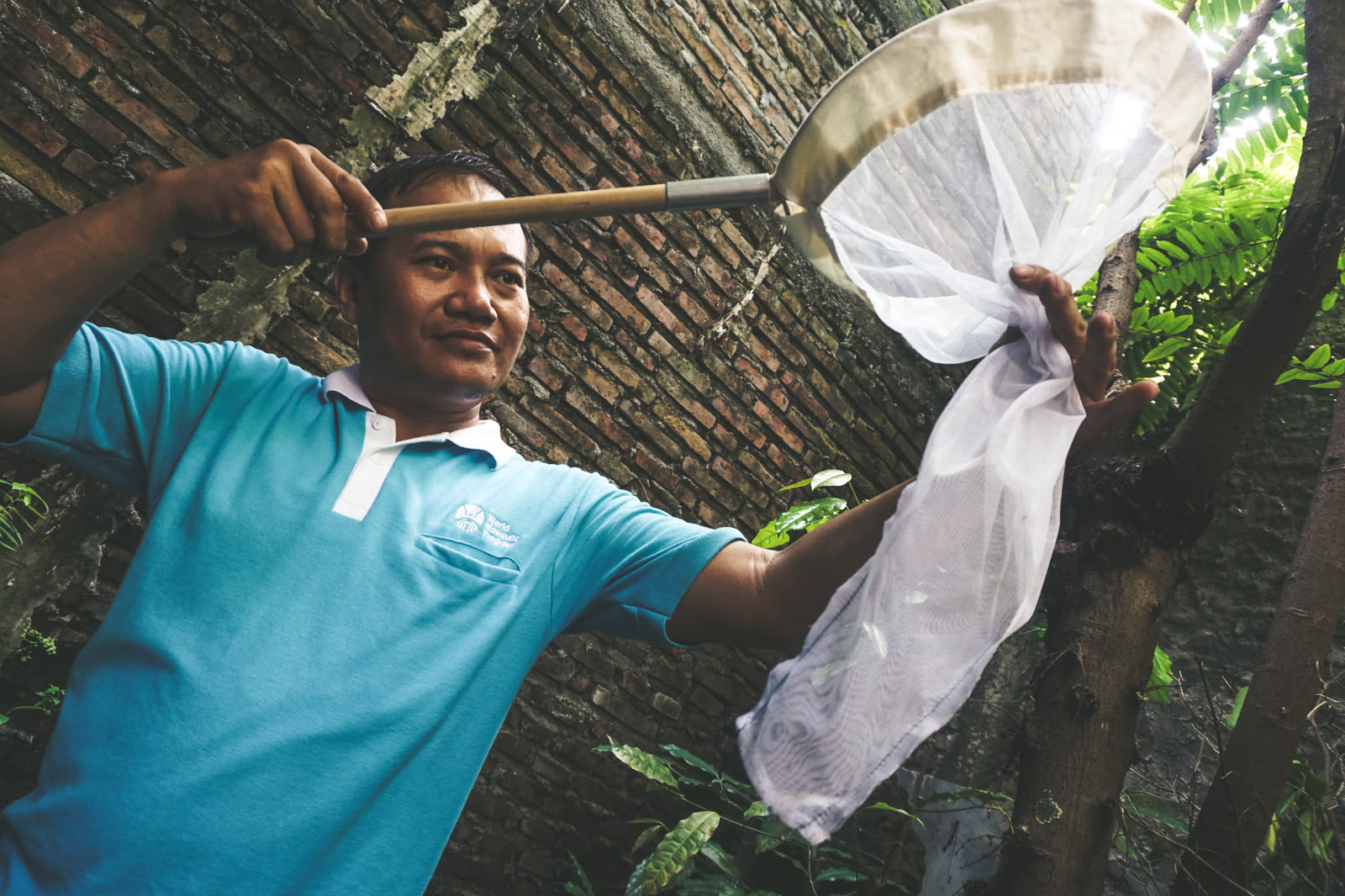
Monitoring then had to show that a transient input had become a stable population trait. Adult and egg releases both established wMel in the pilot sites, although its geographic spread was slower than researchers had observed in Cairns. That is why the sweep net, household trap, and PCR result belong inside the causal mechanism. Inheritance can maintain wMel only where releases first establish it and local movement carries it; a city cannot infer coverage from the number of cups distributed.[2]
The trial tested illness, not just infected mosquitoes
Entomology can show that wMel is present and that dengue replicates poorly in infected mosquitoes. Public health still needs the next link: fewer people becoming ill.
From March through December 2017, the AWED trial deployed wMel-carrying mosquitoes in 12 randomly assigned geographic clusters in Yogyakarta; 12 control clusters continued ordinary local mosquito-control measures without the deployments. Clinical surveillance ran until March 2020. Rather than count only reported diagnoses, the study recruited people aged 3 to 45 who presented to participating clinics with short, undifferentiated fever and used laboratory testing to distinguish virologically confirmed dengue from test-negative illnesses.[1]
The trial enrolled 8,144 participants. In the intention-to-treat efficacy analysis, confirmed dengue occurred in 67 of 2,905 participants from intervention clusters, or 2.3%, versus 318 of 3,401 from control clusters, or 9.4%. The aggregate odds ratio was 0.23 (95% confidence interval, 0.15 to 0.35), corresponding to a protective efficacy of 77.1% (95% CI, 65.3 to 84.9). The direction of effect was consistent across all four dengue serotypes observed.[1]
Hospitalization provided a second clinical boundary. There were 13 hospitalizations among 2,905 participants in intervention clusters, compared with 102 among 3,401 in control clusters. The estimated protective efficacy against hospitalization was 86.2% (95% CI, 66.2 to 94.3).[1] These are cluster-level effects of living in a treated area, not a promise that any one infected mosquito cannot transmit or that any one resident cannot acquire dengue elsewhere.
The intervention also passed its persistence test during the study. Across 27 months of surveillance, the median cluster-level prevalence of wMel in mosquitoes from intervention areas was 95.8%, with an interquartile range of 91.5% to 97.8%.[1] The releases ended; the measured infection remained common. That is the intended advantage of replacement over a control measure that must be reapplied after every breeding cycle.
A strong trial is not the same as a universal answer
The Yogyakarta result is unusually direct evidence for a vector-control intervention: randomized geographic assignment, laboratory-confirmed illness, clinical outcomes, and entomological monitoring all point along the same causal chain. It is neither a laboratory promise nor a simple before-and-after comparison.
Its limits are equally important. A 2024 Cochrane review found only this one eligible randomized trial and rated the evidence that wMel deployments reduce confirmed dengue as moderate certainty. The reviewers called for trials in more varied settings and better reporting of costs, acceptability, and adverse events.[4] A self-maintaining bacterium can reduce the frequency of re-release, but it cannot make deployment independent of climate, mosquito genetics and movement, urban form, laboratory capacity, public consent, or surveillance quality.
Policy is still catching up to that expanding evidence base. On June 11, 2026, the World Health Organization said its 2020 advisory review had found epidemiological impact from population-replacement field trials, but WHO was beginning an updated systematic review and operational manual. Its integrated vector-control guideline group is expected to assess the evidence in 2027 before recommendations are finalized.[5] The honest description today is therefore not “unproven” and not “universal standard.” It is a field intervention with a persuasive randomized result, growing implementation experience, and unresolved questions about transfer across settings.
The release is the visible moment, but it is not the mechanism by itself. Durable dengue control appears only when bacterial inheritance, reproductive advantage, virus blocking, community permission, and field verification hold together. The mosquitoes are temporary visitors from an insectary. The public-health product is a locally established population that has become worse at passing a virus on.
Sources
- Adi Utarini et al., “Efficacy of Wolbachia-Infected Mosquito Deployments for the Control of Dengue,” New England Journal of Medicine 384 (2021) — AWED cluster-randomized trial design, wMel persistence, confirmed-dengue outcomes, hospitalization outcomes, and uncertainty intervals.
- Warsito Tantowijoyo et al., “Stable establishment of wMel Wolbachia in Aedes aegypti populations in Yogyakarta, Indonesia,” PLOS Neglected Tropical Diseases 14 (2020) — pilot chronology, local mosquito backcrossing, release methods, community engagement, monitoring, and establishment.
- Lauren B. Carrington et al., “Field- and clinically derived estimates of Wolbachia-mediated blocking of dengue virus transmission potential in Aedes aegypti mosquitoes,” Proceedings of the National Academy of Sciences 115 (2018) — direct feeds from 141 viremic patients, field-rearing comparison, transmission potential, and mechanistic boundaries.
- Tilly Fox et al., “Does releasing Wolbachia-carrying mosquitoes prevent dengue infection?” Cochrane evidence summary, April 10, 2024 — review scope, moderate-certainty assessment, single-trial evidence base, and generalizability gaps.
- World Health Organization, “WHO update on the assessment of Wolbachia population replacement for the control of Aedes-borne diseases,” June 11, 2026 — current evidence-review, guideline, and operational-manual status.
- World Mosquito Program, “Yogyakarta” — project chronology, monitoring context, community implementation, and source page for the real field photograph used as the article image.