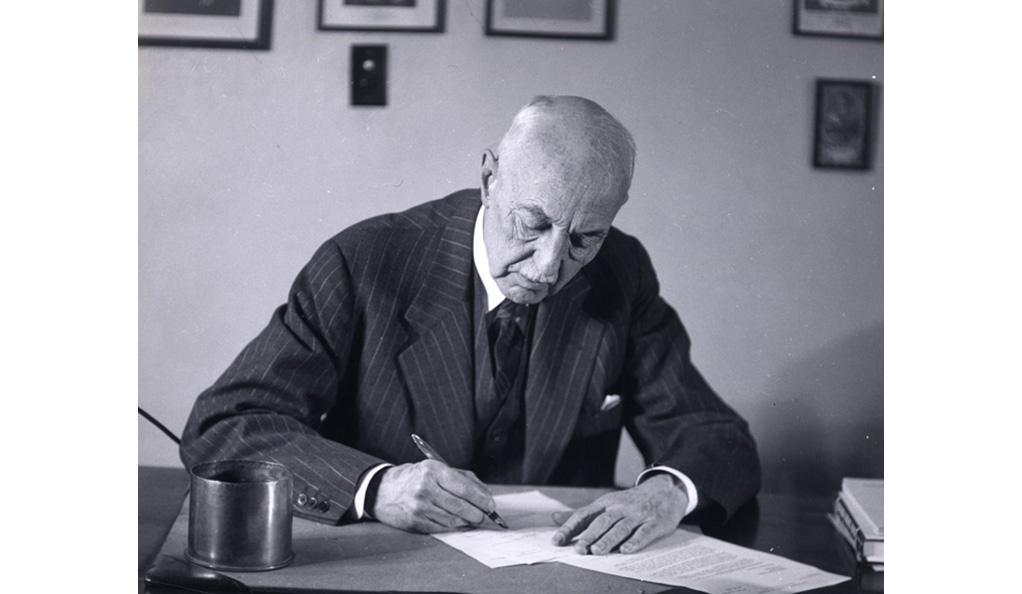
Two Yale undergraduates came to C.-E.A. Winslow's laboratory with a practical question: what sort of career was public health? One was the son of a distinguished health administrator, yet even he needed the field explained. Winslow opens his 1920 address, The Untilled Fields of Public Health, with that encounter. A profession capable of studying bacteria, inspecting water, and organizing nurses had become difficult to describe to its prospective recruits.[1]
The answer eventually becomes a celebrated definition. But the route to it is more revealing than the opening phrase about preventing disease and prolonging life. Winslow follows a sequence of unfinished jobs: finding illness, helping a family obtain treatment, and confronting the household income that makes good advice impossible to follow. Read in that sequence, his definition turns public health into an obligation to organize the conditions under which prevention can work.[1]
It is also an uncomfortable document. The same essay that makes a case for material support describes poor families through hereditary assumptions. Reading the whole address means examining both the reach of its promise and the judgments attached to the people it promises to serve.
A definition earned through a school visit
Winslow delivered the address in St. Louis on January 2, 1920; Science published it a week later, on January 9, across pages 23–33. This reading follows the original journal scan, including the passages surrounding the definition on page 30.[1]
He was speaking from a young institution. Yale had created its Department of Public Health in 1915 and appointed a bacteriologist, rather than a physician, to lead it. Yale's institutional history describes Winslow's program as joining laboratory work to community work. In 1919, he founded the New Haven Demonstration Health Center, where nursing helped give that connection a practical form.[2]
The address makes its strongest case through school medicine. On page 27, Winslow recalls Boston's introduction of school medical inspection in 1894 as an effort to identify communicable disease. The original task was protective: find the infected child so other children would not catch the illness. But inspection also exposed dental, vision, and hearing problems. Those findings could not be addressed simply by separating one pupil from another.[1]
Then came the next unfinished job. Identifying a treatable condition did little unless someone helped the child receive care. In Winslow's account, school nurses followed children into their homes and worked with parents. Even willing parents, however, sometimes lacked money for treatment. School clinics became the next step in his argument.[1]
The progression matters. Each new responsibility arises from a failure to complete the previous one. An examination creates information; a nurse can help turn information into action; a clinic can make action possible when the bill prevents it. My reading is that Winslow expands the profession by asking what happens after its first intervention. He makes the boundary between public health and individual medicine difficult to defend precisely where a child still needs help.
The price of arriving early
On page 28, Winslow moves from schoolchildren to the organization of medical care. He sets out several requirements: specialists must work together; organized care must reach people across the income range; and payment must encourage consultation before illness becomes intolerable. Timing is partly a financial arrangement.[1]
He leaves the institutional design open. Group practice, sickness insurance, and state medicine appear as competing possibilities. He also allows that different places might develop different arrangements. The essay supplies a purpose for reorganizing care without pretending to have settled every argument about how to pay for it.[1]
That distinction keeps the address interesting. It is possible to agree that people should seek help early while leaving intact a payment system that rewards waiting. Winslow's question makes the contradiction visible: what would have to change for the desired behavior to become feasible?
The definition on page 30 compresses this reasoning into a long sentence. Its pivotal phrases are “organized community efforts” and “social machinery.” Between them sit sanitation, infection control, education, and medical and nursing services. At the end comes a standard of living sufficient to maintain health, extended to “every individual.” The household budget belongs inside the definition because the preceding argument has shown why services and instruction cannot always compensate for deprivation.[1]
The promise and the hierarchy
Winslow brings numbers into that argument, but they need to remain attached to their historical source. On page 29, citing a Johnstown survey, he reports infant mortality of 271 deaths per 1,000 births in one ward, 134 per 1,000 across the city, and 50 per 1,000 in its lowest-rate ward. These are figures quoted in his address, not present-day estimates or results independently reanalyzed here.[1]
The contrast makes unequal conditions visible. It does not, by itself, isolate their causes. Winslow explicitly recognizes that poverty and sickness are correlated and that illness can reduce income. Yet he also invokes supposed inherited deficiencies among poorer families, using the phrase “poor protoplasm.” That language introduces a hierarchy of human worth and capacity into the discussion of material need.[1]
There are two readings to hold together. One emphasizes the breadth of his proposal: community resources should support health before deprivation and illness produce a crisis. The other notices how easily assistance is framed through an expert's judgment of supposedly deficient people. The text supports both observations. Its universal promise does not erase its hereditary assumptions; those assumptions do not erase its concrete argument for preventive support.
Nor should the mortality contrast be recruited to validate his hereditarian explanation. The figures as presented do not establish it. A careful reading can preserve his question about inadequate living standards while rejecting the leap from disadvantage to defective ancestry.
A modern comparison clarifies the difference without making Winslow the sole ancestor of today's practice. CDC's account of the 2020 revision of the Essential Public Health Services framework explicitly identifies poverty, racism, gender discrimination, and other structural barriers as obstacles to health equity. That formulation directs attention toward barriers to remove. It offers a useful standard against which to read the judgments embedded in the older essay.[4]
Who would do the work?
After defining the mission, Winslow names the people it requires: physicians, nurses, bacteriologists, epidemiologists, engineers, statisticians, and social workers, with inspectors and administrators also necessary. His public-health nurse must exercise judgment outside a physician's immediate direction and understand a patient within a family and community. The ambitious definition becomes a problem of training and coordination.[1]
Yale's later institutional account records a practical expression of that breadth: during Winslow's first decade as chair, a program open to people without medical training produced Certificate in Public Health, Ph.D., and Dr.P.H. graduates. Public health required several kinds of expertise because its proposed work crossed several kinds of institution.[3]
Return, finally, to the schoolchild. The inspection is complete, the difficulty has a name, and a parent understands the recommendation. Care may still be out of reach. Winslow's lasting challenge is to ask who remains responsible at that point. His answer makes the unfinished work visible—and reading his full essay reminds us to examine how that responsibility is exercised, as well as how widely it extends.
Sources
- C.-E.A. Winslow, “The Untilled Fields of Public Health,” Science 51, no. 1306 (January 9, 1920), pp. 23–33 — original address; especially school medicine and payment on pp. 27–28, poverty and heredity on p. 29, and the definition and workforce on pp. 30–31. Journal scan hosted by Vanderbilt University.
- Steve Kemper, “Public health giant: Remembering the man who launched public health at Yale,” Yale News (June 2, 2015) — department history, the New Haven Demonstration Health Center, and the archival photograph used here.
- Yale School of Public Health, “The Winslow Medal,” section “Who was C.-E.A. Winslow?” — institutional account of Winslow's educational program and its first decade of graduates.
- Centers for Disease Control and Prevention, “Community Planning and Health Assessment” (July 9, 2026) — the Essential Public Health Services framework, its 2020 revision, and structural barriers to health equity.