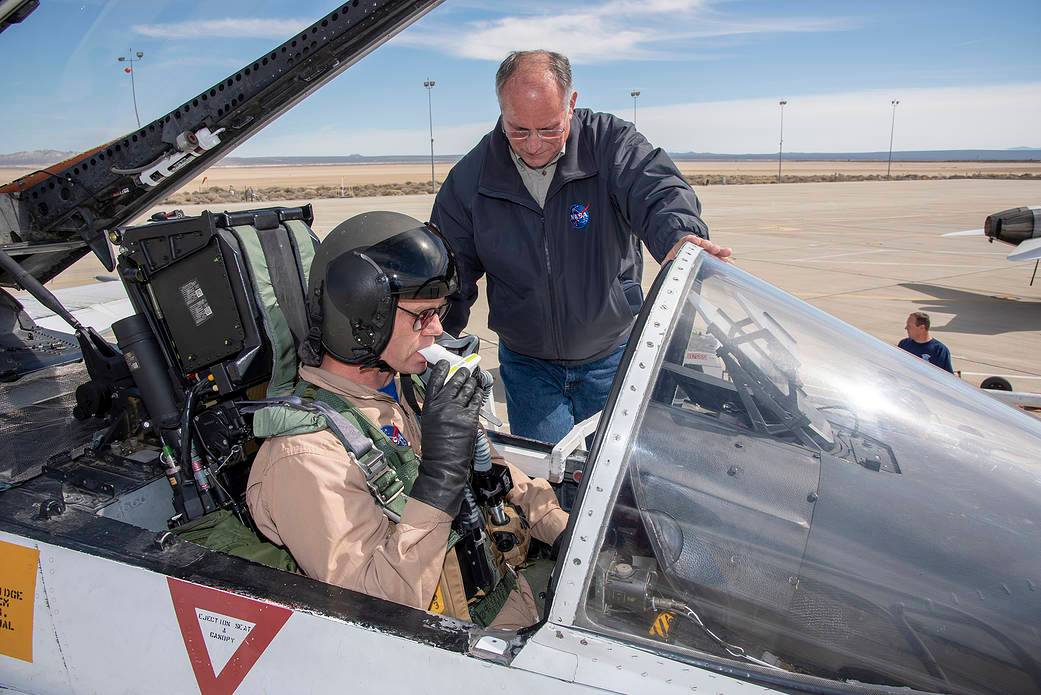
The photograph records a test before a flight: NASA pilot Nils Larsen breathing into a spirometer while Phillip Wellner supervises. Carla Thomas took it at Armstrong Flight Research Center in California on March 4, 2019. It is an unusually useful picture of measurement because the instrument has company. Someone must perform the breath, and someone must judge whether the instrument has captured the intended maneuver.[5]
In clinical spirometry, that distinction can change the apparent answer. Stopping too soon can lower the recorded volume and raise a key ratio, potentially hiding airflow obstruction. The question behind the printout is therefore quite concrete: did the lungs finish emptying as required, or did the recording simply stop?[2]
A breath with a beginning and an end
Spirometry measures how much air a person blows out and how quickly. The procedure asks for a deep inhalation followed by a forceful exhalation into a measuring device. Sometimes clinicians repeat it after a medicine that opens the airways, allowing a comparison before and after treatment. It takes active participation; the effort can leave someone tired or lightheaded.[1]
Two measurements carry much of the interpretation. FVC, forced vital capacity, is the total volume exhaled during a complete forced maneuver starting from a full inhalation. FEV1 is the volume expelled in its first second. Their ratio describes how much of that measured total came out at the start.[3]
The ratio's denominator deserves attention. In a deliberately simplified arithmetic example, 2 liters in the first second divided by a completed total of 4 liters gives 50%. Keep the same first-second volume but stop recording at 3 liters, and the ratio becomes about 67%. No airway has improved in this example. Only the measured total has changed. These invented values illustrate the arithmetic, not diagnostic thresholds.
How a weak maneuver impersonates disease
NIOSH's January 2012 quality-assurance guide explains the clinical trap. Ending exhalation prematurely can make FVC falsely low, suggesting restriction, while making FEV1/FVC falsely high, concealing obstruction. A weak initial blast can push the ratio in the opposite direction and resemble obstructive impairment. Errors do not all distort the result the same way.[2]
That is why the operator looks beyond the final numbers to the recorded curves. One shows accumulated volume over time; another shows airflow against volume. Their shapes can expose an interrupted expiration or an inadequate initial effort. Repeating a weak effort consistently can still produce repeatable values, so agreement between attempts cannot replace scrutiny of the maneuver itself.[2]
The practical implication is easy to miss when results arrive as a neat table. A seemingly precise number may describe a precisely recorded mistake. Software can preserve the trace; interpretation still requires deciding what happened during the breath.
Why the operator asks again
The 2019 ATS/ERS standard separates acceptable individual measurements from repeatability across attempts. Its goal is at least three acceptable FEV1 measurements and three acceptable FVC measurements. For people older than six, the two largest acceptable values should differ by no more than 0.150 liters, assessed separately for FEV1 and FVC. Younger children have different tolerances.[3]
A cough in the first second disqualifies that maneuver's FEV1, although its FVC may remain acceptable. This distinction matters: quality belongs to the particular measurement, rather than being a single stamp applied indiscriminately to everything on the page.[3]
The extra attempts are therefore part of establishing confidence in the result. They give the operator another chance to capture the intended breath and show whether the best measurements agree. Counting blows without examining their quality would miss the point.
What a good blow still cannot settle
Once quality is established, interpretation has another boundary. The 2022 ERS/ATS interpretive standard defines airflow obstruction through an abnormally low FEV1/FVC relative to an appropriate reference range. A low FVC with a preserved ratio can suggest restriction, but it does not establish it. Confirming restriction requires a low total lung capacity, measured separately.[4]
The reason is physical. Exhaled volume does not tell the whole story of the air remaining inside the chest. NHLBI distinguishes spirometry from lung-volume testing, which may use a transparent chamber or a gas-breathing method. It also distinguishes both from diffusion testing, which evaluates gas transfer. These tests ask different questions about the same lungs.[1]
Nor does a physiological pattern, by itself, name its cause. The 2022 standard emphasizes interpreting measurements alongside clinical information and recognizing uncertainty, especially when test quality is poorer.[4] A report becomes useful when its reader can connect the numbers to the maneuver, the relevant comparison, and the patient's circumstances.
Back at the mouthpiece, the supervisor's role looks less incidental. The device records what passes through it. The work around the device establishes how much that recording can tell us.
Sources
- National Heart, Lung, and Blood Institute, "Tests for Lung Disease" — spirometry, lung-volume measurement, and diffusion testing.
- NIOSH, Spirometry Quality Assurance: Common Errors and Their Impact on Test Results (January 2012), especially pages 6, 14–15, and 18–19 — effort, repeatability, and premature termination.
- Brian L. Graham and colleagues, "Standardization of Spirometry 2019 Update," American Journal of Respiratory and Critical Care Medicine 200, e70–e88 — definitions, acceptability, and repeatability criteria.
- Sanja Stanojevic and colleagues, "ERS/ATS technical standard on interpretive strategies for routine lung function tests," European Respiratory Journal 60, 2101499 (2022) — obstruction, restriction, and uncertainty in interpretation.
- NASA, "NASA Pilot Nils Larsen Does a Spirometry Test" (published September 19, 2019) — photograph by Carla Thomas, taken March 4, 2019, image AFRC2019-0065-01.