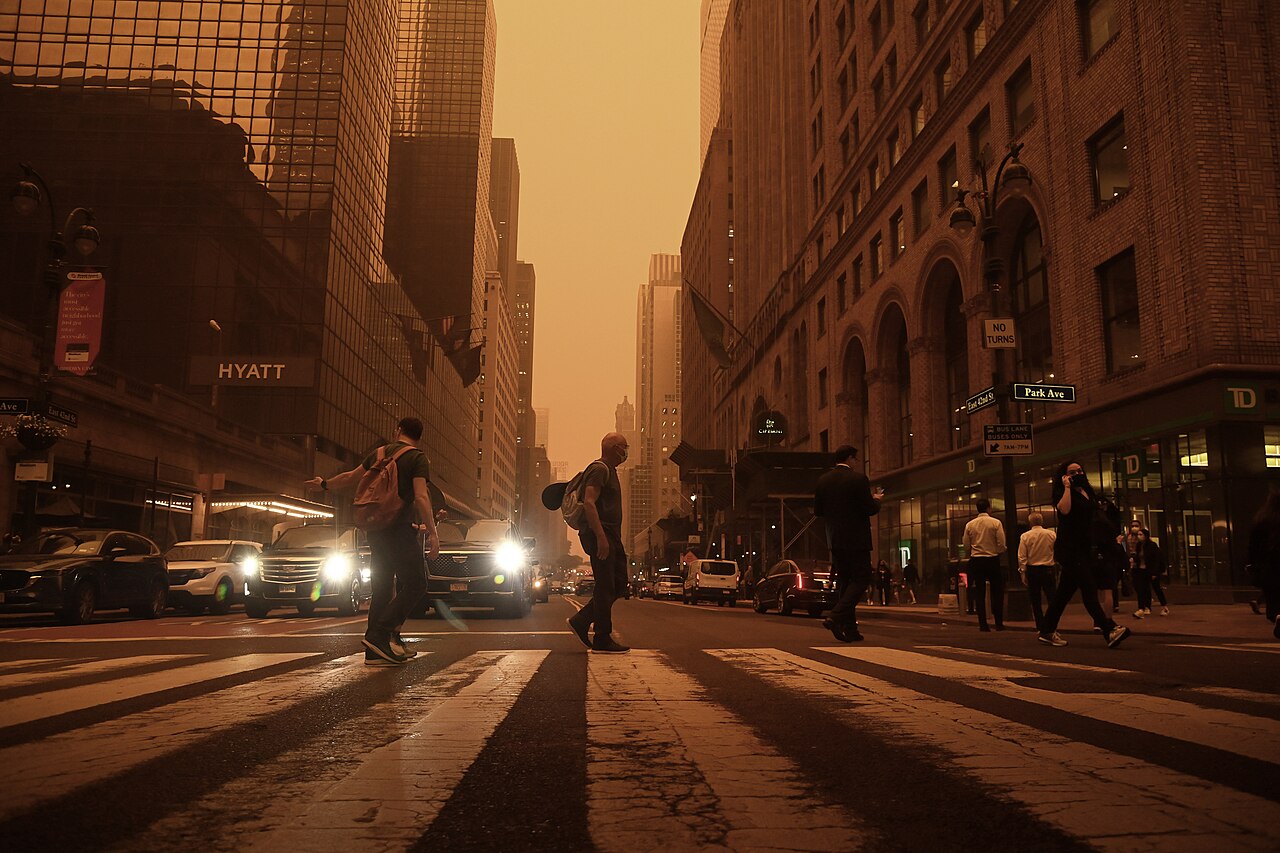
On June 7, 2023, the air in Midtown Manhattan turned orange enough that Grand Central blurred into smoke.[7] On January 7, 2025, the Eaton fire began pushing wildfire pollution into Los Angeles homes, where indoor PM2.5 rose along with the outdoor surge.[6] Those dates matter because they correct a comforting but wrong instinct: the front door is not a hard boundary between dirty outdoor air and safe indoor air.
The practical question is narrower. During a smoke episode, the goal is rarely to make an entire house pristine. It is to cut exposure meaningfully, especially for children, older adults, and people with asthma, COPD, cardiovascular disease, or pregnancy-related risk. EPA's current wildfire guidance centers on a "clean room" for exactly that reason: one room with closed windows and doors, recirculated air, and filtration can lower the particle burden you actually breathe for hours at a time.[1][2]
Image context: wildfire smoke from Quebec shrouding Grand Central Terminal and Midtown Manhattan on June 7, 2023, a documentary reminder that smoke episodes quickly turn outdoor-air crises into indoor-exposure problems as well.[7]
Timeline before the advice
- August 20, 2021: California Air Resources Board published its wildfire-smoke air-cleaner FAQ, emphasizing HEPA-based mechanical filtration and warning consumers away from uncertified ozone-emitting devices.[3]
- 2021: Seattle field measurements during wildfire episodes found indoor infiltration factors ranging from 0.33 to 0.76, meaning a sizable share of outdoor PM2.5 still entered homes even with people sheltering indoors.[5]
- January 30, 2025: EPA updated its clean-room guidance, keeping the same core message: choose one room, run recirculating cooling if needed, filter the air, and avoid particle-generating activities inside that space.[2]
- January 2025: During the Eaton fire, outdoor PM2.5 in the Los Angeles study rose from 19 to 47 ug/m3, while indoor levels rose from 10 to 19 ug/m3 in monitored homes.[6]
The common thread is that "indoors" is a condition that still needs engineering.
Myth 1: "If the windows are closed, the house is basically safe"
Closing windows is the start, not the endpoint. Fine particles from wildfire smoke are small enough to penetrate through leaks, door openings, ventilation pathways, and building envelopes.[1][3] EPA explicitly recommends a cleaner-air room because particle levels in the rest of the house can remain meaningfully higher, especially if people keep moving between rooms, use kitchen exhaust for long periods, or pull outdoor air through fresh-air HVAC settings.[2]
The Seattle study makes this concrete. Even before adding a portable air cleaner, the measured PM2.5 infiltration factor across seven residences ranged from 0.33 to 0.76.[5] In plain language, some homes were still taking in about one-third of the outdoor smoke burden, while leakier homes were taking in much more. Older residences with higher air-exchange rates performed worst.[5]
That is why EPA and CARB both pair "stay indoors" with "filter indoors."[2][3] A closed house without filtration is often only a partial reduction, not a reliable shield.
Myth 2: "Any machine that blows air is good enough"
Device type matters. CARB recommends a mechanical air cleaner with a HEPA filter because it captures very small particles well and does not depend on ozone generation to claim performance.[3] If a product also includes ionization, UV, or other electronic features, CARB's guidance is to verify it is on the certified list so ozone emissions stay within tested limits.[3] That is a different claim from "the gadget works because it has extra technology."
Sizing matters just as much. EPA's home-filtration guidance points readers toward Clean Air Delivery Rate, and its DIY research page cites the appliance-industry rule of thumb that CADR should roughly match room square footage.[4] That principle explains why underpowered units disappoint: people often buy for price or quiet operation, then ask one small purifier to clean a large open-plan living area.
The cleaner-room approach avoids that mismatch. Match the device to one room you can actually keep closed, and the unit's airflow has a fighting chance to cycle the room air fast enough to matter.[2][4]
Myth 3: "One purifier protects the whole house"
This is the most expensive misunderstanding because it combines a true idea with a false scale. Portable filtration works; whole-house assumptions often do not.
In Los Angeles during the January 2025 Eaton fire, homes assigned active HEPA filtration had indoor PM2.5 levels about 3 ug/m3 lower, or roughly 15% lower, than non-HEPA homes during the fire period.[6] That is a real reduction, but it is not magic. The study authors describe it as statistically significant and modest, and they explicitly argue that building-level and behavioral measures still matter.[6]
The older Seattle wildfire study found larger short-term room-level benefits when HEPA-based portable cleaners were actually run during smoke episodes, with effectiveness ranging from 48% to 78% depending on building characteristics.[5] Put together, the evidence points to a useful boundary: filtration can materially cut inhaled particles, but the result depends on where the unit is placed, how leaky the building is, whether the filter is fresh, and whether people are trying to clean one room or an entire floor plan.
A purifier is therefore best understood as a room-scale exposure tool. It buys cleaner hours where people sleep, recover, or keep children indoors. It does not repeal the geometry of a house.
Myth 4: "Box-fan filters are internet folklore"
DIY units are not folklore, but they are also not a license for improvisation. EPA's current research summary says box-fan cleaners built with MERV 13 filters can be a cost-effective way to reduce smoke concentrations indoors, especially when commercial units are unavailable or unaffordable.[4] Design details change performance sharply: EPA measured CADR of about 111 for a one-filter design, 156 after adding a cardboard shroud, 248 with one 4-inch MERV 13 filter plus shroud, and 401 for a four-filter Corsi-Rosenthal box.[4]
That spread matters because a bad DIY build can leave people thinking filtration failed when the real problem is undersized airflow or a dirty filter. EPA also adds a safety boundary that should be treated as non-negotiable: use a newer box fan from 2012 or later, look for UL or ETL safety marking, do not use an extension cord, and do not leave an older fan unattended or running while people sleep.[3][4] CARB's FAQ echoes the same age cutoff and advises closing windows and doors while the box-fan filter is running.[3]
In other words, a DIY cleaner is a bounded emergency tool. Built and used correctly, it can help. Built carelessly, it can underperform or create avoidable electrical risk.
What the evidence supports right now
The defensible indoor strategy is sequential, not magical.
- Pick one room you can keep closed and use as the cleaner-air room.[2]
- Set HVAC or window AC to recirculate rather than fresh-air intake, and avoid fans or exhaust setups that pull more smoke inside.[2]
- Run a correctly sized HEPA purifier or a properly built DIY box-fan filter with a fresh MERV 13 filter.[3][4]
- Avoid making your own particles in that room: no frying, candles, smoking, vaping, or unnecessary vacuuming unless the vacuum has HEPA filtration.[2]
- Watch the AQI and be ready to leave if smoke, heat, or power loss makes sheltering unsafe.[1][2][3]
The central correction is simple. Wildfire-smoke protection at home is not about pretending the whole house is sealed. It is about creating one cleaner zone and keeping the physics working in your favor.
Sources
- U.S. Environmental Protection Agency, Wildfires and Indoor Air Quality (IAQ) - preparation steps, clean-room guidance, and indoor smoke reduction measures.
- U.S. Environmental Protection Agency, Create a Clean Room to Protect Indoor Air Quality During a Wildfire (updated January 30, 2025).
- California Air Resources Board, Indoor Air Cleaners and Wildfire Smoke FAQ (August 20, 2021) - HEPA, ozone certification, and DIY box-fan boundaries.
- U.S. Environmental Protection Agency, Research on DIY Air Cleaners to Reduce Wildfire Smoke Indoors (last updated July 10, 2025).
- Xiang J, et al., Field measurements of PM2.5 infiltration factor and portable air cleaner effectiveness during wildfire episodes in US residences (Science of the Total Environment, 2021; PMCID available).
- Xiang J, et al., Fine particulate matter levels and HEPA filtration in Los Angeles homes during a wildland-urban-interface fire (npj Clean Air, 2025; PMCID available).
- Wikimedia Commons, Wildfire Smoke (52959214403).jpg - Metropolitan Transportation Authority photograph of Midtown Manhattan under Quebec wildfire smoke, June 7, 2023.