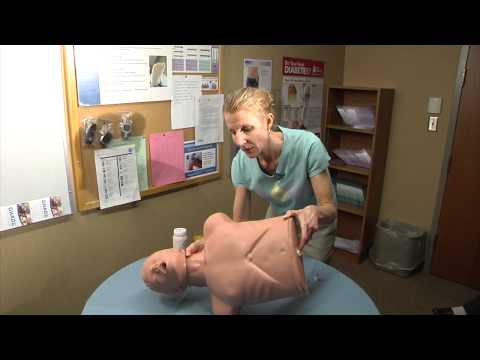
As of 2026-04-03 UTC, the most useful way to watch Mayo Clinic's 193-second "How to Use Glucagon," published on June 12, 2014, is as a record of every step that severe-hypoglycemia rescue used to demand from a caregiver under pressure.[1] The video demonstrates a mixed glucagon emergency kit, not the newer ready-to-use devices that diabetes groups now prefer. That age is exactly what makes it valuable. The older kit exposes the whole failure surface: open the case, remove caps, inject diluent into powder, swirl the vial clear, draw the dose back into the syringe, inject, roll the person onto a side, and keep moving toward emergency care.[1][2][3]
Current written guidance makes the stakes plain. The American Diabetes Association says severe hypoglycemia is an emergency and that glucagon, preferably a ready-to-use formulation, should be used when a person cannot safely swallow carbohydrates, becomes confused, or loses consciousness.[2] NIDDK says glucagon is the best way to treat severely low blood glucose and stresses that family, friends, and coworkers should know when and how to give it, then call 911 after administration.[4] MedlinePlus adds the practical rescue boundary: after glucagon is given, an unconscious person will usually wake within about 15 minutes; if they do not, a second dose should be given and emergency medical treatment should already be in motion.[5]
Taken together, those pages reveal what the Mayo video is really teaching. It is not only a tutorial for an older product format. It is a visible map of rescue tempo. Every motion that looks slow on screen is a motion that newer nasal sprays and premixed autoinjectors are trying to eliminate. Watching the mixed kit now helps a reader understand why "ready-to-use" became more than a convenience label. It became a safety argument.[2][3]
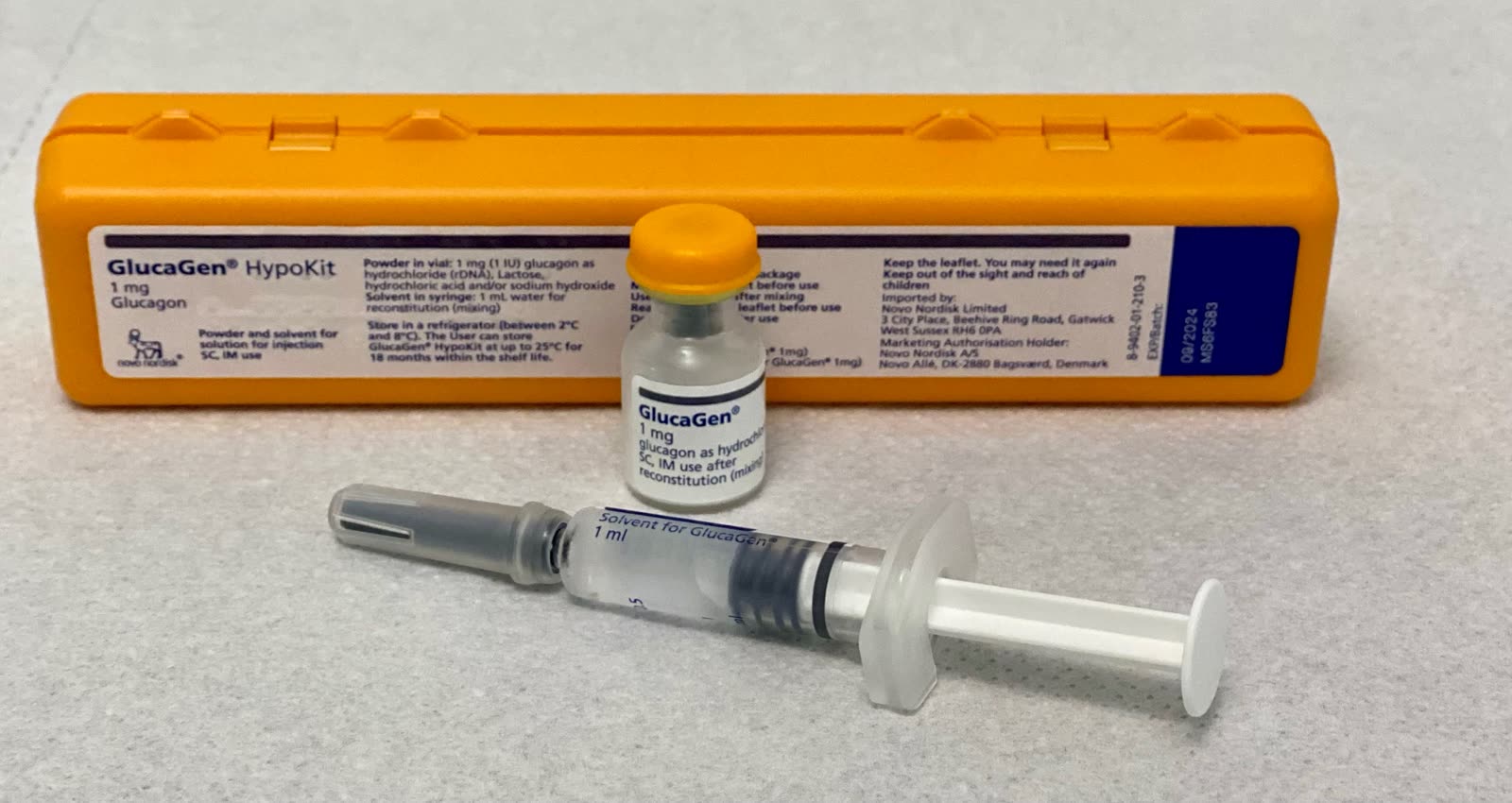
Image context: the cover uses a documentary Wikimedia Commons photograph of a GlucaGen HypoKit case, vial, and syringe. That image belongs here because the article is about kit recognition and rescue choreography, not about abstract glucose physiology; the picture lets the reader see the physical object that older glucagon rescue depended on.[6]
In the opening minute, the mixing sequence shows what newer glucagon design is trying to remove
The first reason this video still matters is that it does not hide the assembly burden.[1] Very quickly, the caregiver is asked to move through a chain that is easy to read calmly and much harder to execute during shaking, confusion, and the fear that the person on the floor may be slipping toward seizure or unconsciousness. Remove the cap from the vial. Take the cover off the syringe. Push the liquid into the powder. Swirl until the solution is clear. Draw it back up. Then inject.[1]
That choreography is precisely why the ADA's current severe-hypoglycemia page now says ready-to-use glucagon is preferred and lists three formulations: premixed pens or injections, nasal powder, and the older kit that requires mixing powder and liquid before administration.[2] The organization is not making a branding argument. It is making a rescue-sequence argument. In severe hypoglycemia, the problem is rarely that caregivers lack goodwill. The problem is that a rescue that requires multiple fine-motor steps competes with panic, poor lighting, interrupted memory, and the awkwardness of handling a semi-conscious or unconscious body.
The ADA's separate administration page makes this contrast even sharper by laying the mixed-kit steps beside the newer one-step formats.[3] Nasal glucagon and premixed pens were built to compress the exact interval that the Mayo video stretches open for the viewer. That is why the clip is still worth embedding in 2026. It lets the reader see the rescue tax directly. A modern ready-to-use product looks better once you remember what the older alternative asked an ordinary caregiver to do.
The video also carries a subtler lesson about preparedness. Mixed glucagon was never just a medicine in a box. It was a workflow stored in a box.[1][3] If the caregiver had not seen the device before, or if the kit had been sitting untouched for months, the rescue could stall before the needle even reached the skin. The video is therefore useful not because older kits are ideal, but because it shows why training and rehearsal remain part of glucagon prescribing even when the hardware improves.
Around the injection and recovery steps, the video makes body positioning and follow-through feel heavier than most summaries do
Many public explainers flatten glucagon into a single dramatic act: injection happens, sugar rises, crisis ends. The Mayo clip is better than that. Once the medicine goes in, the video keeps the scene in emergency mode.[1] The caregiver is told to place the person on a side. That detail matters because vomiting is a known complication and airway protection is part of the rescue sequence, not an optional afterthought.[1][3][5]
MedlinePlus gives the same instruction in plain language: after injection, turn the patient onto their side to prevent choking if they vomit.[5] The page also explains why the side-positioning step sits inside a larger timeline. A person who is unconscious from severe hypoglycemia will usually wake within about 15 minutes; if they do not, a second dose should be given. Emergency medical treatment should already be underway, and once the person can swallow, they should receive a fast-acting source of sugar followed by a longer-acting source.[5] Read beside that guidance, the video's recovery phase looks less like cleanup and more like the second half of treatment.
NIDDK reinforces the same structure from a family-readiness angle. People at risk of severe low blood glucose should talk with their care team about when and how to use a glucagon emergency kit, teach family and coworkers how to give it, and make sure those helpers know to call 911 right away after administration.[4] That is an important correction to the folk idea that glucagon is a self-contained fix. It is first-line rescue, but it is still rescue. The patient needs observation, the caregiver needs to watch for response, and the emergency system may still be needed even if the person begins to recover.
This is where the Mayo video becomes more than a device demonstration. It shows that severe-hypoglycemia care is partly pharmacology and partly scene management.[1] Someone has to steady their hands, carry out the steps in order, protect the airway, watch the clock, and keep the transition to emergency care or post-recovery feeding from falling apart. The side-positioning moment looks simple only because the video makes it look practiced.
Why this older Mayo clip still belongs in a current glucagon conversation
At first glance, a 2014 video about a mixed kit could look outdated enough to skip. Current guidance points readers toward faster formulations, and rightly so.[2][3][5] Yet the older clip remains instructive because it reveals the logic behind that shift. When diabetes groups now say "prefer ready-to-use glucagon," they are not only describing a newer product category. They are responding to the delay built into the older choreography.[2][3]
The video also protects against a different mistake: assuming that ready-to-use means no preparation is needed. NIDDK still says people should teach family, friends, and coworkers how and when to give glucagon.[4] MedlinePlus still says caregivers should learn the device before an emergency and replace it after use.[5] Hardware can shorten the sequence, but it cannot eliminate the need for recognition, access, familiarity, and follow-through. A nasal or premixed device is easier to deliver correctly; it does not make severe hypoglycemia casual.
That is why the embedded clip should be watched as a historical stress test for modern rescue design. It lets the reader see every place where time can leak out of an emergency: locating the kit, remembering the steps, mixing cleanly, drawing up the dose, reaching the thigh, then managing the body after injection.[1] Once those failure points are visible, the rest of the written source stack becomes easier to interpret. ADA's preference for ready-to-use glucagon, NIDDK's insistence on caregiver training, and MedlinePlus's instructions about side-positioning, second dosing, and replacement all point at the same reality: severe hypoglycemia is survivable partly because modern rescue tries to remove procedure from the moment when cognition is collapsing.[2][4][5]
The deeper value of the Mayo video, then, is not nostalgia for the older kit. Its value is explanatory. It shows why rescue in diabetes has moved toward shorter, clearer, more foolproof sequences, and it reminds readers that the job is not finished when the medicine is prescribed. The rescue still has to be imaginable in the hands of the person who will actually open the case.
Sources
- Mayo Clinic, "How to Use Glucagon - Mayo Clinic Patient Educaction," YouTube video, published June 12, 2014.
- American Diabetes Association, "Severe Hypoglycemia" - emergency criteria, formulations, and preference for ready-to-use glucagon.
- American Diabetes Association, "How to Use Glucagon" - nasal, premixed, and mixed-kit administration guidance plus side-positioning after use.
- National Institute of Diabetes and Digestive and Kidney Diseases (NIDDK), "Low Blood Glucose (Hypoglycemia)" - glucagon emergency-kit planning, caregiver teaching, and 911 follow-through.
- MedlinePlus, "Glucagon Injection" - available formulations, side-positioning, 15-minute wake-up window, second-dose guidance, and replacement after use.
- Wikimedia Commons, "File:Glucagen with case.jpg" - documentary photo of a GlucaGen HypoKit case, vial, and syringe.