When people compress polio history into a duel between Jonas Salk and Albert Sabin, they usually force the question into the wrong shape. The useful comparison is not which scientist was smarter or which vaccine was simply "better." The real question is which bottleneck each vaccine solved. Salk's inactivated poliovirus vaccine, or IPV, was built to keep infection from crossing into catastrophic disease. Sabin's oral poliovirus vaccine, or OPV, became the stronger tool for pushing down intestinal replication and person-to-person spread at campaign scale.[1][3][5][6]
That distinction matters because polio itself is an awkward disease to govern. Most infections stay invisible. CDC notes that most infected people show no visible symptoms, while the WHO still summarizes the classic public-health danger in one blunt ratio: about 1 in 200 infections leads to irreversible paralysis, and 5-10% of those paralyzed die when breathing muscles fail.[2][3] A vaccine program therefore has to answer two different questions at once. How do you keep children from entering the small but catastrophic tail of paralysis? And how do you keep silent gut infection from continuing to circulate through a community?[2][3][6]
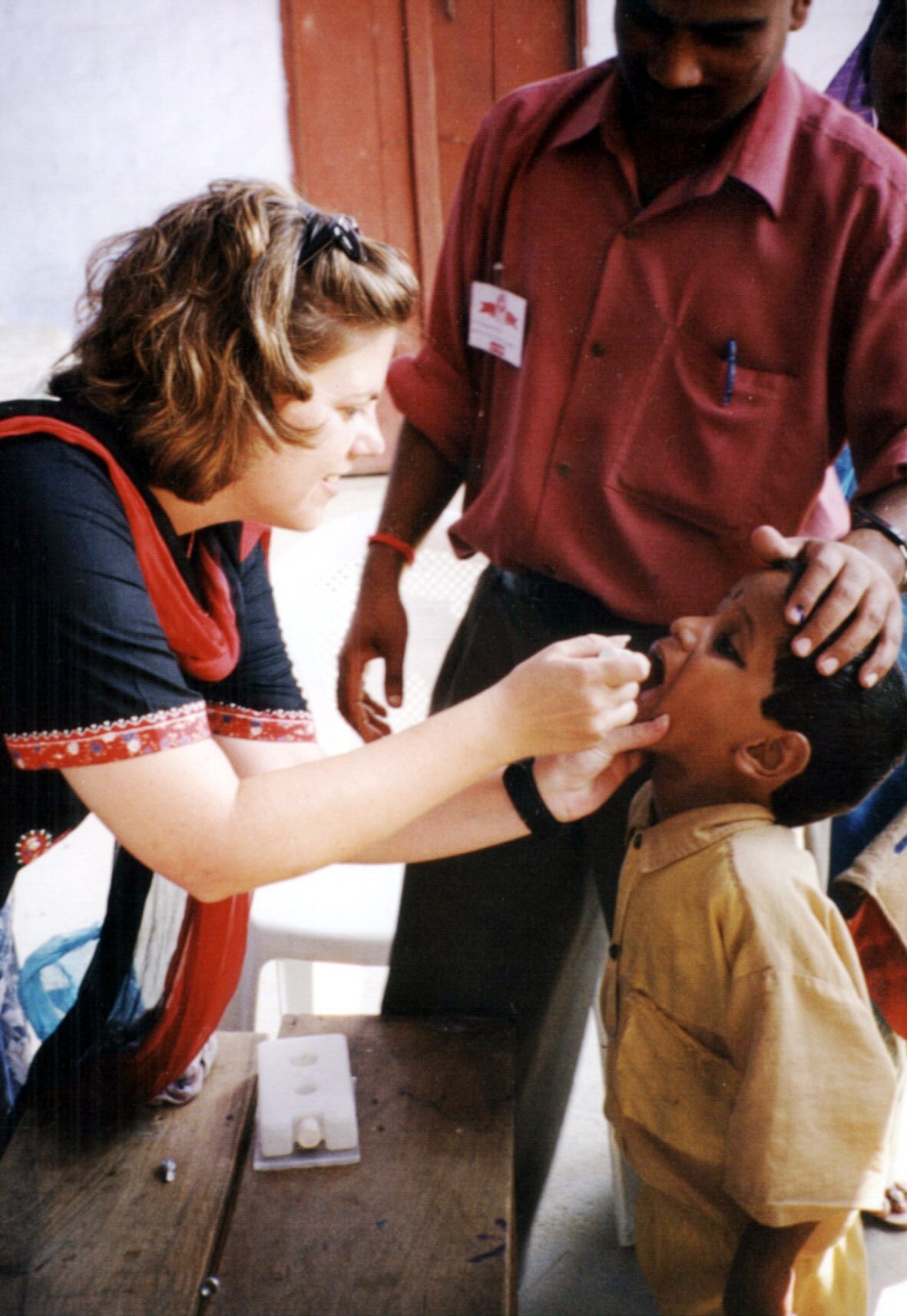
Image context: the cover image is a real CDC campaign photograph from India in 2002, preserved on Wikimedia Commons. It belongs here because this article's argument turns on delivery format as much as laboratory design; the shift from injection to oral drops changed how many children a program could reach, how fast, and with what effect on transmission.[7]
Timeline anchors before comparison
- 1954: the Salk field trials become the largest vaccine experiment yet attempted, fixing attention on whether a killed-virus shot can prevent paralytic poliomyelitis at national scale.[4]
- 1955: Salk's IPV enters rollout after the trial result is publicly announced, making injectable protection against paralysis the first viable large-scale answer in the United States.[4][5]
- 1961-1963: Sabin's OPV moves into widespread use, first in monovalent forms and then as trivalent oral vaccine, giving programs a cheaper, easier mass-campaign tool.[5]
- 1988: the Global Polio Eradication Initiative begins, and OPV becomes central to the worldwide attack on transmission; WHO's current fact sheet measures the result as a decline of more than 99% in wild-polio cases from the estimated 350,000 cases then seen annually.[3][5][6]
- 2000: CDC notes that the United States shifts to IPV-only use in order to remove the risk of polio variants associated with OPV.[1]
- 2025: WHO still lists only two countries with endemic wild-poliovirus transmission, which means the campaign has moved from epidemic control into an unstable endgame rather than a solved past tense.[3]
1. What Salk solved first: the paralysis problem
The achievement of IPV looks clearest when you start from the frightening asymmetry of polio. Most infections never become visible, yet a small minority break into the spinal cord and leave permanent weakness or death.[2][3] In that setting, a killed-virus vaccine had a clean public-health promise. It did not have to imitate natural infection in the gut to be valuable. It had to generate enough circulating antibody to stop the virus from reaching the nervous system. That is why Salk's vaccine mattered so quickly. It translated immunology into a direct political sentence parents and physicians could understand: a child who gets exposed is far less likely to enter the paralytic tail.[4][5][6]
The historical logic of the 1954-1955 rollout followed that risk profile. Naomi Rogers's reconstruction of the 1954 field trials shows a country willing to accept an enormous experimental undertaking because the disease burden had become emotionally and politically intolerable.[4] The shot fit the institutional world that first adopted it. It could be standardized, documented, and delivered inside clinics, schools, and physician offices. In a high-capacity health system, injection was not a flaw. It was evidence of control.[4][5]
This is also why it is wrong to treat IPV as a failed first draft that OPV later replaced. The first job was to break the terror of summer paralysis. Salk's vaccine directly addressed that job.[4][5] In comparative-history terms, IPV belonged to the stage when the public-health system needed a safer biologic that could protect individuals from the worst clinical outcome even before transmission control was perfect.
2. What Sabin solved next: the transmission problem
OPV changed the comparison because it was built for a different terrain. CDC's current vaccine page still gives the essential contrast in plain language: IPV is the injected vaccine; OPV is delivered as drops in the mouth and continues to be used in many parts of the world.[1] That delivery difference mattered operationally, but the deeper difference was immunological. Reviews by Bandyopadhyay and Minor both emphasize that IPV is highly effective at inducing humoral protection, while OPV does more in the intestine, where poliovirus first replicates and from which it spreads onward.[5][6]
That made Sabin's vaccine a transmission weapon. It was easier to administer, did not require sterile needles at every contact point, could move through mass campaigns at speed, and in many settings was better suited to reducing the gut-level replication that keeps fecal-oral spread alive.[1][5][6] Once global eradication became the frame after 1988, those traits were decisive. A program trying to interrupt circulation across millions of children did not only need strong individual protection. It needed throughput, repeatability, and a vaccine that worked where the virus actually lived before paralysis appeared.[3][5][6]
This is the point at which a false ranking usually enters the story. OPV can look like the superior vaccine because it traveled better through large campaigns and because global eradication was unthinkable without it. Yet that is only true if the main problem is live transmission in large populations. Sabin solved the hardest operational problem of the eradication era: how to push immunity through entire communities fast enough to make the virus run out of hosts.[5][6]
3. Why the "better vaccine" question flips in the endgame
Polio's endgame forces the comparison to turn once more. The same CDC page that distinguishes IPV from OPV also explains why the United States abandoned OPV in 2000: IPV-only use removed the risk of polio variants associated with the live oral vaccine.[1] That is the paradox built into the history. OPV's strength is that it behaves enough like live infection to suppress transmission efficiently. OPV's weakness is also that it behaves enough like live infection to create trouble when wild virus has already been pushed into corners and overall immunity becomes patchy.[1][5][6]
Bandyopadhyay's review makes the endgame logic explicit. If eradication of wild poliovirus is certified and programs still need to prevent all polioviruses from reclaiming territory, the world cannot think only in terms of the mid-century race between Salk and Sabin.[5] Minor makes the same point from the pathogenesis side: because most infections remain silent and circulation can continue without visible paralytic cases, endgame policy cannot rely on case counts alone.[6] The final phase therefore bends back toward IPV, layered schedules, and tighter surveillance. As the disease burden falls, the governance problem changes. Programs become less willing to tolerate the live-virus tradeoff that once made OPV so powerful.[1][3][5][6]
Seen this way, the late history does not show Salk finally defeating Sabin after all. It shows the campaign moving into a new risk environment. Early epidemic control rewarded the direct anti-paralysis value of IPV. Mass eradication rewarded OPV's mucosal and logistical power. Endgame management rewards a different balance again, because the acceptable downside of a live vaccine shrinks once the wild virus is rare.[1][5][6]
The strongest two interpretations
Interpretation A: Sabin's vaccine made Salk's vaccine historically obsolete
This reading captures one important truth. OPV became the workhorse of global eradication because it was easier to deliver and better suited to suppressing transmission at scale.[1][5][6] If the benchmark is campaign efficiency in high-burden settings, Sabin's design changed the game more radically than Salk's shot could.
Interpretation B: Salk and Sabin solved different stages of the same problem, and the endgame has revived Salk's logic
This interpretation fits the full arc better. IPV first reduced the risk of paralytic disease and still offers the safer immunization base where programs want to avoid live-vaccine complications.[1][4][5] OPV then became indispensable when the task shifted from protecting individuals to crushing community transmission.[1][5][6] The later return toward IPV-heavy schedules is therefore not a reversal of history. It is the campaign acknowledging that the governing problem has changed again.[1][3][5][6]
What the comparison changes
The cleanest conclusion is that polio control was never one race with one winner. Salk's vaccine answered the clinical horror of paralysis with a safer injectable shield. Sabin's vaccine answered the public-health mechanics of spread with a faster, more gut-focused campaign tool. The eradication endgame now inherits both histories at once.[1][3][5][6]
That is why the comparison still matters. It teaches a broader health lesson about technologies that look like rivals when they are actually tuned to different failure modes. One product can be best at protecting the individual from catastrophe. Another can be best at reorganizing transmission across a population. Polio required both insights, just on different calendars.[4][5][6]
Sources
- CDC, "Polio Vaccination" (current U.S. vaccine-use summary comparing IPV and OPV, including the 2000 IPV-only shift).
- CDC, "About Polio in the United States" (clinical course, silent infection, and symptom distribution).
- World Health Organization, "Poliomyelitis" fact sheet, updated April 2, 2025 (global burden, paralysis ratio, mortality range, and endemic-country status).
- Naomi Rogers, '"A calculated risk": the Salk polio vaccine field trials of 1954' (BMJ, 1999; full text via PubMed Central).
- Ananda S. Bandyopadhyay, Julie Garon, Katrin Seib, Walter A. Orenstein, "Polio vaccination: past, present and future" (Future Microbiology, 2015; PubMed record).
- Philip Minor, "The polio endgame" (Human Vaccines & Immunotherapeutics, 2014; full text via PubMed Central).
- Wikimedia Commons, "File:Vaccination-polio-india.jpg" (2002 CDC National Immunization Program photograph used for the article image).