The WHO Surgical Safety Checklist is easy to misread because it looks too plain. Its genius is not that it contains obscure medical knowledge. Its genius is that it makes ordinary safety knowledge hard to leave unspoken. In the 2009 implementation manual, the checklist is divided around three moments: before anesthesia, before incision, and before the patient leaves the operating room.[1] That structure turns the operation into a sequence of mandatory pauses.
Read closely, the document is less a form than a piece of choreography. It does not ask one expert to remember everything. It asks the team to stop at points where omission becomes dangerous: patient identity before induction, airway and blood-loss risk before the case deepens, antibiotics before the incision, equipment before it is needed, specimen labels before confusion hardens into the record, and recovery concerns before the patient disappears into the next handoff.[1][2]
That is why the checklist belongs in health history as well as quality improvement. WHO launched Safe Surgery Saves Lives in 2007, announced the checklist in June 2008, published major guidance in 2009, and then spent the following years facing the harder implementation question: how do you make a short script change room behavior without becoming empty ritual?[1][2][4]
The first pause narrows the identity problem
The first section, before induction of anesthesia, begins with the least glamorous question in medicine: is this the right patient, right site, right procedure, and valid consent?[1] In ordinary prose, that sounds obvious. In an operating room, obvious facts can become fragile because each professional may believe someone else already checked them.
The checklist's answer is not to add mystique. It forces explicit confirmation before the patient is made more vulnerable by anesthesia. The same pause also brings anesthesia safety into the open: equipment, pulse oximetry, allergy, airway risk, aspiration risk, and possible blood loss.[1] The point is not that a surgeon, anesthetist, or nurse would otherwise know nothing about these issues. The point is that silent knowledge is not shared knowledge.
This is the source's first important move. It treats communication as a clinical intervention. The patient has not yet been cut, but the operation is already underway as a system. A missing oximeter, a difficult airway, an unspoken allergy, or an underestimated blood-loss plan can shape the case before the first incision. The checklist gives those risks a place in time.
The second pause makes hierarchy audible
The most revealing section is the "Time Out" before skin incision. WHO's public explanation says the checklist brings together surgeons, anesthesia providers, and nurses at vital phases of care.[2] That language matters. It does not frame safety as a surgeon's private memory or a nurse's paperwork duty. It names the whole operating team.
The details make the point sharper. Before incision, team members confirm the patient, site, and procedure; introduce themselves when needed; review anticipated critical events; confirm antibiotic prophylaxis where indicated; and ask whether essential imaging is displayed.[1][2] This is a brief moment, but it changes the social physics of the room. It gives junior staff, anesthesia staff, and nursing staff a sanctioned moment to speak before speed and hierarchy become harder to interrupt.
The WHO Q&A is unusually candid about why introductions matter. It says that having people speak aloud can make them more likely to speak up later if they have concerns.[2] That is a behavioral claim embedded inside a medical checklist. The first utterance is not ceremonial. It lowers the cost of the second utterance, the one that may catch an error.
The 2007-2008 pilot study published in the New England Journal of Medicine tested a surgical safety program across eight hospitals in eight cities and compared outcomes before and after checklist introduction.[3] The reported mortality rate fell from 1.5% to 0.8%, and inpatient complications fell from 11.0% to 7.0%.[3] Those numbers made the checklist famous. But the primary source helps explain why the result was plausible: the intervention did not try to solve one disease. It targeted recurrent failure points in surgical work.
The third pause protects the handoff
The final section, before the patient leaves the operating room, is where the checklist's design becomes most mature. Many safety tools end once the dramatic task is complete. WHO's checklist keeps going. It asks the team to confirm the procedure performed, instrument and sponge counts, specimen labeling, equipment problems, and key concerns for recovery.[1]
This part is easy to undervalue because it happens after the central action. But surgery does not end when the wound closes. A mislabeled specimen can change diagnosis. A retained sponge can turn recovery into harm. A missing equipment problem can repeat in the next case. A recovery concern that remains implicit can fail at the transfer point between operating room and ward or recovery unit.
The checklist therefore reads the operation as a chain of custody. The patient, the tissue, the instruments, the information, and the future risk all have to leave the room in a knowable state. That is a broader idea of safety than "the procedure went well." It asks whether the system can still tell the truth after the procedure.
The evidence is strong, but implementation is the condition
The checklist's afterlife also warns against a shallow reading. A systematic review of surgical checklists published in BMJ Quality & Safety included 33 studies and concluded that checklists were associated with better hazard detection, fewer surgical complications, and improved communication, while also emphasizing leadership, staff feedback, local adaptation, and avoidance of redundant paperwork.[4]
That last clause matters. A checklist is not a magic object. If a hospital treats it as a signature exercise, the spoken pause can decay into a checkbox. If it is imposed without workflow fit, staff may experience it as interruption rather than shared safety work. WHO's own manual says successful implementation depends on early engagement, active leadership, local champions, multidisciplinary involvement, coaching, feedback, and local adaptation.[1]
The best reading, then, is neither "checklists save lives" nor "checklists are bureaucracy." The stronger claim is narrower and more useful: a well-implemented checklist can make critical coordination visible at moments when silence is dangerous. Its text is short because the intervention is not the paper. The intervention is the room stopping together.
That is what makes the WHO document still worth close reading. It takes the operating room, one of medicine's most specialized spaces, and insists on a humble principle: the most important facts are not safe until the team has made them shared facts. The pause becomes part of the operation because the operation was always more than the cut.
Sources
- World Health Organization, Implementation manual WHO surgical safety checklist 2009, published April 2, 2009 - primary implementation source for checklist phases, required pauses, and adoption factors.
- World Health Organization, "Patient safety: Safe surgery saves lives," Q&A page, August 20, 2014 - official explanation of checklist purpose, team roles, and spoken introductions.
- Alex B. Haynes et al., "A Surgical Safety Checklist to Reduce Morbidity and Mortality in a Global Population," New England Journal of Medicine, 2009 - PubMed record with pilot-study methods and outcome summary.
- Jonathan R. Treadwell, Scott Lucas, and Amy Y. Tsou, "Surgical checklists: a systematic review of impacts and implementation," BMJ Quality & Safety, 2014 - open-access review of checklist effects, barriers, and implementation factors.
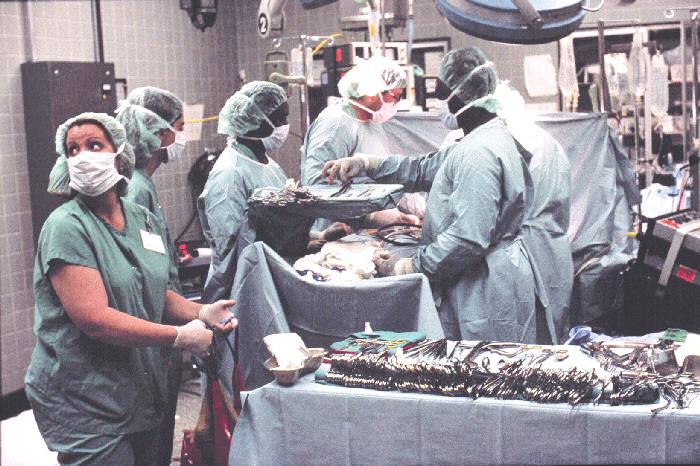
- CDC Public Health Image Library, image ID 1410 - public-domain operating room photograph used as the article image.