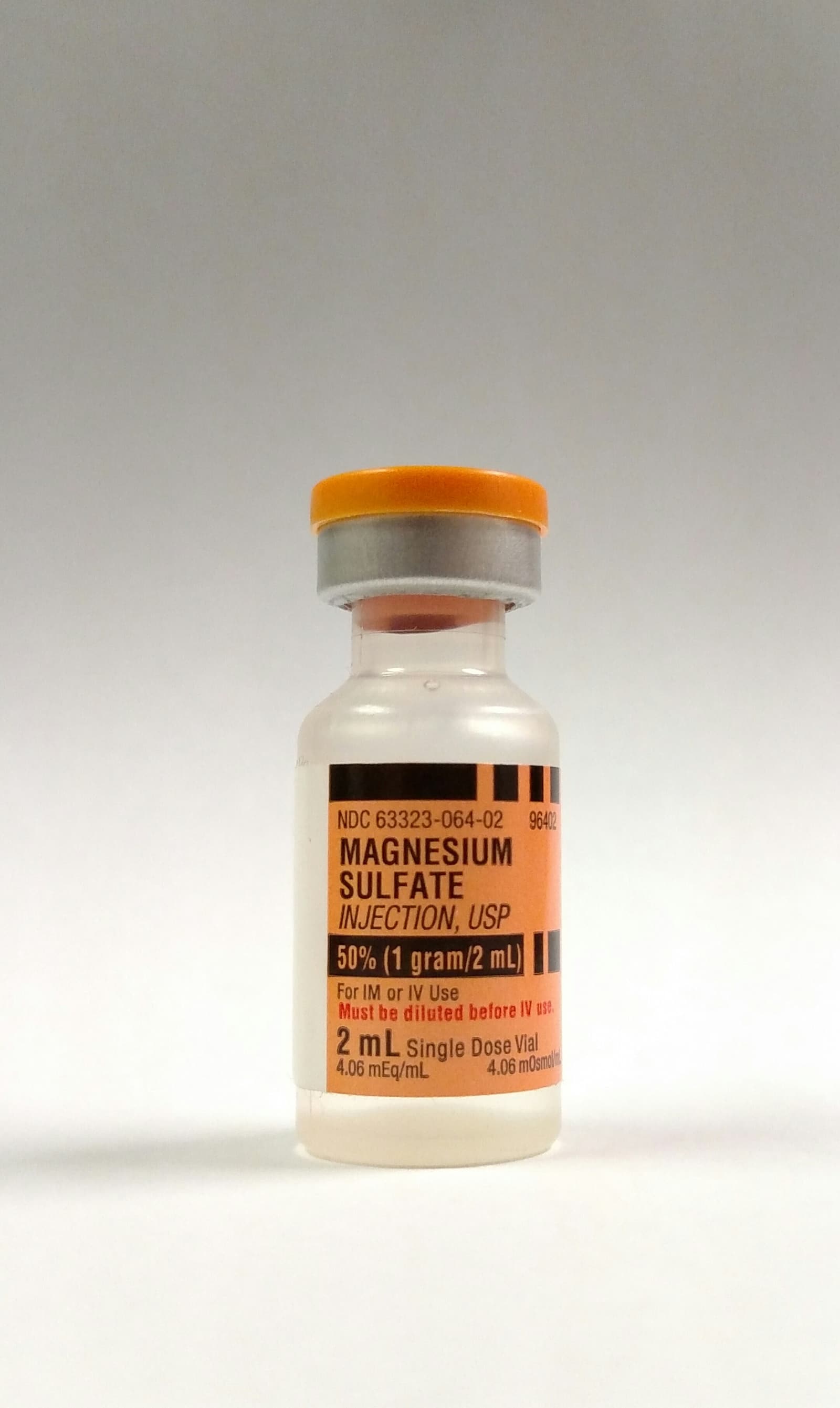
Magnesium sulfate is easy to misread because the name sounds ordinary. Magnesium is sold in supplements. Sulfate sounds like chemistry class. But in obstetric care, magnesium sulfate is not a wellness mineral with a better publicist. It is a hospital drug used at one of pregnancy's most dangerous borders: the interval in which pre-eclampsia can become eclampsia, and eclampsia means seizures.
That border is the whole mechanism. Pre-eclampsia is not simply "high blood pressure in pregnancy." Hypertension is the visible sign, but the danger includes multi-organ disease, severe neurologic symptoms, liver and kidney injury, low platelets, pulmonary edema, fetal risk, and seizure. The ACOG practice-bulletin summary in American Family Physician treats severe features as a clinical threshold that changes management, and it identifies magnesium sulfate as the seizure-prevention and seizure-treatment drug for pre-eclampsia with severe features and eclampsia.[4]
So the central question is not whether magnesium sulfate lowers blood pressure the way an antihypertensive does. It does not solve the pregnancy. It does not remove the placenta, end the disease process, or replace delivery planning. Its importance is narrower and more decisive: it makes the seizure window less likely to open, and it treats seizures when that window has already opened.
The disease is a threshold problem
Eclampsia is best understood as a threshold event. A patient can move from warning signs to convulsion, and once that happens the risk is no longer abstract. The immediate harms include injury, aspiration, hypoxia, stroke risk, fetal compromise, and the cascade that follows an obstetric emergency. That is why the drug's timing matters. It is used before seizures in high-risk pre-eclampsia, and it is used after seizures in eclampsia, because both moments sit close to the same neurologic edge.[1][4]
The World Health Organization's recommendations put this plainly in policy form: magnesium sulfate is recommended for preventing eclampsia in women with severe pre-eclampsia and for treating women with eclampsia.[1] That double role is important. A drug that only worked after convulsions would be emergency treatment. A drug that only worked before them would be prophylaxis. Magnesium sulfate became central because it occupies both sides of the line.
This also explains why the story is not a simple "old drug beats new drug" morality tale. Older anticonvulsants could stop or reduce seizures in some settings, but the obstetric question is more specific: which therapy best fits the biology and timing of eclampsia? The answer became clearer when large trials and systematic reviews stopped treating seizure control as folklore and measured it.
The evidence turned a salt into the default
The Magpie Trial, published in 2002, randomized women with pre-eclampsia to magnesium sulfate or placebo and asked whether the drug prevented eclampsia and improved outcomes. Its PubMed abstract reports that magnesium sulfate more than halved the risk of eclampsia compared with placebo, with a relative risk of 0.42.[2] That is the kind of result that changes routine care, because it is not merely a laboratory mechanism or a small case series. It is evidence at the scale of clinical policy.
Cochrane's review summary reaches the same practical conclusion from a wider evidence base: magnesium sulfate reduces the risk of eclampsia compared with placebo or no anticonvulsant, and it is preferred to older anticonvulsants used for this problem.[3] The point is not that magnesium sulfate makes pre-eclampsia benign. It is that a major complication, seizure, becomes less likely when the drug is used in the right clinical context.
That context matters because pre-eclampsia is still managed as an obstetric syndrome, not as an isolated seizure disorder. Blood pressure control, maternal laboratory findings, fetal status, gestational age, symptoms, and delivery timing all shape care. The ACOG summary describes delivery thresholds and severe-feature management alongside magnesium sulfate, which is the right framing: the drug is a seizure intervention inside a larger maternal-fetal decision system.[4]
The mechanism is useful even where it is incomplete
The exact anticonvulsant mechanism of magnesium sulfate in eclampsia is not as tidy as a single on-off switch. NCBI's StatPearls review describes several relevant actions, including effects on neuromuscular transmission, calcium entry, vascular tone, and central nervous system excitability.[5] In plain English, magnesium sulfate appears to push an overexcitable system away from seizure, while also affecting vascular and neuromuscular pathways that matter in this syndrome.
That incomplete mechanism is not a weakness if it is handled honestly. Many important drugs were clinically useful before their mechanisms were fully mapped. What matters for this article is the causal shape: severe pre-eclampsia creates a state in which the brain is at risk of convulsion; magnesium sulfate reduces that convulsive risk; and the benefit has been shown in trials and reviews, not merely inferred from biochemistry.[2][3][5]
The mechanism also helps explain what magnesium sulfate is not. It is not a home supplement strategy for pregnancy swelling or blood pressure. It is not a substitute for prenatal care. It is not a reason to ignore headache, visual symptoms, right-upper-quadrant pain, shortness of breath, severe-range blood pressure, or reduced fetal movement. In this setting, "magnesium" means a monitored IV or intramuscular medication protocol used by clinicians, not an over-the-counter bottle.
The same drug that protects can harm
The other half of the causal story is toxicity. Magnesium sulfate is useful because it changes neuromuscular and nervous-system behavior. That also means too much magnesium can depress reflexes and breathing, and risk rises when clearance is impaired, especially because magnesium is eliminated through the kidneys.[5] The clinical bargain is therefore not "safe mineral versus dangerous disease." It is "high-value anticonvulsant effect, used under observation, with toxicity checks built into the treatment."
This is why bedside monitoring is not bureaucratic decoration. Reflexes, respiratory status, urine output, renal function, and serum magnesium in selected circumstances are part of making the drug's useful window wider than its harmful window.[5] WHO's recommendations also include regimen and administration guidance rather than treating the drug as a casual add-on.[1] The protocol is part of the therapy.
That point is easy to miss in public health writing because magnesium sulfate has a modest name. If the same medication had a futuristic brand name, readers might expect tight monitoring. Because it sounds elemental, the risk can be underestimated. The better interpretation is the opposite: the drug's power is exactly why it belongs in supervised obstetric care.
The boundary that keeps the lesson clean
Magnesium sulfate changed eclampsia care because it answered a specific question better than the alternatives: how do clinicians prevent or treat seizures in a syndrome where the pregnancy itself is driving systemic danger? The answer is not to call magnesium sulfate a cure. The answer is to recognize that eclampsia has a seizure window, and that the drug narrows it.
The strongest current framing has three parts. First, severe pre-eclampsia and eclampsia are emergency-grade conditions, not variations of ordinary pregnancy discomfort.[4] Second, magnesium sulfate has strong clinical evidence for reducing seizure risk and treating eclampsia, which is why WHO and obstetric guidance place it at the center of care.[1][2][3] Third, the drug's benefits require medical boundaries: correct indication, appropriate protocol, renal and respiratory awareness, and monitoring for toxicity.[5]
That is the durable lesson. Magnesium sulfate is not famous because it is chemically exotic. It is famous because it acts at the point where a hypertensive pregnancy disorder can become a neurologic emergency. The medicine matters because the timing matters.
Sources
- World Health Organization, WHO recommendations for prevention and treatment of pre-eclampsia and eclampsia (2011; NCBI Bookshelf) - recommendation context for magnesium sulfate in severe pre-eclampsia and eclampsia.
- The Magpie Trial Collaborative Group, "Do women with pre-eclampsia, and their babies, benefit from magnesium sulphate? The Magpie Trial," Lancet, 2002; PubMed record - randomized placebo-controlled trial of magnesium sulfate in pre-eclampsia.
- Cochrane, "Magnesium sulphate and other anticonvulsants for women with pre-eclampsia" - systematic review summary of magnesium sulfate compared with placebo/no anticonvulsant and other agents.
- American Family Physician, "Gestational Hypertension and Preeclampsia: A Practice Bulletin from ACOG" (2019) - accessible summary of ACOG guidance on severe features, delivery timing, and magnesium sulfate use.
- NCBI Bookshelf / StatPearls, "Magnesium Sulfate" - pharmacology, monitoring, toxicity, and clinical-use boundaries for magnesium sulfate.
- Wikimedia Commons, "File:Magnesium sulfate (cropped).jpg" - photographic source for the article image.