The most quoted sentence in the World Health Organization's Constitution is also the sentence most often detached from its own company. Read alone, it sounds like a maximalist definition in search of an impossible human condition: health as "a state of complete physical, mental and social well-being and not merely the absence of disease or infirmity."[1] Read inside the preamble that surrounds it, the line becomes more precise. It is part of a founding attempt to move health out of the narrow custody of sanitary administration and clinical repair, and into a larger field that includes rights, public cooperation, unequal development, child life, mental life, and government responsibility for social measures.[1]
That wider reading matters because the Constitution was drafted in a very specific institutional moment. The Second World War had just ended. Diplomats and public-health officials were trying to create an organization that would do more than monitor quarantines or exchange epidemic notices.[2][3] They wanted a body with enough legitimacy to speak about standards, research, maternal and child welfare, mental health, and the social conditions that make populations vulnerable in the first place.[1][3] The famous definition was the verbal front door to that larger jurisdiction.
The core argument of this close reading is narrow and stronger than the usual "WHO defined health broadly" summary. The Constitution's health language did three jobs at once. First, it enlarged the object of health beyond disease. Second, it tied that object to peace, equality, knowledge-sharing, and social provision. Third, it preserved a sovereignty bargain: the new organization could declare norms and rights, but governments still had to ratify the Constitution and provide the health and social measures that would make the language real.[1][2][3] The ambition was expansive. The mechanism was still political.
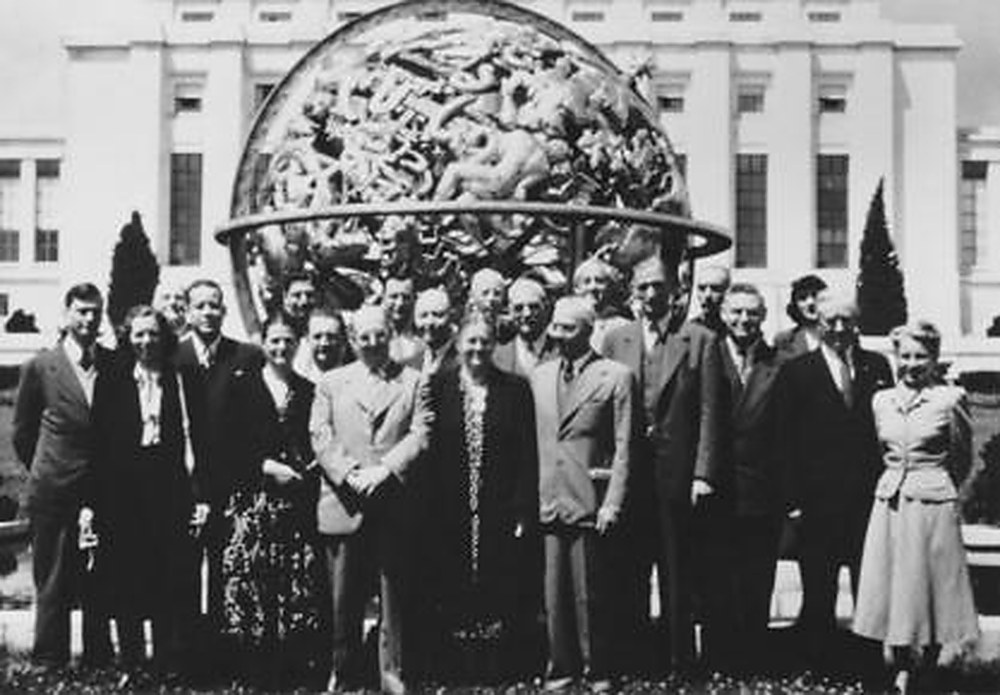
Image context: the cover uses a 1948 photograph of delegates at the first World Health Assembly in Geneva.[6] That image suits the essay because the Constitution did not become meaningful when one sentence was drafted in 1946; it became meaningful when governments ratified the document, sent delegates, and turned a definition into agenda, procedure, and institutional obligation.
Timeline anchors
- April 1945: at the San Francisco conference that created the United Nations, representatives of Brazil and China pushed for a new international health organization.[2]
- 15 February 1946: the UN Economic and Social Council instructed the Secretary-General to convene an international health conference.[2]
- 18 March to 5 April 1946: a Technical Preparatory Committee met in Paris and drafted proposals for the future constitution.[2][3]
- 19 June to 22 July 1946: the International Health Conference met in New York and adopted the Constitution of the World Health Organization.[1][3]
- 7 April 1948: the Constitution entered into force when the 26th of the 61 signatory governments ratified it.[1][2]
- 24 June 1948: the first World Health Assembly opened in Geneva with 53 of the organization's 55 Member States represented.[2]
- 21 November 1986: the Ottawa Charter kept the Constitution's broad horizon but reframed health as a "resource for everyday life," not a final state to be possessed once and for all.[4]
1. The famous sentence is only the first move in a much larger preamble
The Constitution's opening line is radical partly because it refuses to let health stop at diagnosis.[1] "Complete physical, mental and social well-being" is already much wider than the older habit of treating health as the successful absence of pathology. But the sentence gains its real force from what immediately follows. The next clauses declare the enjoyment of the highest attainable standard of health a fundamental right, link the health of peoples to peace and security, warn that unequal development is a common danger, emphasize the extension of medical and psychological knowledge, insist on informed public opinion and active cooperation, and finally say that governments bear responsibility for the health of their peoples through adequate health and social measures.[1]
That sequence tells us what the Constitution is trying to do with the word "health." It is not merely describing an ideal condition inside one person. It is reordering a field of obligation. Rights language places health above charity. Peace-and-security language gives it geopolitical weight. Unequal-development language makes one country's public-health weakness a shared risk. The final clause about governments and social measures prevents the whole preamble from floating away into moral atmosphere.[1] The preamble enlarges health, then immediately begins attaching institutions, duties, and international consequences to that enlargement.
This is why the phrase "complete well-being" cannot be read as a stand-alone utopian flourish. In context, it works as the broad opening through which the rest of the preamble can enter. Once health includes mental and social well-being, it becomes reasonable for the document to speak about the child's environment, public knowledge, social measures, and the value of one state's achievements to all peoples.[1] The sentence is not isolated excess. It is the constitutional hinge that allows the rest of the preamble to make sense.
2. The founding record shows a postwar bid for a wider kind of health authority
The historical setting makes the textual move easier to understand. WHO's own history page traces the institutional sequence clearly: Brazil and China pushed the issue at the UN conference in 1945; ECOSOC ordered a conference in February 1946; the preparatory committee met in Paris in March-April 1946; and the New York conference adopted the Constitution on 22 July 1946.[2] This was not a routine handoff between technical bureaux. It was the construction of a new specialized agency in the first years of the postwar order.
The conference record confirms that the Constitution's wider health language matched a wider catalogue of functions.[3] The official summary of proceedings shows a proposed organization empowered to promote maternal and child health and welfare, foster the ability to live harmoniously in a changing environment, advance mental health, conduct research, improve training, study administrative and social techniques affecting public health and medical care, build informed public opinion, standardize diagnostic procedures, and develop international standards for food and biological and pharmaceutical products.[3] In other words, the Constitution's preamble was not promising one thing while the institutional chapters built something narrower. The larger definition and the larger mandate belonged to the same design.
That design helps explain why the document sounds so unlike a narrow medical statute. A body intended only to watch epidemics could have defined health much more modestly. A body expected to speak about welfare, standards, education, research, mental health, and cross-border risk needed a broader entry point.[1][3] The famous sentence was expansive because the institution being founded was expansive.
3. The Constitution enlarges health, but it does not erase the state
The boldness of the preamble can make it easy to miss the restraint built into the document. WHO could state principles, coordinate, recommend, and standardize. It could not simply command health into existence. The Constitution entered into force only when enough governments ratified it, and WHO's own history page is explicit about the threshold: the 26th ratification among the 61 signatories triggered entry into force on 7 April 1948.[1][2] The right to health appears early, but the machinery underneath it is still treaty law and member-state consent.
The same sovereignty bargain appears inside the preamble itself. The phrase "highest attainable standard" already implies variation in material circumstance and institutional capacity.[1][5] The governments clause then says responsibility can be fulfilled only through adequate health and social measures, which means the Constitution is not imagining a purely technocratic fix delivered from Geneva.[1] It is assigning a direction of travel and leaving implementation to states, budgets, law, administration, and public legitimacy.
WHO's current human-rights page still carries that structure forward. It describes health as a fundamental right recognized in the Constitution, but then immediately explains that states have legal obligations shaped by time and resources, alongside immediate duties such as non-discrimination and equal treatment.[5] The continuity is revealing. The Constitution never promised instantaneous equal outcomes. It made a rights claim large enough to judge governments by, while accepting that realization would remain politically mediated.
4. Why "complete" aged awkwardly, and why WHO later revised the tone without abandoning the horizon
The word that attracts the most criticism is "complete." It makes the definition sound static, total, and almost impossible to inhabit for anyone living with chronic illness, disability, or ordinary fluctuation.[7] That criticism is real, but it should be aimed precisely. The constitutional text was trying to prevent health from shrinking to disease absence; the same rhetorical move also made the endpoint sound finished and absolute.
The most important internal revision did not come from deleting the old definition. It came from reframing it. The 1986 Ottawa Charter still echoes the constitutional language of physical, mental, and social well-being, yet shifts the emphasis toward capacity, control, environment, and everyday life.[4] Its most famous corrective phrase is that health should be seen as "a resource for everyday life, not the objective of living."[4] That sentence does not abandon the 1946 horizon. It operationalizes it. Health becomes something people use, build, and defend inside schools, workplaces, homes, cities, and political systems, not a perfect state that must be fully achieved before one counts as healthy.
That is why the Constitution still reads alive in 2026. Its value is not that it solved the definition of health once and for all. Its value is that it permanently widened the field. It made it difficult, after 1946 and 1948, to speak about health as if public policy, rights, peace, inequality, mental life, and social provision were secondary additions rather than part of the subject itself.[1][2][4][5] The cost of that victory is that the language remains aspirational and sometimes too large for clinical or measurement work. The benefit is that it still resists the old temptation to confuse health with the mere nonappearance of disease.
Sources
- World Health Organization, "Constitution of the World Health Organization" - official constitutional text and preamble, including the clauses on complete well-being, the right to health, public cooperation, and government responsibility for health and social measures.
- World Health Organization, "History of WHO" - official institutional history covering the 1945 proposal, the 1946 Paris preparatory committee, the New York conference, the 61 signatories, and the 7 April 1948 entry into force after the 26th ratification.
- International Health Conference (New York, June-July 1946), Summary report on proceedings, minutes and final acts of the International Health Conference held in New York from 19 June to 22 July 1946 - official WHO record of the conference that framed the Constitution and the organization's wider field of powers.
- World Health Organization Regional Office for Europe, Ottawa Charter for Health Promotion, 1986 - official WHO text that reframed health as a resource for everyday life while retaining the Constitution's broad social horizon.
- World Health Organization, "Human rights" - current WHO page connecting the Constitution's right-to-health language to state obligations, non-discrimination, participation, and the underlying determinants of health.
- U.S. National Library of Medicine, "Photo Gallery" - exhibition gallery page containing the 1948 photograph of Martha May Eliot with delegates to the first World Health Assembly used for the article image.
- Thomas Schramme, "Health as Complete Well-Being: The WHO Definition and Beyond" (Public Health Ethics, 2023) - open-access philosophical reading of why the Constitution's "complete well-being" language still attracts both criticism and defense.