Chlorine in drinking water is easy to misunderstand because the public encounters it first as taste and smell. A glass tastes faintly like a pool, a filter pitcher promises to remove the note, and the real engineering story disappears behind a sensory complaint. But chlorination is not mainly a flavor problem. It is a residual public-health system: a small, measured disinfectant backstop that follows treated water through pipes, storage tanks, pressure changes, and household taps.[2][3]
That is why the history matters. CDC's historical summary puts the U.S. hinge at 1908, when Jersey City, New Jersey began routine disinfection of a community drinking-water supply. In the decade that followed, thousands of cities and towns adopted routine disinfection, contributing to a sharp fall in waterborne disease.[1] The important lesson is not nostalgia for a single chemical. It is that safe drinking water became safer when treatment stopped being a one-time event at the plant and became a monitored system that still had a margin after water left the plant.
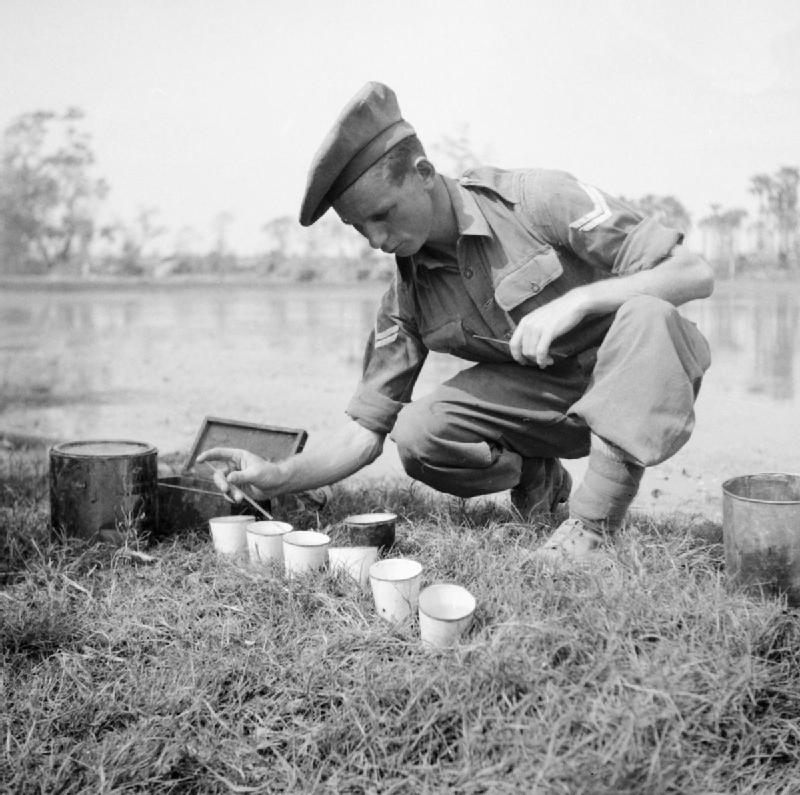
Image context: the cover image is a real 1945 photograph from Burma showing a Royal Army Medical Corps orderly testing whether drinking water contains the right quantity of chlorine. It is a strong visual for this piece because the article's central word is "residual." In a field camp or a city network, the point is not simply that chlorine was added earlier. The point is whether enough disinfectant is still present when the water reaches people.[8]
The myth frame
The common myths all collapse a system into one object. Some people treat chlorine as an obsolete nineteenth-century smell. Others treat filtration as if it settles microbiological safety by itself. Still others treat disinfection byproducts as proof that the safest water would be disinfectant-free. The evidence points to a narrower and more useful picture: source protection, filtration, disinfection, residual monitoring, and byproduct control are separate jobs that have to be coordinated.[2][3][5][6]
Myth 1: clear water is the same thing as safe water
Clear water is reassuring to the eye, but it is not a microbiology test. CDC's current public page explains the basic pathway plainly: reservoirs and wells can contain germs, and germs can also enter water as it travels through miles of pipes to the tap.[2] That second clause is the part many household filters and taste complaints obscure. Finished water still has to move through a distribution system.
That is why utilities add chlorine or chloramine at low levels. CDC describes the purpose as killing germs and helping keep water safe as it travels through pipes.[2] WHO's chlorination guide treats the same issue operationally: chlorination practice depends on dosing, contact time, standard operating procedures, testing, and capacity inside real water systems, especially small and medium supplies where routine control can be fragile.[3]
So the first correction is simple: appearance is not enough. Turbidity, organic matter, pipe intrusion, storage, pressure loss, and time all shape risk. A clear glass can still need a residual disinfectant history behind it.
Myth 2: filtration made chlorination redundant
Filtration is one of the great water-treatment achievements, but it does not erase the residual problem. It removes particles and reduces microbial load; it does not travel with the water after the filter bed. Chlorine and chloramine do a different job: they leave a measurable disinfectant trace that can continue protecting the system downstream.[2][3]
The difference becomes clearer in emergency and household settings. CDC lists boiling, chlorination, filtration, and solar disinfection as common ways to make water safer, but it also draws boundaries around each method. Chlorination kills many bacteria and viruses, while resistant parasites such as Cryptosporidium and Giardia require more care; no ordinary disinfection method makes water safe if the problem is fuel, toxic chemicals, or radioactive contamination.[6] That is a systems view, not a magic-chemical view.
For public utilities, the lesson is similar. Filtration, disinfection, and monitoring are layers. If one layer is treated as a substitute for all the others, the system becomes brittle. The better question is not "filter or chlorine?" It is "what does each layer remove, what remains, and how will the system know whether the backstop is still there at the tap?"[2][3][6]
Myth 3: chloramine is just a sneaky way to keep chlorine in the water
Chloramine anxiety often starts from the right instinct - people want to know what is in their water - and then jumps to the wrong frame. EPA describes chloramines as disinfectants made when ammonia is added to chlorine, used as secondary disinfection because they provide longer-lasting protection as water moves through pipes.[4] EPA also says more than one in five Americans uses drinking water treated with chloramines, and water that meets EPA regulatory standards is safe for ordinary household uses such as drinking, cooking, and bathing.[4]
That does not mean chloramine and chlorine are interchangeable in every setting. CDC notes special handling for dialysis water, where disinfectants must be removed before use, and for aquatic animals such as fish, reptiles, and amphibians, which can be harmed even by low levels that are acceptable for people.[2] EPA adds that some utilities changed secondary disinfectants to meet disinfection-byproduct requirements.[4]
The evidence therefore supports a more precise claim than either panic or indifference. Chloramine is a distribution-system tool with tradeoffs: longer persistence in pipes, different byproduct chemistry, and special-use exceptions that must be handled explicitly.[2][4][5]
Myth 4: disinfection byproducts prove chlorination was the wrong path
Disinfection byproducts are real. They form when disinfectants react with organic and inorganic material in water, and EPA's Stage 1 and Stage 2 rules exist because long-term exposure above standards can increase health risk.[2][5] Treating byproducts as imaginary would be bad public health.
But treating them as an argument for no disinfection is also bad public health. EPA frames the rule history as an interrelated microbial-and-byproduct problem: source water can contain pathogens such as Giardia, Cryptosporidium, and viruses, while disinfectants can also create byproducts that need regulatory control.[5] The public-health task is to reduce both risks at once.
That is the crucial distinction. The mature water system does not deny the chemistry cost. It manages it through precursor removal, disinfectant choice, compliance monitoring, and regulatory limits while preserving microbial protection.[4][5] In that sense, byproduct rules are not a repudiation of chlorination. They are evidence that chlorination became important enough to govern with more precision.
Myth 5: if the system fails, people will know from taste or smell
Outbreak history is less comforting. In Dushanbe, Tajikistan, a large typhoid fever epidemic in 1997 exposed how fragile the residual backstop can become. CDC reported that chlorination of the municipal water supply ceased in December 1996 when chlorine supplies were exhausted and resumed in April 1997 after outside organizations provided chlorine. Even after resumption, 30% of tap-water samples tested during June to August remained below the utility's target free-chlorine residual of 0.2 mg/L.[7]
The behavioral detail is just as important as the technical one. In a later household survey, 51% of respondents said they still drank unboiled water because they perceived municipal water to be safe.[7] That sentence is the whole myth in miniature. People can live inside a compromised water system and still read normalcy from the tap.
The Dushanbe report does not say chlorine alone was the entire explanation for the epidemic. CDC also discussed water wastage, treatment-plant conditions, groundwater shifts, and public messaging.[7] But it shows why residual disinfectant belongs near the center of drinking-water safety. A system can look ordinary at the kitchen sink while the protective margin has already thinned.
The better mental model
The most useful way to think about chlorination is not as a smell, a slogan, or a single historical invention. It is a continuity device. Treatment reduces the initial burden. Disinfectant residual protects the distribution path. Monitoring tells operators whether the protection survived contact time, pipe distance, storage, and contamination pressure. Regulations then constrain the chemical tradeoff so microbial protection does not create unmanaged long-term exposure.[2][3][4][5]
That is why the old field photograph still feels current. The orderly is not admiring clean water. He is testing a boundary. Chlorination's public-health value lives in that boundary: enough residual to keep microbial risk under control, not so much that chemistry outruns regulation, and enough measurement to know the difference.
Sources
- CDC Stacks, "History of drinking water treatment: a century of U.S. water chlorination and treatment: one of the ten greatest public health achievements of the 20th century" (2012) - historical summary of Jersey City's 1908 routine disinfection and subsequent U.S. adoption.
- Centers for Disease Control and Prevention, "About Water Disinfection with Chlorine and Chloramine" (Feb. 14, 2024) - current overview of why utilities add disinfectants, residual protection in pipes, safe levels, dialysis, and aquatic-animal exceptions.
- World Health Organization, Principles and practices of drinking-water chlorination: a guide to strengthening chlorination practices in small-to medium sized water supplies (2017) - operational guide to dosing, procedures, and chlorination capacity.
- U.S. Environmental Protection Agency, "Chloramines in Drinking Water" (last updated Mar. 12, 2026) - EPA explanation of chloramines as secondary disinfection, household safety under standards, and distribution-system persistence.
- U.S. Environmental Protection Agency, "Stage 1 and Stage 2 Disinfectants and Disinfection Byproducts Rules" - regulatory overview of microbial risks, disinfection byproducts, and long-term exposure controls.
- Centers for Disease Control and Prevention, "Household Water Treatment" (Apr. 22, 2024) - CDC boundary notes on boiling, chlorination, filtration, resistant parasites, and chemical/radioactive contamination limits.
- Centers for Disease Control and Prevention, "Epidemic Typhoid Fever - Dushanbe, Tajikistan, 1997" (MMWR) - outbreak report documenting interruption of chlorination, free-chlorine residual monitoring, and household water-use behavior.
- Wikimedia Commons, "An RAMC orderly testing to see if the right quantity of chlorine is present in drinking water in Burma, April 1945. SE3692.jpg" - archival photograph source for the cover image.