The Nuremberg Code is often remembered as the place where research ethics first said that consent matters.[1][2][3] That memory is correct, but it is thinner than the text deserves. A close reading of the August 19, 1947 judgment shows that the code was not written as a general professional preface to clinical investigation. It was written inside the Doctors' Trial, after months of evidence about freezing, malaria, seawater, sterilization, and other concentration-camp experiments conducted on prisoners who had no meaningful chance to refuse, withdraw, or survive.[1][2]
That origin changes the way the document reads. The code's famous opening line about "voluntary consent" is only the first part of a larger argument.[1][4] The judges were trying to mark the boundary at which human experimentation stops being medicine or science and becomes coercion, random suffering, or organized cruelty. That is why the rest of the ten points move so quickly through scientific necessity, prior knowledge, risk limits, qualified personnel, the subject's liberty to end participation, and the investigator's non-delegable duty to stop the experiment when danger becomes too great.[1]
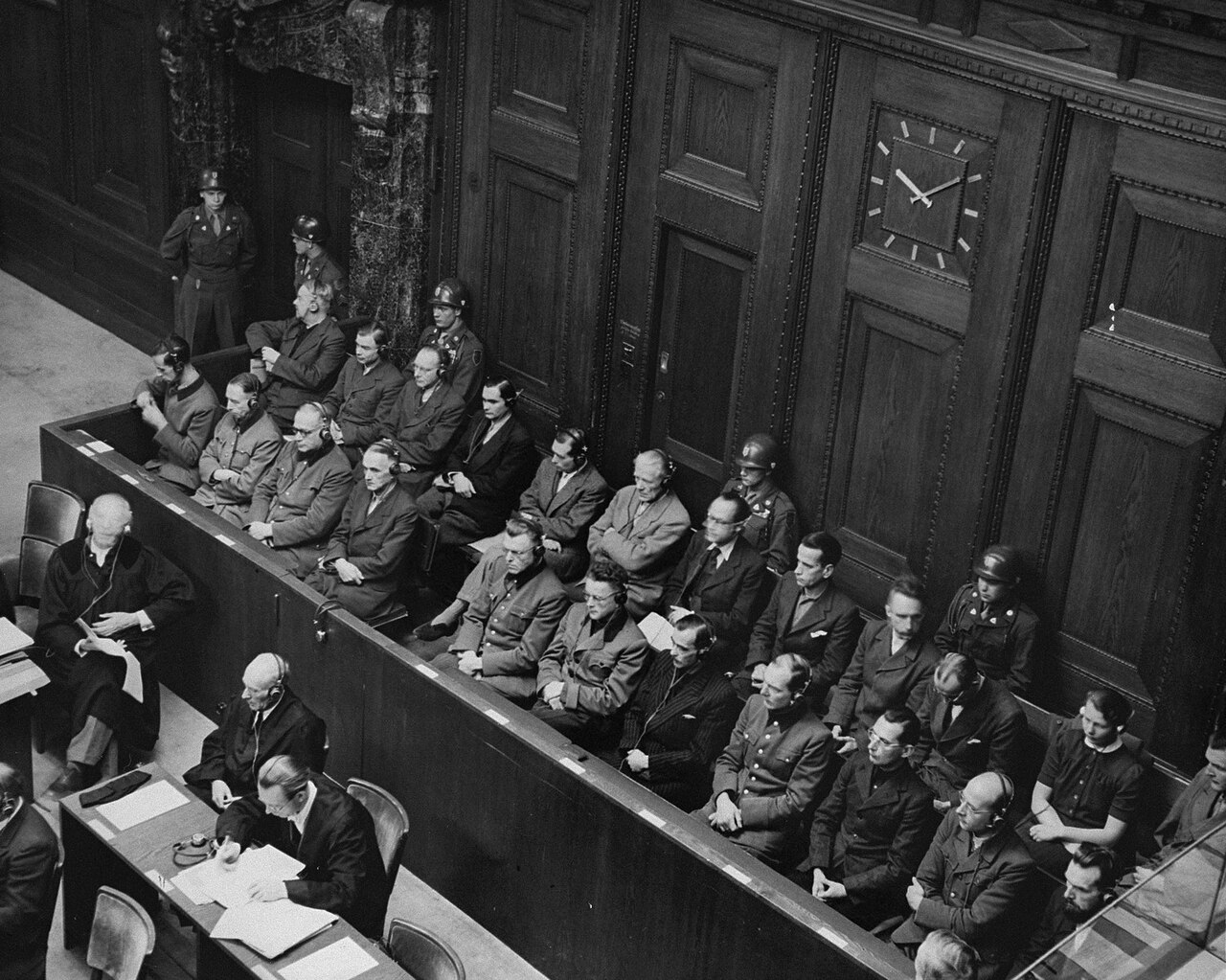
Image context: the cover image is a real archival courtroom photograph from the Doctors' Trial. It fits this essay because the Nuremberg Code was produced in that room's legal and evidentiary atmosphere. The text sounds absolute partly because the judges were not writing from the middle of routine protocol review. They were writing after a murder trial built from evidence of torture and fatal coercion.[6]
Timeline anchors before interpretation
- December 9, 1946: an American military tribunal opened proceedings against 23 German physicians and administrators in what became known as the Doctors' Trial.[2][5]
- April 17, 1947: according to the United States Holocaust Memorial Museum, Dr. Leo Alexander submitted a memorandum to U.S. war-crimes counsel outlining six points for legitimate medical research.[2]
- August 19, 1947: the tribunal delivered its verdict and inserted a section titled "Permissible Medical Experiments," expanding that framework into ten principles now known as the Nuremberg Code.[1][2]
- 1964: the World Medical Association adopted the Declaration of Helsinki, a later physician-centered ethics framework that occupied much of the practical space the Nuremberg Code had opened.[3][5]
- 1974 and after: U.S. federal human-subject protections moved into statutory and regulatory form through the National Research Act and later 45 CFR 46, while HHS still identifies the 1947 code as an historical starting point.[3]
1. The code begins as a verdict section, not an ethics manifesto
The most revealing phrase in the Harvard transcript is the section heading itself: "Permissible Medical Experiments."[1] The judges did not announce a theory of autonomy in the abstract. They first said that the evidence showed some forms of human experimentation can fit within medical ethics if they stay within "reasonably well-defined bounds," then they drew those bounds point by point.[1] That sequence matters. The tribunal was deciding what kinds of experiments could ever count as permissible after hearing evidence about experiments that plainly could not.
The historical setting is visible in the source record. The same judgment pages that contain the code also summarize counts involving high-altitude, freezing, malaria, poison, and sterilization experiments on concentration-camp prisoners.[1] The source states this directly; the inference is that the code's severity is inseparable from the crimes surrounding it. A document written inside that evidentiary frame will naturally sound less like a flexible guideline and more like a wall.
That is also why the code's tone differs from later research-ethics language. It does not begin with professional aspiration, social trust, or institutional process. It begins with limits that had to be stated clearly enough to distinguish experimentation from torture in a criminal forum.[1][2]
2. Consent here is capacity, freedom, knowledge, and personal duty
The underread part of the first principle is not the phrase "voluntary consent" by itself. It is the long definition that follows.[1][2][4] The subject must have legal capacity, freedom from force, fraud, deceit, duress, overreaching, and coercion, plus enough knowledge and comprehension to make an "understanding and enlightened decision."[1][2] The document then specifies what that knowledge includes: nature, duration, purpose, method, expected inconveniences and hazards, and possible effects on health or person.[1][2]
That structure keeps the code from collapsing into signature ethics. Consent is not reduced to a form, and it is not treated as something an institution can vaguely assume. The judgment goes further: the duty to ascertain the quality of the consent rests on "each individual" who initiates, directs, or engages in the experiment, and that duty cannot be delegated with impunity.[1] In modern language, the code places the burden on the investigator, not on a ritual of paperwork.
This is one place where the trial setting still matters. The judges were answering a defense argument that there had been no workable line between legal and illegal experimentation.[2] Their response was to define voluntariness in operational detail. A person under compulsion, captivity, deception, or informational darkness does not satisfy the standard. That reading is explicit in the source; the further inference is that the first principle was drafted to eliminate excuses, not to preserve discretionary ambiguity.[1][2]
3. The rest of the code is a legitimacy test, not a list of nice-to-haves
Once the first principle is read closely, the other nine points stop looking secondary. The code says an experiment must yield fruitful results for the good of society, be unprocurable by other methods, and avoid being random or unnecessary.[1] It must be designed on the basis of prior animal experimentation and knowledge of the disease or problem under study.[1] Risk cannot exceed the humanitarian importance of the problem; preparations and facilities must protect against even remote possibilities of injury, disability, or death; qualified persons must conduct the work; subjects must be free to stop; investigators must terminate when probable cause of harm appears.[1]
Taken together, that is a full test of legitimacy. The experiment has to be scientifically serious, methodologically justified, proportionate in risk, competently run, and continuously revocable by both subject and investigator.[1] The tribunal's later application confirms how the judges understood their own list. They wrote that the ten principles were honored more often in the breach than the observance, that subjects in the proven experiments did not consent, were not free to withdraw, were frequently handled by unqualified persons, and endured random suffering, inadequate precautions, permanent injury, mutilation, or death.[1]
This is why the code should not be remembered as a single-consent document. Consent is first because the crime record demanded it, but the code's deeper point is that human experimentation becomes permissible only when freedom, scientific necessity, competence, and stopping rules hold together at the same time.[1][2]
4. Why the code mattered, and why medicine still partially sidelined it
There are two overlapping histories after 1947. One is canonization. USHMM calls the code a landmark document, and HHS says the history of contemporary human-subject protections begins there.[2][3] The other is partial displacement. USHMM also notes that the code's legal force was never well established.[2] A later historical essay on informed consent explains the practical result: many postwar physician-investigators treated the code as a criminal court's response to Nazi barbarity rather than a description of their own daily work, so it was often regarded as too absolute or too inconvenient for ordinary research settings.[5]
That tension helps explain why later frameworks mattered so much. The Declaration of Helsinki in 1964 and later federal regulations did not erase the Nuremberg Code, but they translated research ethics into a more ordinary professional and regulatory language.[3][5] The code remained the hard reference point in the background, while later systems took on more of the day-to-day work.
So the most defensible reading is neither that Nuremberg solved research ethics in 1947 nor that it was merely symbolic. The source record supports a narrower claim. It established a boundary language with unusual moral sharpness, and later regimes had to decide how much of that sharpness they could absorb into normal medicine, institutional review, and state regulation.[2][3][5]
The strongest two interpretations
Interpretation A: the Nuremberg Code is mainly the origin story of informed consent
This interpretation has a true core. The first principle is categorical, detailed, and historically foundational, and later ethics systems kept returning to it.[1][3][5]
Interpretation B: the code is better read as a boundary document separating legitimate experimentation from coercive injury
This interpretation fits the primary source more fully. The code appears inside a criminal judgment, follows months of evidence about torture and non-consensual experimentation, and couples consent with necessity, competence, proportional risk, withdrawal, and investigator termination duties.[1][2]
Current assessment: Interpretation B is stronger. The code's special force comes from the fact that it was written to draw a line that had failed catastrophically in practice.
What would change the assessment: evidence that the tribunal intended the code to function only as a narrow criminal appendix for Nazi atrocities, with no broader statement about human experimentation, would strengthen Interpretation A. The sources used here point in the opposite direction.[1][2][3][5]
What the close reading changes
Remembering the Nuremberg Code only as the birthplace of consent makes the document easier to admire and easier to domesticate. Reading it in context does something harder. It restores the connection between ordinary research language and the conditions that made the judges write so harshly in the first place: captivity, coercion, fake science, unqualified operators, irreversible injury, and death.[1][2]
That does not mean every modern research controversy is equivalent to the Doctors' Trial. The sources do not support that flattening, and the later regulatory history shows how much ethics had to be rebuilt in more ordinary institutional terms.[3][5] What the close reading does support is a stricter memory of the document itself. The Nuremberg Code is not simply an early consent form in prose. It is a threshold text about when medicine loses the right to call an experiment legitimate at all.[1][2]
Sources
- Harvard Law School Library, Transcript for NMT 1: Medical Case (August 19, 1947 sequence covering "Permissible Medical Experiments") — primary judgment text of the Doctors' Trial containing the ten principles and the tribunal's application of them.
- United States Holocaust Memorial Museum, "The Nuremberg Code" — historical overview of the trial, Leo Alexander's April 17, 1947 memorandum, the August 19 verdict, and the code's later status.
- HHS Office for Human Research Protections, "45 CFR 46 FAQs" — current U.S. regulatory history page stating that contemporary human-subject protections begin in 1947 with the Nuremberg Code and tracing the later path to federal regulations.
- Office of Research Integrity, "Nuremberg Code" — archival presentation of the code's text, including the opening consent clause and the ten directives for human experimentation.
- George J. Annas, "Where Did Informed Consent for Research Come From?" (The Journal of Law, Medicine & Ethics, 2018; PMC) — historical analysis of why the code was both foundational and often sidelined in postwar medical practice.
- Wikimedia Commons, "File:Dock at the Doctors' trial, from above.jpg" — source page for the archival courtroom photograph used as the article image, uploaded from the United States Holocaust Memorial Museum collection.