The easiest sentence to write about Vipeholm is also the most dangerous: the experiment proved that frequent, sticky sugar causes tooth decay.
The finding was influential, and parts of it have endured. But that neat sentence turns an institution full of people with intellectual disabilities into laboratory scenery. It makes the result active and the residents passive, as though evidence simply appeared in their teeth.
Two interpretations now organize Vipeholm's history. The first treats it as an unusually controlled human study that separated the amount, form, timing, and oral retention of sugar. The second argues that this control was achieved by exploiting people whose institutional lives made refusal, departure, and ordinary care structurally unavailable. These are not rival stories in which scientific rigor cancels ethical criticism or ethical criticism makes every recorded cavity imaginary. The harder conclusion is that Vipeholm produced consequential evidence through an abusive research arrangement. Its result can be assessed; the experiment cannot be redeemed.[1][2][4]
From prevention study to deliberate damage
The chronology shows that provocation was a choice, not the study's starting condition.
- 1938: Sweden began organizing a national Public Dental Service while facing an enormous burden of untreated caries. The program's cost helped turn prevention into a state research problem.[1][3]
- 1945: the National Swedish Board of Health began work at Vipeholm Hospital in Lund. Early studies tested vitamins, minerals, fluoride tablets, and other possible protective additions.[1][3]
- 1947: after the preventive phase produced no clear difference between groups, researchers began a carbohydrate study using sweetened drinks, high-sugar bread, chocolate, caramels, and specially manufactured toffees. The purpose had changed from looking for protection to inducing caries under controlled conditions.[1][2]
- 1949: the design shifted from extreme sugar regimens toward quantities intended to resemble ordinary Swedish consumption more closely. Historian Elin Bommenel's archival research places that redesign—and delayed publication—inside a difficult relationship among researchers, the Board of Health, and confectionery-industry funders.[4]
- 1953–1954: the findings entered Swedish public and parliamentary debate, followed by the expanded English-language account of 436 residents observed across five years.[1][2][4]
- 1955: the experiments ended after funding trouble and pressure from advocates for children with learning disabilities. A nationwide dental-health campaign followed in 1957.[1][4]
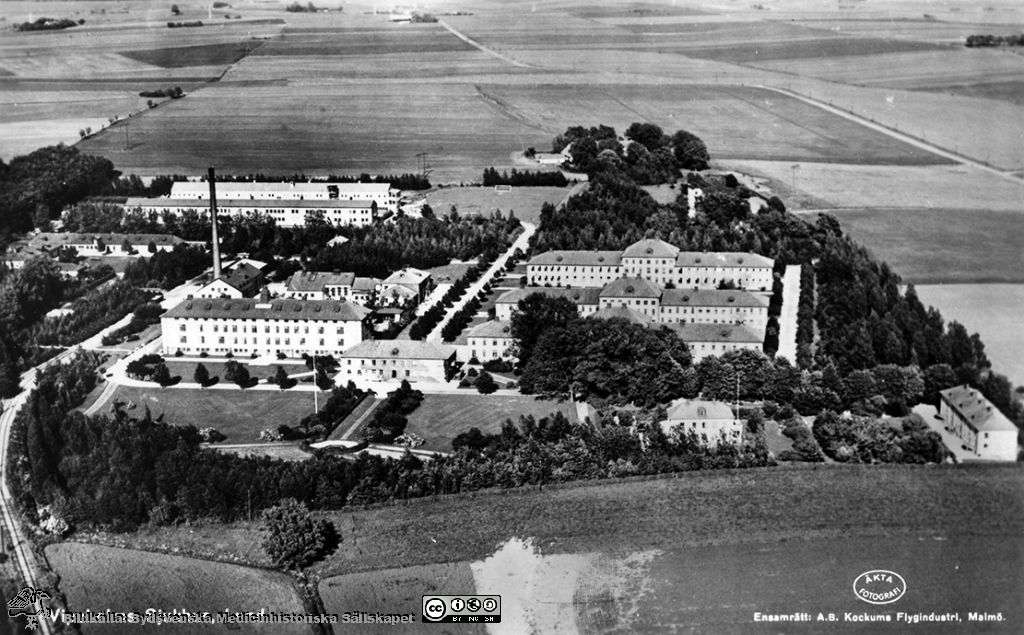
The aerial photograph fixes this sequence in a place. Vipeholm was arranged as closed departments in separate pavilions, with residents moving outside under supervision. The main paper described 12 departments in six buildings and a staff of 300. The researchers regarded that organization as an experimental advantage: meals could be assigned by ward, sweets distributed on schedule, and departures from the diet observed.[2][7]
That is the central historiographical problem in one image. The hospital was not merely where the study happened. The institution was part of the apparatus.
What the numbers actually showed
The broad research program involved more people, but the celebrated five-year analysis used a “main material” of 436 residents who remained in the same ward—and therefore the same dietary group—from 1946 to 1951. They were the continuously observed remainder of 633 residents examined in 1946. Remaining available for the full period was not a neutral sampling feature; it was one consequence of long-term institutionalization.[2]
The experimental contrasts were striking. One group received added sucrose in drinks and food at meals. Others received high-sugar bread at meals. The between-meal groups received chocolate, caramels, or specially made sticky toffees. In the most extreme regimen, the nominal daily ration was 24 toffees, about 180 grams of confectionery containing roughly 120 grams of sugars, plus 150 grams of sucrose in solution.[2]
The paper's Table 11 tracked new decay on a standardized set of 100 tooth surfaces. In the male 24-toffee group, the mean rose from 0.33 new carious surfaces per person during the earlier vitamin period to 3.90 and 4.15 in the two high-toffee periods. In the female group, the corresponding sequence was 0.23, 6.13, and 6.46. After the toffee regimen was withdrawn and replaced with margarine, the means fell to 0.21 and 0.40 for men and 0.28 and 0.38 for women over the next two periods.[2]
The rise after exposure and fall after withdrawal made the between-meal finding much stronger than a one-time comparison. The paper also reported comparatively low activity in the group given large quantities of dissolved sucrose at meals. Its authors therefore emphasized not only sugar quantity but retention on tooth surfaces and exposure between meals.[2]
Yet “controlled” should not be mistaken for “flawless.” Residents were assigned by department rather than through a modern randomized trial. Starting susceptibility differed among groups. Actual sweet consumption varied: some residents ate several pieces at once, some swallowed them, and some ate none. The investigators also acknowledged uncertainty in detecting early lesions and conceded that differences between chocolate and toffee groups might partly reflect different underlying susceptibility. Vipeholm offered unusually tight dietary administration, not timeless methodological perfection.[2]
Reading one: a rare causal experiment
The strongest case for Vipeholm's scientific importance begins with sequence.
Earlier population observations had linked wartime sugar rationing with lower caries, but many other conditions changed during war. Animal experiments and laboratory measurements could suggest mechanisms without proving the same effect in people. Vipeholm followed individuals over time, altered the way sugar was delivered, and then removed the exposure. That design made three claims unusually visible: sugar could accelerate caries; frequent exposure between meals mattered; and a sticky vehicle could prolong the local opportunity for damage.[2][3]
This reading is strengthened by the investigators' refusal to give their commercial funders the comforting result they wanted. Bommenel found that confectionery interests financed much of the work and expected guidance on safe consumption or less damaging sweets. Instead, the published findings identified chewy confectionery as especially cariogenic. Industry pressure shaped the research relationship and delayed publication, but it did not simply purchase a favorable conclusion.[4]
On this account, Vipeholm is a landmark because it turned a broad correlation into a controlled temporal pattern. The post-exposure decline is particularly difficult to explain away. The experiment did not discover that caries has only one cause, and the paper itself noted continuing lesions under severe carbohydrate restriction. It did show that changing a repeated dietary exposure could change the rate at which new lesions appeared.[2]
Reading two: captivity was hidden inside “control”
The opposing interpretation does not need to deny the measurements. It asks what had to be true of the participants for those measurements to become possible.
The planning paper praised Vipeholm because residents were expected to remain for a long time, lived in separated departments, and could be watched by staff. Its admission criterion said a resident should not object to dental examination. That is not informed consent to a regimen designed to produce disease. Agreement to open one's mouth for an examination does not authorize researchers to change the diet in order to damage the teeth being examined.[2][3]
Sweden's Ethical Review Authority now describes the study as exploitation: residents did not understand the harm, researchers deliberately exposed them to it, and relevant care was withheld. The ethical failure was not an omitted signature on an otherwise acceptable protocol. It joined vulnerability, confinement, induced injury, and institutional authority into one system.[1]
Nor can the experiment be excused simply as a product of an era incapable of objection. Bommenel documents criticism in Parliament when the results became public, including accusations that the government had supported humiliating experiments on people with learning disabilities. Later archival work changed the emphasis because the original scientific account made politics, industry, care, and social hierarchy appear external to the production of the data. They were not external. They determined who could be studied, for how long, under what surveillance, and at whose cost.[4]
This reading also changes the meaning of the word benefit. Swedish dental policy gained a prevention message, and the wider public received it through campaigns. The residents bore the induced disease. To call the project beneficial without naming that distribution repeats its original moral arithmetic: a marginalized group pays so that a national system can learn.
Where the debate should land
Three questions are often collapsed into one.
Were the observations fabricated or scientifically empty? No. The original report contains longitudinal contrasts, explicit measurement rules, withdrawals, caveats, and large effects that deserve scrutiny as evidence.[2]
Does a useful result justify the way it was obtained? No. Social value is one condition of ethical research, not a permission slip to recruit people because confinement makes them convenient. Vipeholm is remembered in Sweden's official ethics guidance precisely because scientific ambition and administrative approval failed to protect participants.[1]
Must present-day dental guidance rest on Vipeholm alone? Also no. A systematic review prepared for World Health Organization guidance found broadly consistent human evidence linking the amount of free sugars consumed with caries, while explicitly declining to isolate frequency because amount and frequency are tightly related in ordinary diets. WHO's resulting guidance addresses total free-sugar intake rather than treating meal timing or stickiness as the whole preventive story.[5][6]
That later evidence matters historiographically. It does not wash Vipeholm clean. It allows us to stop using harmed residents as the indispensable warrant for advice that can be supported by a broader evidence base. It also corrects an overextension of the classic lesson: Vipeholm made exposure pattern vivid, but modern public health cannot infer from its at-meal groups that total sugar amount is unimportant.
The most responsible way to retain Vipeholm's finding is therefore to change its legend. Do not tell a triumphal story in which researchers conquered uncertainty with a clever toffee. Tell how a welfare state made prevention a priority, how a controlled result emerged from an institution built around unequal power, how commercial and public interests crowded the boundary of the laboratory, and how the people who supplied the evidence were denied the standing of research participants.
The result survived. What should not survive is the idea that survival makes the experiment honorable.
Sources
- Swedish Ethical Review Authority, Guide to the Ethical Review of Research on Humans, “The Vipeholm Study,” 2024 — official account of the study's chronology, induced harm, exploitation, and research-ethics legacy.
- Bengt E. Gustafsson et al., “The Effect of Different Levels of Carbohydrate Intake on Caries Activity in 436 Individuals Observed for Five Years,” Acta Odontologica Scandinavica 11, 1954 — primary report of the design, group regimens, outcome tables, withdrawal effects, and methodological caveats.
- J. Axel Höjer and Arvid Bernhard Maunsbach, “Purposes and Organisation,” Acta Odontologica Scandinavica 11, 1954 — primary planning account covering the public-dental context, institutional rationale, study phases, and supervision model.
- Elin Bommenel, Sockerförsöket: Kariesexperimenten 1943–1960 på Vipeholms sjukhus för sinnesslöa, Lund University research portal, 2006 — doctoral archival history of the experiment's relationship to institutional care, government, industry, publication, criticism, and policy.
- Paula J. Moynihan and Sarah A. M. Kelly, “Effect on Caries of Restricting Sugars Intake: Systematic Review to Inform WHO Guidelines,” Journal of Dental Research 93(1), 2014 — modern human-evidence review on the amount of sugars consumed and the limits of separating amount from frequency.
- World Health Organization, Guideline: Sugars Intake for Adults and Children, 2015 — evidence-based population guidance on free-sugar intake and dental-caries prevention.
- South Swedish Society for the History of Medicine open image archive, “Aerial photograph of Vipeholm Hospital from before the mid-1950s” — source record for the article's archival photograph.