The decisive result looked like a failure: blood from 111 suspected polio patients, one recovery of poliovirus.
During a 1943 outbreak in New Haven, Dorothy Horstmann and the Yale Poliomyelitis Study Unit collected specimens from people arriving at the hospital. The sole positive blood sample came from a nine-year-old girl whose blood had been drawn within six hours of the onset of a mild illness. She never developed paralysis. Most of the other patients were sampled later, after the dramatic neurological phase had begun.[1][2]
That difference in timing gave Horstmann a better question. Perhaps poliovirus was not rarely present in blood. Perhaps investigators usually looked for it after the bloodstream phase had already ended.
This is the microhistory inside Horstmann's larger career: a sequence of studies from 1943 to 1954 in which one anomalous sample changed the meaning of 110 negative ones. By sampling before paralysis, then rebuilding the result in orally infected primates and early human infections, Horstmann helped replace an overly nerve-centered model of polio with a timed pathway: entry through the mouth, replication around the gut, a transient passage through blood, and—in a small minority of infections—invasion of the central nervous system.[3][4][5] The work did not create a vaccine by itself. It made the vaccine's job anatomically and immunologically clearer.
The disease was being observed from its loudest moment
Horstmann arrived at Yale in 1942 as a Commonwealth Fellow in internal medicine and joined a group that already treated epidemics as field problems. Founded in 1931, the Yale Poliomyelitis Study Unit went into homes and neighborhoods, took histories, examined patients, and collected throat washings, stool, blood, and environmental specimens. Its researchers were trying to understand an infection across a community rather than only the damage visible in a hospital ward.[1][7]
That approach mattered because paralysis distorted the scientific view. It was polio's most terrifying outcome and therefore the point at which patients, clinicians, and researchers converged. Yet paralysis is late in the infection. A current clinical review estimates that 75 to 90 percent of poliovirus infections are asymptomatic and that paralysis occurs in no more than about 1 in 200 infections.[5] A model built mainly from the rare neurological endpoint risks mistaking the last act for the whole disease.
Laboratory practice reinforced the distortion. Earlier investigators had repeatedly passed poliovirus through monkey nervous tissue and introduced it directly into the brain. That model was useful for producing paralysis, but repeated neural passage selected a virus-host system that made nervous tissue appear to be both the beginning and the destination. When those adapted strains failed to produce disease after oral administration, a direct route along nerves—especially from the nasal region—looked more plausible than a systemic phase.[1]
The Yale field studies began from a different geometry. During outbreaks in New Haven, Chicago, Bakersfield, Hickory, and New York in 1943 and 1944, the unit sampled multiple anatomical sites and followed where virus could be recovered over time. Stool often remained positive for weeks; throat recovery was briefer and less consistent. Those findings pulled attention toward the gastrointestinal tract. They also sharpened the missing-link problem: if infection began around the gut, how did the virus reach motor neurons?[1]
One positive sample changed the denominator
The team's 1946 paper on blood initially treated its result cautiously. Blood samples from 111 patients were tested in 75 pools by inoculation into susceptible monkeys. Only one pool produced infection, and the researchers traced it to the nine-year-old patient sampled at the beginning of a mild illness. With one success against so many failures, they inferred that viremia—the presence of virus in blood—was uncommon and probably not central to polio's pathogenesis.[2]
That conclusion was reasonable on the observed count. It was also vulnerable to a timing error.
Horstmann noticed that the positive case was not simply one more patient. It occupied a different point on the disease clock. The girl had been sampled early, before paralysis and before the immune response expected later in infection. The negative samples were therefore not 110 exact replications of the positive test. Many asked a later biological question.
This reframing is the core of Horstmann's contribution. A negative specimen can mean that an organism was never present, that a test could not detect it, or that the specimen missed a short window. Those explanations are not interchangeable. Once timing became the variable, the almost-empty result stopped saying “blood is irrelevant” and began saying “look earlier.”
The practical difficulty was obvious: researchers could not know exactly when an exposed person would develop polio, and it would have been both inefficient and ethically unacceptable to infect people deliberately to find out. Horstmann instead used a natural route in susceptible primates. She fed poliovirus to cynomolgus monkeys and chimpanzees, then sampled their blood during the incubation period rather than waiting for paralysis. In her 1952 report, virus appeared in 7 of 10 monkeys and 3 of 4 chimpanzees. The result was no longer a lone human anomaly. Viremia appeared repeatedly when the experiment was aligned with the early infection window.[3]
The virus disappeared as the antibody appeared
Animal evidence made the timing hypothesis credible; early human infections made it clinically relevant.
Horstmann and Robert McCollum next examined a family during a 1952 Ohio outbreak. Three children developed minor febrile illnesses while a fourth remained well. Virus could be recovered during the mild or asymptomatic phase, supporting the idea that circulation in blood preceded rather than accompanied the dramatic neurological illness.[1][4]
Their larger 1954 human study found type 1 poliovirus in the blood of 6 of 33 infected people. Among the 27 without detectable viremia, 18 already had type 1 antibodies. The positive circumstances included minor illness, asymptomatic infection, and one sample collected several days before a mild nonparalytic attack.[4] The important pattern was not simply “six positive.” Virus and antibody occupied different portions of the clock. By the time a patient reached the hospital with recognizable paralysis, neutralizing antibodies could already have removed free virus from the blood.
That observation repaired the apparent contradiction in the 1946 study. The late negative samples were real, but they did not describe the early infection. Horstmann had not made blood into the best routine diagnostic specimen; modern clinical guidance still prefers stool for laboratory confirmation.[5] She had shown why blood could be biologically decisive while usually being diagnostically unrewarding.
The modern pathogenesis summary retains the transient bloodstream phase but adds an important boundary. Poliovirus replicates in the oropharynx and gastrointestinal tract; in the absence of antibodies, a usually asymptomatic viremia can follow. In the small minority of viremic infections that reach the central nervous system, the virus may cross the blood-brain barrier or travel by retrograde transport along peripheral nerves.[5] Horstmann overturned the idea that polio was confined to nervous tissue; she did not prove that every neuroinvasion used blood alone. Most infections never become neurological disease, and viremia is not a promise of paralysis. It is a route with immune checkpoints.
A vaccine target, not a lone-victor story
Once blood was understood as an early corridor, circulating antibody became more than a laboratory measurement. It could be a barrier positioned before central nervous system invasion.
That logic helps explain why the inactivated poliovirus vaccine introduced in 1955 could prevent paralytic disease. The injected vaccine produces protective systemic immunity but a less robust mucosal response in the gut. Oral poliovirus vaccine, introduced in the United States in 1961, adds intestinal immunity that can reduce transmission.[5] Horstmann's work clarified why immunity in blood mattered and why immunity around the gut could add another layer.
It would be wrong, however, to compress polio vaccination into “Horstmann found viremia, therefore the vaccines followed.” Enders, Weller, and Robbins made poliovirus cultivation in non-neural tissue practical. Jonas Salk developed and tested an inactivated vaccine. Albert Sabin and other researchers developed live attenuated candidates. Manufacturers, trial organizers, regulators, public-health workers, parents, and millions of children turned those technologies into population immunity.[1][5] Horstmann supplied a crucial mechanistic bridge: the virus was not confined to nerves, and antibodies did not need to enter a motor neuron to protect it.
Her later career also showed that she understood evidence as something that had to survive outside the laboratory. In 1959, after Soviet scientists reported mass trials of Sabin's oral vaccine, the World Health Organization sent Horstmann to review the design, execution, safety evidence, and reliability of the results. By her account, millions of children had already received vaccine amid international skepticism. Her favorable report contributed to wider acceptance of the oral program.[6]
This was not the same intellectual task as finding virus in a blood sample. It required judgment across field records, surveillance, manufacturing, and political distrust. But the habit was continuous: examine when and how evidence was produced before deciding what a result meant.
Institutional recognition arrived slowly. Horstmann became the first woman to hold the rank of full professor at Yale School of Medicine in 1961 and, in 1969, the first woman at Yale appointed to an endowed professorship.[7] Those milestones belong in the biography, but they are not substitutes for the science. Her most durable lesson sits in the work itself.
The signal was a window
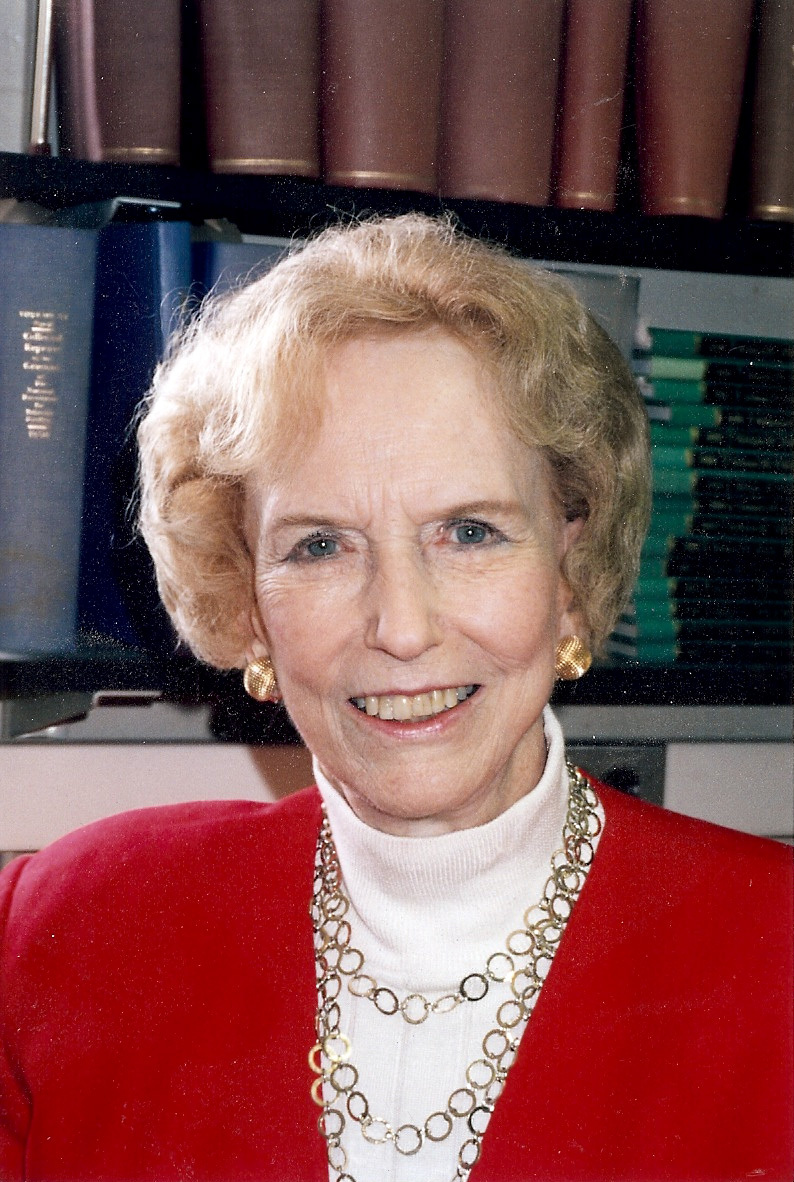
The portrait shows Horstmann surrounded by bound journals, the accumulated record of completed studies. Her breakthrough began at the opposite end of that record: with an outlier that made a completed study feel unfinished.
If she had treated one positive result among 111 as contamination or trivia, the blood phase might have remained obscured longer. If she had treated it as final proof, the inference would have outrun the evidence. Instead, she used the patient's early presentation to generate a timing hypothesis, tested the sequence through oral infection in primates, returned to early human cases, and connected the pattern to antibody.[1][2][3][4]
That is why Horstmann's polio work remains more than a preface to famous vaccines. It demonstrates a demanding form of clinical epidemiology: follow the disease before its loudest symptom, ask whether negative results are synchronized, and let the sampling window become part of the causal model. The virus had not been absent from blood. Investigators had mostly arrived after it had moved on.
Sources
- Heather A. Carleton, “Putting Together the Pieces of Polio: How Dorothy Horstmann Helped Solve the Puzzle,” Yale Journal of Biology and Medicine 84(2), 2011 — peer-reviewed biography covering the 1943 specimen, outbreak fieldwork, pathogenesis studies, vaccine work, and the article's archival portrait.
- Robert Ward, Dorothy M. Horstmann, and Joseph L. Melnick, “The Isolation of Poliomyelitis Virus from Human Extra-neural Sources. IV. Search for Virus in the Blood of Patients,” Journal of Clinical Investigation 25(2), 1946 — original report of the one positive recovery among blood samples from 111 patients.
- Dorothy M. Horstmann, “Poliomyelitis Virus in Blood of Orally Infected Monkeys and Chimpanzees,” Proceedings of the Society for Experimental Biology and Medicine 79(3), 1952 — primary experimental report on early viremia after oral infection.
- Dorothy M. Horstmann, Robert W. McCollum, and Anne D. Mascola, “Viremia in Human Poliomyelitis,” Journal of Experimental Medicine 99(4), 1954 — primary human study relating early virus recovery to minor illness, asymptomatic infection, and antibody timing.
- Jonathan G. Wolbert, Michael Rajnik, Helena M. Swinkels, and Karla Higginbotham, “Poliomyelitis,” StatPearls, updated October 6, 2024, via NCBI Bookshelf — current clinical synthesis of pathogenesis, asymptomatic infection, specimen choice, and IPV/OPV immune effects.
- Dorothy M. Horstmann, “The Sabin Live Poliovirus Vaccination Trials in the USSR, 1959,” Yale Journal of Biology and Medicine 64(5), 1991 — Horstmann's retrospective account of the WHO review and the evidence behind international acceptance of the oral vaccine trials.
- Yale University Library Online Exhibitions, “Faculty (1940s–1960s): Dorothy Horstmann” — institutional chronology of Horstmann's Yale appointments, polio work, 1959 WHO mission, and professorial milestones.